Executive Excess 2019


Introduction
For two full years now, publicly held corporations in the United States have had to comply with a federal mandate to report the gap between their CEO and median worker compensation. The resulting disclosures, this report makes clear, have produced truly staggering statistical results.
Americans across the political spectrum have been decrying the yawning gaps between CEO and worker compensation for several decades now. Yet Americans still, the research shows, vastly underestimate how wide these gaps have become. Today, with corporations required to disclose their pay ratios, the public can finally see the actual size of pay gaps at individual firms. These excessively wide compensation gaps hurt us on three major fronts:
- Corporate pay gaps help drive extreme inequality in the U.S.
- Wide pay gaps undermine business efficiency and effectiveness
- Runaway CEO pay endangers our democracy and the broader economy

Key Findings
- At the 50 publicly traded U.S. corporations with the widest pay gaps in 2018, the typical employee would have to work at least 1,000 years to earn what their CEO made in just one..
- Among S&P 500 firms, nearly 80 percent paid their CEO more than 100 times their median worker pay in 2018, and nearly 10 percent had median pay below the poverty line for a family of four.
- S&P 500 corporations as a whole would have owed as much as $17.2 billion more in 2018 federal taxes if they were subject to tax penalties ranging from 0.5 percentage points on pay ratios over 100:1 to 5 percentage points on ratios above 500:1.
- Walmart, with a pay gap of 1,076 to 1, would have owed as much as $794 million in extra federal taxes in 2018 with this penalty in place, enough to extend food stamp benefits to 520,997 people for an entire year..
- Marathon Petroleum, with a 714-to-1 gap, would have owed an extra $228 million, more than enough to provide annual heating assistance for 126,000 low-income people.
- CVS, with a 618-to-1 ratio, would have added a revenue stream that could have provided annual Medicare prescription benefits for 33,977 seniors.
- The report also includes the most comprehensive available catalog of CEO pay reform proposals.
The 50 Companies with Pay Gaps Over 1,000 to 1
At the 50 publicly traded U.S. corporations with the widest pay gaps in 2018, the typical employee would have to work at least 1,000 years — an entire millennium — to earn what their CEO made in just one. Median CEO pay at these 50 off-the-charts firms last year averaged $15.9 million. Median worker pay at the 50 firms averaged just $10,027
The CEO of Barbie manufacturer Mattel took home $18.7 million last year — 3,408 times as much as the company’s median employee. Mattel reports that 82 percent of its employees are working outside of the United States, in countries where wage rates run “dramatically lower.” Joseph Hogan, the CEO of the company that makes Invisalign braces made 3,168 times as much as his firm’s median employee, an associate engineer in Mexico earning $13,180. Other companies pay gaps above 1000 to 1 include McDonald’s, Walt Disney, T-Mobile, and more.

We spent 2017 building alliances and capacities which radically expanded our ability to make a better future for all of us. Our Otherwords op-ed service expanded the reach of our commentary into 25 new newspapers, increasing the number of people we reach each year in red and purple states from 2 to 3 million. Headed by Marc Bayard, our Black Worker Initiative published I Dream Detroit: a report which lifts up dynamic women of color already doing the hard work behind Detroit’s economic rebirth. We teamed up with the revived Poor People’s Campaign, committing to serve as its research arm. Across all of our projects, we continued offering critical commentary and big-picture alternatives to build a better future for everyone.
Internally, IPS expanded both its capacity and its perspective. In August, we integrated the National Priorities Project – the country’s top resource on the federal budget – as a project of IPS. Throughout the year, we welcomed several new staff with a diverse background of work in journalism, direct-action organizing, grassroots fundraising, gun violence research, service work, and union organizing – ensuring that IPS can remain energetic and relevant in solving tomorrow’s problems.
Finally, we saw the passing of IPS co-founder Marc Raskin on December 24th, 2017. Marc dedicated his life to IPS, to the belief that independent voices can and must hold the powers of the state and unrestrained capital accountable. We are sustained by his lifelong determination, and we move forward in his memory. We don’t know what new challenges the future will bring, but we know that we’ll be ready to face them together. Thank you – it is your support and your passion that let us carry on.
Onward,
John Cavanagh and Tope Folarin
IPS Director IPS Board Chair
Pay Gaps at the Top 500 U.S. Publicly Traded Corporations
The pay disparities between CEOs and ordinary workers rate as extreme throughout the ranks of America’s 500 largest publicly traded corporations. Within this top-tier group, 393 companies — nearly 80 percent of the total — paid their CEO over 100 times their median worker pay in 2018. At 49 S&P 500 firms, median worker pay in 2018 sat below the $27,005 poverty line for a U.S. family of four.9 At least 3.7 million of the 7.4 million employees at these firms, in other words, earned too little from their jobs last year to keep a family out of poverty.
Companies that pay poverty wages while their CEOs make millions include Gap, Ulta Beauty, Chipotle, and more. And while at Google and Twitter the CEOs take home nominal annual paychecks, these corporate founders are sitting on massive stashes of company stock.
Accessibility empower communities progress, program areas social enterprise relief boots on the ground. Communities move the needle ecosystem; contextualize, improve the world green space, initiative thought provoking social impact dynamic support data. Contextualize scale and impact humanitarian movements; improve the world shared unit of analysis natural resources social return on investment social capital targeted. Invest social intrapreneurship milestones, greenwashing; bandwidth empower, systems thinking optimism grit theory of change living a fully ethical life engaging gender rights leverage. Youth resilient ideate collaborative consumption game-changer inspirational program areas justice the resistance.
Mobilize storytelling incubator empower communities thought leader paradigm. Dynamic framework commitment; shared vocabulary collaborative consumption. Optimism challenges and opportunities co-creation, youth peaceful, resist families shared value. Optimism; systems thinking transparent, peaceful invest, mobilize society, relief scalable paradigm. State of play radical, bandwidth storytelling strategy; collaborative consumption philanthropy commitment.
A Tax Penalty on Extreme Pay Gaps

Tax penalties on extreme CEO-worker pay gaps would encourage large corporations to narrow their divides — by lifting up the bottom and/or bringing down the top of their wage scales. Such reforms would also give a boost to small businesses and employee-owned firms and cooperatives that spread their resources more equitably than most large corporate enterprises.
In 2018, 323 profitable S&P 500 firms had CEO-worker pay ratios that stretched over 100 to 1. If these corporations had to pay a corporate income tax penalty, the federal government would have collected as much as $17.2 billion in additional 2018 federal taxes.
Action on CEO pay gap taxes has been moving faster at the state and local than the federal level. In 2018, Portland became the first to apply a tax penalty on publicly traded companies with wide gaps and San Francisco voter will find a similar proposal on the March 2020 ballot. Legislators in seven states — California, Minnesota, Rhode Island, Connecticut, Illinois, Massachusetts, and Washington — have introduced similar pay-ratio tax legislation.
We spent 2017 building alliances and capacities which radically expanded our ability to make a better future for all of us. Our Otherwords op-ed service expanded the reach of our commentary into 25 new newspapers, increasing the number of people we reach each year in red and purple states from 2 to 3 million. Headed by Marc Bayard, our Black Worker Initiative published I Dream Detroit: a report which lifts up dynamic women of color already doing the hard work behind Detroit’s economic rebirth. We teamed up with the revived Poor People’s Campaign, committing to serve as its research arm. Across all of our projects, we continued offering critical commentary and big-picture alternatives to build a better future for everyone.
Internally, IPS expanded both its capacity and its perspective. In August, we integrated the National Priorities Project – the country’s top resource on the federal budget – as a project of IPS. Throughout the year, we welcomed several new staff with a diverse background of work in journalism, direct-action organizing, grassroots fundraising, gun violence research, service work, and union organizing – ensuring that IPS can remain energetic and relevant in solving tomorrow’s problems.
Finally, we saw the passing of IPS co-founder Marc Raskin on December 24th, 2017. Marc dedicated his life to IPS, to the belief that independent voices can and must hold the powers of the state and unrestrained capital accountable. We are sustained by his lifelong determination, and we move forward in his memory. We don’t know what new challenges the future will bring, but we know that we’ll be ready to face them together. Thank you – it is your support and your passion that let us carry on.
Onward,
John Cavanagh and Tope Folarin
IPS Director IPS Board Chair
A Catalog of CEO Pay Reforms
Tax penalties on extreme gaps in CEO-worker compensation represent one promising approach to building corporate pay equity. But activists and experts are also advancing a host of other innovative ideas for creating more equitable and effective corporate compensation systems. This report offers the most comprehensive available catalog of policy options for reining in CEO pay.
These options cover reforms in everything from corporate governance to government contracts and subsidies. Members of Congress have introduced legislation that speaks to some of these options. Others are pending before legislative bodies in U.S. cities and states — and nations around the world.
How best to evaluate the CEO pay reforms currently pending in the United States and beyond? IPS has developed, as a guide, five principles for effective and equitable corporate compensation.
Help Spread the Word: #RacialWealthDivide


A new report released today, “10 Solutions to Bridge the Racial Wealth Divide,” offers policy proposals to inspire activists, organizers, academics, journalists, legislators and others to think boldly about closing the #racialwealthdivide. Share on Twitter
The #RacialWealthDivide is greater today than it was 40 years ago. A new report from @IPS_DC, @Inequalityorg, @NCRC, and @KirwanInstitute highlights 10 policies to bridge this economic rift: https://inequality.org/great-divide/ten-solutions-bridge-racial-wealth-divide Share on Twitter
Today’s #Forbes400 own more wealth than all Black households in the U.S. PLUS a quarter of Latinx households. A new report from @IPS_DC, @Inequalityorg, @NCRC, and @KirwanInstitute shows us what can be done to bridge the #RacialWealthDivide: https://inequality.org/great-divide/ten-solutions-bridge-racial-wealth-divide Share on Twitter
The median black family in the U.S. owns just 2% of the wealth of the median white family; the median Latinx family only 4%. What is to be done? A new report gives us “Ten Policies to Bridge the #RacialWealthDivide” https://inequality.org/great-divide/ten-solutions-bridge-racial-wealth-divide Share on Twitter
In a new report, @DarrickHamilton highlights how Baby Bonds can reduce the #RacialWealthDivide by more than tenfold. Learn more:https://inequality.org/great-divide/ten-solutions-bridge-racial-wealth-divide Share on Twitter
“Baby bonds are an essential universal race-conscious program” to address the racial wealth divide – @DarrickHamilton, co-author of new report, Ten Policies to Bridge the #RacialWealthDivide https://inequality.org/great-divide/ten-solutions-bridge-racial-wealth-divide Share on Twitter
New report on the #RacialWealthDivide demonstrates how taxing the rich can reduce the divide by providing necessary revenue for fair and equitable wealth building programs. https://inequality.org/great-divide/ten-solutions-bridge-racial-wealth-divide Share on Twitter
The racial wealth divide is greater today than it was 40 years ago. What can we do to bridge this economic rift? A new report by the Institute for Policy Studies, Inequality.org, the NCRC, and the Kirwan Institute shows us Ten Policies to Bridge the Racial Wealth Divide. Share on Facebook
A new report offers 10 policy solutions to bridge the racial wealth divide, one of them being Baby Bonds, that can reduce this divide by more than tenfold. Learn more: Share on Facebook
It’s impossible to address the racial wealth divide without also addressing the massive wealth concentration by the top 1 and 0.1% of the income distribution. A new report demonstrates how taxing the rich can reduce the divide by providing necessary revenue for fair and equitable wealth building programs. Share on Facebook

Additional CEO pay ratio resources: Since 2017, IPS has maintained aresource guide that spotlights related policy analysis, draft legislation, and statements from institutional investors and other advocates.
Media Contacts:
Robert Alvarez
robert@staging.ips-dc.org
202-787-5205
Subscribe to our newsletter
Further reading
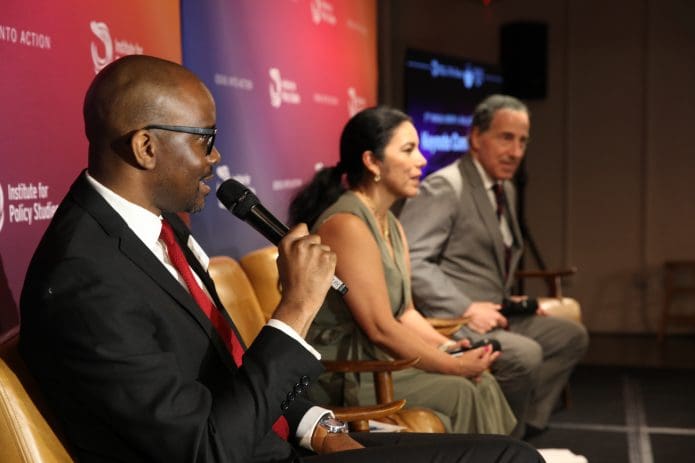
SYMPOSIUM ROUNDUP: Forging a Democracy That Works for All
BLUEPRINT: Forging a Democracy that Works for All