Gilded Giving 2026: Philanthropy Under Oligarchy


Introduction
“Oligarchy has often been thought of as ‘rule by the few,’” political scientist Jeffrey Winters told Inequality.org a few years ago, “but, in Aristotle’s original formulation, it was ‘rule by the wealthy few.’” He added: “One thing that all oligarchs do politically is what I call wealth defense.”
For many extremely wealthy Americans, philanthropy — ostensibly a form of generosity — has become part of that defense of extreme wealth.
Philanthropy is definitionally a phenomenon of wealth inequality: Someone with resources to spare chooses how and where to deploy them. But whatever good charity, voluntarism, or institutional giving can do is undercut by our tax code, which turns philanthropy into a vehicle for defending wealth and status.
The biggest donors prefer funding intermediaries, such as private foundations and donor-advised funds (DAFs), over direct support; exercise caution and deference towards the president’s politics; and often invest their endowments against their own institutions’ stated missions.
All of these status quo choices follow the oligarchic pattern painfully visible across the executive branch, the courts, big business, and the media: Concentrated private wealth decides whether and how to act in the public interest or the private interest, accountable to almost no one.
Our nation’s largest fortunes keep growing, elite impunity is now assumed rather than exceptional, and the president is weaponizing the government to persecute his perceived enemies. Everyday people pay the price in slashed social services, in rising bills, in fear on the streets, and in taxpayer expenditures — we subsidize up to 73 cents of every dollar donated to charity by an ultra-wealthy American. And philanthropy hasn’t shown itself capable of rising to the occasion.
Consider these harrowing statistics from the Center for Effective Philanthropy: 69 percent of nonprofits report experiencing funding cuts from public and/or private giving, and 65 percent of nonprofit leaders reported increased demand for their services in 2025, while in 2026, 73 percent of nonprofit leaders reported increased demand for their services. In spite of this increased demand, 46 percent of nonprofit leaders express concern their organizations will need to close or merge, and nearly a third report their organization had to reduce their offered services.
Nonprofits generally operate under a climate of economic precarity, even in normal times: surveys show that the vast majority maintain a financial cushion of just months in operating expenses. Under the Trump Administration, those regular financial pressures have greatly increased.
By contrast, the assets of wealthy donors and the philanthropic vehicles they employ (private foundations, donor-advised funds, etc.) have soared to unprecedented heights, reflecting the impact both of equity markets untethered to the economic conditions facing families and communities, and of policies and actions by the administration and Congress.
On top of these economic factors, key sectors and organizations have faced ever-mounting political, legal and regulatory attacks by Federal and state agencies and prosecutors, from Congressional committees, and from non-governmental allies on the far-right.
This report will tell the story of philanthropy under oligarchy. We’ll explain the political conditions that allow for ultra-wealthy givers to dominate and benefit from charitable giving in America instead of meaningfully mobilizing to protect democracy in a time of crisis. Along the way, we’ll illustrate the three major response patterns of our nation’s big funders: Accumulation, capitulation, and all-too-rare, all-too-important solidarity.
While structural reform of our broken system remains a pipe dream under the current federal government, this report will lay out a policy agenda for the future, and offer meaningful voluntary efforts that funders, nonprofit workers, and anyone interested in diminishing oligarchic power in the sector can adopt in the meantime.
A summary follows below. Our complete findings can be read in the full PDF.
Key Findings
Elite foundations are growing — and lagging in real giving.
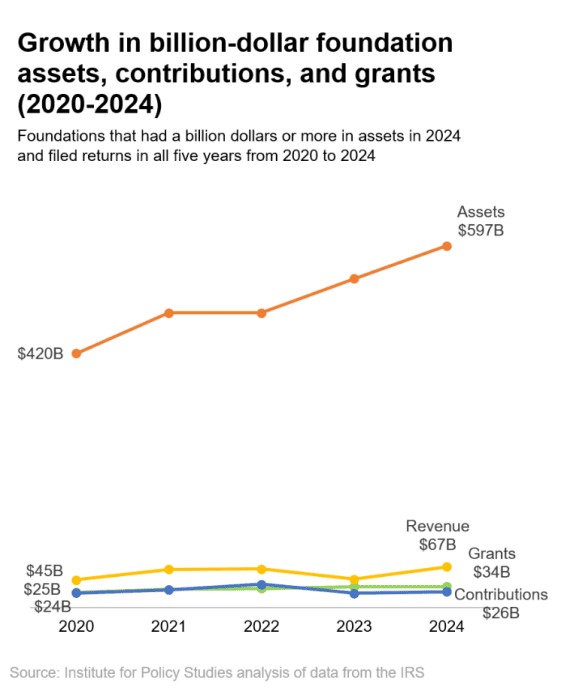
- Median payout at major grantmaking institutions — the 144 private foundations with endowments over $1 billion — was 5.1 percent (in 2024). The legal payout requirement is to donate 5 percent of annual assets, showing that the nation’s largest institutional funders are treating that as a ceiling instead of a floor. Foundations can get away with underpayment due to inadequate enforcement and clever accounting.
- Aggregate foundation market returns are estimated by FoundationMark at 12 percent over 2024, and 7.2 percent over the past five years (per December 2025 fiscal year-end foundation figures). In short, these foundations are growing much faster than they are giving.
- The nation’s now-largest foundation, the Lilly Endowment, reached a 5 percent payout in 2025 for the first time since 2009. Their payout was just 3 percent in 2024 and 3.4 percent in 2023. Their assets have more than doubled in value since 2022 due to the popularity and proliferation of GLP-1 drugs.
- If the 121 billion-dollar-plus private foundations that paid out less than 10 percent had to pay out at 10 percent in 2024, they would have directed an additional $23.4 billion to charity.
Donor-advised funds are also booming — and lagging in real giving.
- While they’ve often been described as “rainy day funds,” donor-advised funds (DAFs) have no legal payout requirement and are piling up assets far above the increase in their grants. Rather than meeting the moment, they are stashing away money while charities are experiencing unprecedented crises.
- Donor-advised fund sponsors comprise 11 of America’s top 20 charities in terms of incoming contributions and have grown 475 percent in 16 years.
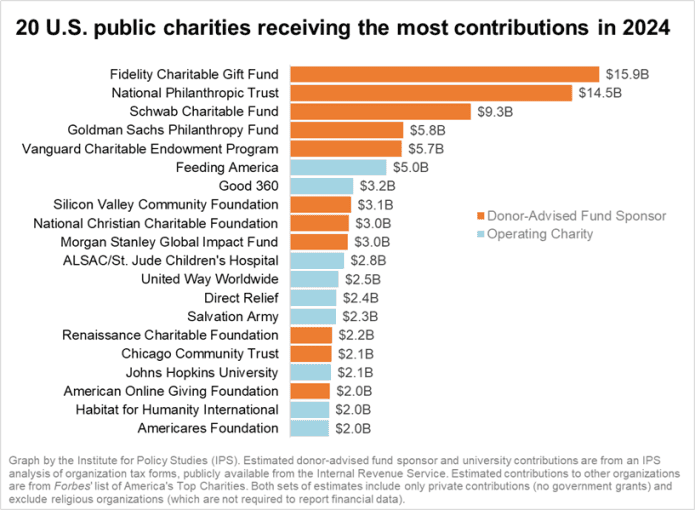
- DAFs sponsored by financial institutions — commercial DAFs — are responsible for much of this growth. United Ways of California president and CEO Pete Manzo sums it up: Commercial DAFs are “not really charities with a mission, advancing a point of view about strategic goals, so much as they are financial firms providing services to their investment clients.”
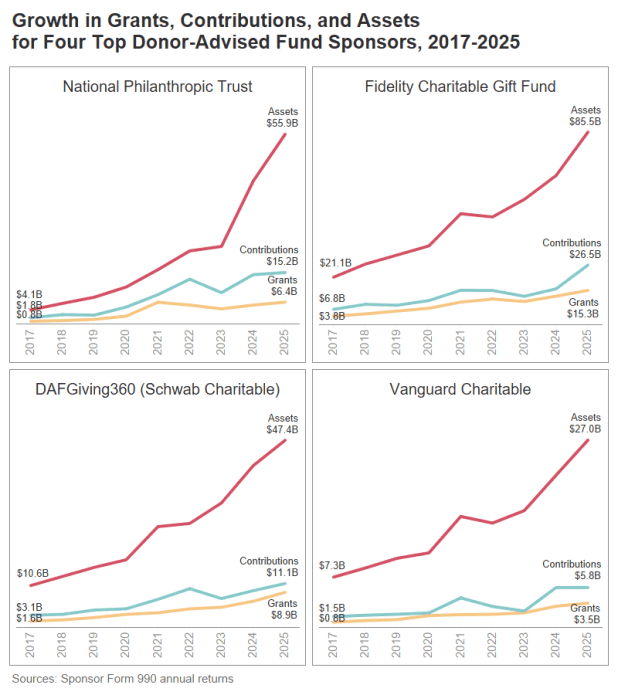
- Some of the nation’s largest DAF sponsors — the National Philanthropic Trust, Fidelity Charitable Gift Fund, DAFgiving360, and Vanguard Charitable — have collectively seen their assets grow about 64 percent faster than grants since 2017.
- By 2025, these four donor-advised fund sponsors held an average of $6.84 in assets for every $1 they paid out in grants — ranging from about $5.33 at DAFgiving360 to $8.73 at National Philanthropic Trust.
- Wealthy donors poured record amounts into donor-advised funds before certain provisions of the “One Big Beautiful Bill Act” took effect that might limit the value of their income tax deductions. These gifts were “bunched” to maximize tax benefits up front, meaning that donor-advised funds may take years to disburse grants back out.
- And as CNBC reports, the “surge in IPOs and valuations for private tech companies is creating a secondary boom in donations of shares to donor-advised funds,” noting that DAFs are “attractive to tech workers who tend to be younger, since they can make the donations now and wait until their later years to decide on the individual grant recipients.”
Charitable intermediaries keep piling up wealth.
- While these sectors lag, they are also receiving an ever greater share of charitable contributions. As of 2024, DAFs and foundations together took in 38 percent of all individual giving in the United States. If these two types of intermediaries continue to grow at the rate they have for the past five years, by 2028 they will take in half of all U.S. individual giving.
- Giving to private foundations has increased from 11 percent to 15 percent of all charitable giving by individuals since 2010.
- Giving to DAFs has increased from 4 percent to 23 percent of all individual giving since 2010.
- The assets held in DAFs and foundations have far surpassed $2 trillion in 2026. Private foundations held $1.865 trillion at the end of 2025 and DAFs held $328 billion at the end of 2024. That’s well over $2 trillion sidelined from flowing immediately to nonprofit organizations working to solve problems — but where the donors have already gotten their tax deduction.
Mega-givers dominate the nonprofit sector — and U.S. taxpayers foot the bill.
- Giving USA reports that mega-gifts (donations over $600 million) totaled $19.22 billion in 2025 — a dramatic rise from $2.7 billion in gifts $30 million or larger (then the mega-gift threshold) made in 2009.
- From research by David Wolcheck of Candid and Michael Kavate of Inside Philanthropy, living billionaires have increased from 24 percent to 48 percent of large foundation leadership over the last decade — and this figure can’t account for the large and increasing number of ultra-wealthy givers using LLCs, DAFs, and non-(c)3 entities to enact their tax-advantaged philanthropic visions. 66 Americans now have twice as much money as the Ford Foundation. In other words, individual wealthy donors command increasing control and resources in the nonprofit sector — outpacing legacy, institutional grantmakers or public charities that have comparatively more accountable governance.
- With each passing year, up to 73 cents of each dollar donated by high wealth individuals is subsidized by taxpayers: That’s the total subsidy wealthy donors can derive from tax avoidance through charitable donations.
- Givers who practice solidarity are far too rare — and money isn’t reaching movements. Some grantmakers have been a backstop for lost federal government funding, but gifts to social movements — which seek to, in the 1963 adage of Martin Luther King Jr., tackle the “circumstances of economic injustice which make philanthropy necessary” — likely fall in the low single percentage-point range of all philanthropic giving.
- It’s quite difficult to ascertain what percentage of charitable gifts fund grassroots organizing and social movement building. From what we can tell, we estimate that gifts to social movements hover well below 5 percent of total charity — likely in the range of a couple of billion dollars.
Individual funders can do a lot… but they can’t save us, and many don’t want to.
- Mackenzie Scott accounted for one-third of all mega-gifts this last year. After donating a cumulative $27 billion to charities in less than a decade, she has only decreased her net wealth, per Forbes, by $7.4 billion between 2020 and 2026.
- The Giving Pledge has only added a handful of new signatories and is facing intense “backlash” from right-wing givers like Peter Thiel and Elon Musk.
- Megadonors increasingly see their enterprise as a more important contribution than their giving. For example…
- Mark Zuckerberg: “I actually think the idea that you make money with a company and then find a way to do good with a philanthropy is a really outdated way of thinking about things. In most cases, the companies people build will be the main way they make an impact in the world. That’s why it’s so important that the work of these companies pushes human progress forward. And then yes, of course it’s great if you can also find a cause or mission that you care about to re-invest in.”
- Jeff Bezos: “If I do my job right, the value to society and civilization from my for-profit companies will be much, much larger than the good that I do with my charitable giving.”
- (It’s worth noting that Bezos’s companies can also be a drain on public coffers. A recent analysis by Popular Information estimated that since the take-home pay of many Amazon workers hovers at or below the poverty line, they qualify for Medicaid, costing taxpayers close to $1 billion a year.)
Too many donors are choosing to capitulate to the Trump administration.
Some major grantmakers have pre-emptively censored web language, abandoned social justice principles, contributed to funds that burnish the administration’s reputation or arguably function as payola, and have paused grants to charities due to political considerations.
They are using philanthropy’s cover and power to keep themselves safe during a time of rising authoritarianism and peril for nonprofits.
Some important donors are choosing to give in solidarity with social movements. They should be applauded — and copied en masse.
Some donors and foundations have quickly moved to compensate for slashed federal funding, organized against rising authoritarianism, boosted their payout rates to channel money quickly to embattled-yet-essential social movements, and have aligned their investment portfolios with their missions.
They are using philanthropy’s power and privilege to stand up for vulnerable people and communities, and to curtail oligarchic control. And they invite as many grantmakers as possible to join them.
Recommendations
In a dangerous political environment, commitments like voicing concern about democratic backsliding, increasing payout in the short-term, and implementing investment screens are a good place to start. In the long term, we suggest deeper structural changes to rebalance power in the nonprofit sector.
Pledges alone haven’t been able to move the needle, so funders interested in countering oligarchy need to step up now. We recommend that they raise the standard for acceptable conduct immediately: double required payout to 10 percent a year, vigorously fund movements, align all their investing with their missions, and support structural reform that turns today’s exemplary conduct into universal baseline expectations.
Here are reforms funders can opt into now:
- Raise payout to at least 10 percent, and actively work towards spending-down or out.
- Cap or prevent personnel expenditures from counting towards that 10 percent.
- Deploy those dollars more quickly, flexibly, and equitably (with less restrictive, faster-moving grants from larger allocations).
- Use a DAF sponsor that encourages moving money quickly and doesn’t collaborate with political attacks on the sector.
- Commit to board independence.
- Post full 990 and 990PF public disclosure copies on websites, since the IRS now doesn’t include key sections.
- Align 100 percent of the endowment with mission, not just the payout.
- Set a public target and timeline for the share of endowment in mission-aligned or impact-first vehicles, the same way payout commitments need a number and a date to mean anything.
Beyond voluntary measures by funders, structural reforms could unleash untold billions:
- Raising the legal private foundation payout requirement to 10 percent would unleash an estimated $66.3 billion in warehoused philanthropic wealth to working charities in 2026 — and using 2024 projections through 2029, a total of $351 billion.
- Using National Priorities Project and tax filing data, $351 billion from private foundations could: provide 3.7 years of SNAP benefits for the 42 million Americans who depend on them; sustain all existing units of public housing for decades; or fund the combined annual revenue of all 300 top food banks, the United Negro College Fund, Habitat for Humanity International, and Doctors Without Borders USA more than 18 times over in a single year.
- Creating a five-year payout requirement for donor-advised funds would unleash an estimated $37 billion in 2026, and an estimated $213 billion through 2029.
The structural charity reform compact that we recommend:
The last congressional overhaul of philanthropic sector rules was in 1969, when wealth concentration was much lower than today. That framework created tax incentives for timely giving but also opened the loophole enabling commercial exploitation of donor-advised funds.
Reform goals include promoting an independent nonprofit sector, preventing tax-avoidance abuses, and protecting democracy from the undue influence of private wealth.
Discourage the warehousing of charitable funds.
- Require donor-advised funds to pay out within 3-5 years of donation, change the timing of their tax benefits, and set better transparency standards to prevent shell games.
- Increase private foundation payout from an annual 5 percent to 10 percent, exclude certain expenses from counting towards payout, incentivize mission alignment, and increase transparency on board and trustee members.
Build integrity.
- Establish independent oversight capacity and increase public access to tax filings and disclosures.
- Prevent the politicization of the IRS and fully fund its enforcement and auditing mechanisms.
- Shine light on dark money by requiring donor disclosure from any section 501(c) organization.
Make giving fair — by fighting inequality.
- Reverse top-heavy philanthropy and extreme inequality by capping charitable tax benefits and closing giving loopholes.
- Restore and strengthen standards of fiduciary duty, with a plan ready for how, when and if executive branch leadership changes, government can build back from a gutted system.
- Broaden giving by preserving the universal non-itemizer charitable deduction for all households, and restore the social safety net and global aid funding after disastrous austerity measures.
- Fairly tax and distribute wealth beyond the charitable sector to curtail the power of mega-givers in the first place.
Subscribe to our newsletter
Further reading

Gilded Giving 2026: Philanthropy Under Oligarchy

Executive Excess 2026