A Perfect Storm: How Federal Policy Changes Are Increasing Economic Insecurity for America’s Families


Introduction
Less than halfway into Trump’s second presidential term, families confront an affordability crisis that threatens the well-being of millions across the country.
Inflation is up, utility costs are soaring, and the cost of food, housing, and healthcare continues to rise. Americans are wondering how they will build stable lives for their families, as nearly half cannot afford the rising cost of living.
At the same time, the United States is experiencing one of the most significant rollbacks of social safety net programs in recent history. These cuts to critical programs are happening alongside major tax breaks for the wealthy and large budget increases for the Pentagon and the Department of Homeland Security.
The passage of H.R. 1, known as the “One Big Beautiful Bill Act,” on July 4, 2025, marked what’s been called the most sweeping transfer of wealth from working families to the richest Americans in our history. The law cuts over $1 trillion from critical programs such as Medicaid, SNAP, and other forms of public assistance that millions of families rely on to meet basic needs. These programs aim to reduce poverty in the country and provide crucial resources for individuals and families.
The same bill gives over $1 trillion in tax cuts to the nation’s wealthiest one percent over a 10 year period, while extending corporate tax breaks under the 2017 Trump tax cuts. And it handed over an additional $156 billion to the Pentagon (raising total Pentagon spending for that year to $1 trillion) and nearly $200 billion to the Department of Homeland Security, each of which was already funded through regular spending bills that Congress passes each year.
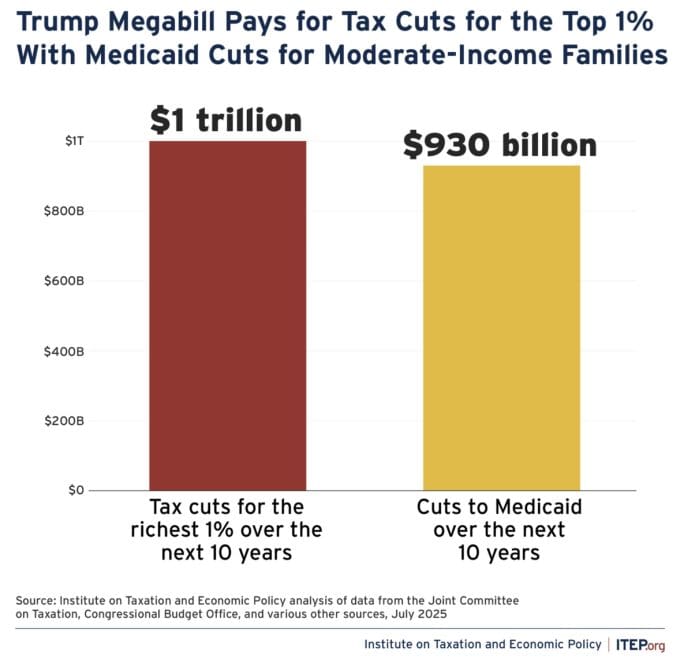
Chart by the Institute on Taxation and Economic Policy (ITEP).
This is an affordability crisis created by choice — and we know how to fix it. We know anti-poverty policies work. For example, many COVID-era policies resulted in a record-low supplemental poverty measure rate of 7.8 percent, while child poverty was cut nearly in half to a historic low of 5.2 percent. However, as COVID-era policies expired, not only did poverty rise, but so did the choice to deepen it through federal policy choices.
The passage of H.R. 1 makes the U.S. government’s priorities clear: instead of supporting families, it is cutting the programs many families depend on. Alongside the 2026 federal budget reconciliation bill, newly released work requirements, and major agency-level changes, these policy choices are pushing millions of people into increasingly precarious conditions. The effects are already devastating — and as more implementation requirements take effect, the harm is likely to grow.
This report examines how recent policy changes in healthcare, food assistance, housing, and immigration are affecting families and communities, while also outlining what to expect in the coming year.
Healthcare
Medicaid is one of the most important sources of health coverage in the United States.
- Over 65 million people relied on Medicaid for their health coverage during March 2026, a fairly typical month.
Medicaid and CHIP are federally funded programs that provide low-cost or free health coverage to eligible low-income adults, families, children, pregnant women, seniors, and people with disabilities. Medicaid helps cover essential services like routine doctor visits, inpatient and outpatient hospital services, laboratory and X-ray services, nursing home care, and in-home care, among many others.
- The passage of H.R. 1 threatens this, with an estimated 10 million people expected to lose coverage within the next decade.
- The bill slashed Medicaid spending by $911 billion, part of the largest healthcare cut in U.S. history.
The effects of these cuts will not fall evenly.
- Among non-elderly Medicaid enrollees, nearly half are children, 57 percent are female, and 6 in 10 are people of color.
- Forty-one percent of all births in the U.S. are covered by Medicaid.
One of the most harmful of these changes is the creation of new Medicaid work reporting requirements. The final rule released by the Centers for Medicare & Medicaid Services (CMS) directs states to implement new, burdensome work reporting requirements by January 2027, requiring people on Medicaid to work up to 80 hours per month or obtain a health-related exemption.
- Researchers find that between 19 percent and 37 percent of recipients who are already working will lose their coverage due to challenges in documenting work hours.
This means that eligible people could lose coverage due to paperwork, missed deadlines, or confusion about changing state rules.
These requirements are especially dangerous for people with serious or complex medical conditions. Although the reconciliation law exempts people who are medically frail or have special medical needs, that protection depends on how states define, identify, and verify medical frailty. As a result, people who should be exempt could still be forced to prove their medical condition or risk losing coverage.
Federal requirements that force people to work to be eligible for health coverage are unprecedented. They threaten the foundation of public health, especially for disadvantaged medically frail people and those suffering from chronic health conditions.
The effects of these cuts will also reach hospitals and health systems. Medicaid is a major funding source, especially for those living in rural areas. Medicaid covers a higher proportion of adults in rural areas (21 percent) than in urban areas (16 percent).
- More than 40 percent of rural hospitals operate at a loss, and 417 rural hospitals are considered vulnerable to closure.
Although H.R.1 created a $50 billion rural health fund, researchers warn that this temporary fund will not fully offset the Medicaid-related losses facing rural health systems. Even when hospitals do not close, they may reduce services. This is already happening in rural health care.
- Between 2014 and 2024, 448 rural hospitals stopped offering chemotherapy services, and hundreds also stopped offering obstetric and surgical services.
These service reductions force families to travel farther for care. For families without reliable transportation, paid time off, or child care, longer travel distances can mean delayed or missed care.
Those who rely on Affordable Care Act marketplace plans are also facing loss of coverage. At least five million people have dropped the coverage after the GOP Congress declined to extend the subsidies that made these plans affordable.
These changes make healthcare less stable and less accessible for families and vulnerable communities across the country. Millions are at risk of losing coverage, facing greater financial strain in an already unaffordable time.
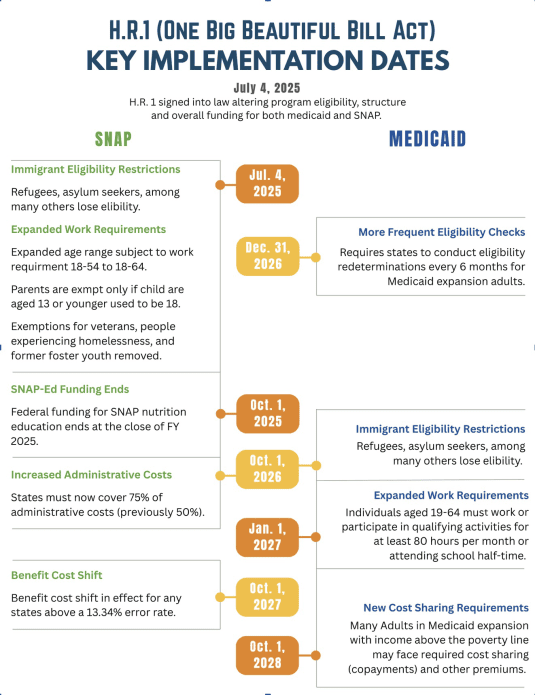
Graphic by Layla Sayed / Institute for Policy Studies. Sources: Center for Best Practices and Kaiser Family Foundation.
Food Assistance
Food assistance programs are one of the most direct ways the federal government helps families meet basic needs. The Supplemental Nutrition Assistance Program, or SNAP, provides monthly funds to buy groceries.
- In a typical month in 2021, SNAP helped about 41.5 million low-income Americans afford a nutritious diet.
- Two-thirds of SNAP participants are in families with children, and over a third are in households with older adults or people with disabilities.
- SNAP improves child health and even improves academic performance.
- In 2021, increased SNAP benefits reduced child poverty by 8.6 percent.
- SNAP also benefits local economies, with each dollar in federally funded SNAP benefits generating $1.54 in economic activity according to a federal estimate from 2019.
Despite these benefits, new requirements enacted through H.R. 1 have led to a sharp decline in SNAP participation. While many of the law’s changes will not be fully implemented until 2027, some are already in effect and are already affecting access to benefits.
One major change is the elimination of SNAP nutrition education (SNAP-ed) at the end of fiscal year 2025.
H.R. 1 also expanded work requirements.
- The age limit for able-bodied adults without dependents has been expanded to include adults through age 64 (previously through age 54), requiring individuals to work at least 80 hours per month or participate in an education/training program to receive benefits.
- Parents who were previously exempted if they had a child under age 18 are now only exempted if they have a child under age 14.
The law also removed key exemptions for vulnerable groups. Veterans, formerly unhoused individuals, and young adults aging out of foster care are no longer exempt.
H.R. 1 makes several categories of lawfully present immigrants — including many refugees, asylees, and survivors of human trafficking — ineligible for SNAP,
These changes are already reflected in participation data.
- From the passage of H.R.1, to March 2026, the estimated number of people receiving SNAP has dropped by 10 percent.
The effects vary across states. In Arizona, for example, SNAP participation fell by an estimated 53 percent. It’s estimated that the number of children receiving SNAP has dropped by more than 1.5 million, since July 2025.
H.R. 1 also shifts major SNAP costs from the federal government to the states. Currently, the federal government pays 100 percent of SNAP benefit costs. Beginning in fiscal year 2027, states with SNAP payment error rates above 6 percent — that’s 44 states as of FY 2024 — will be required to pay between 5 and 15 percent of benefit costs. As of FY 2024, 44 states have had an error rate above 6 percent.
The law also increases the state share of SNAP administrative costs from 50 percent to 75 percent starting October 1st, 2026. This shift will likely lead to cuts to SNAP benefits as state governments face difficulty raising sufficient revenue.
When 1 in 5 children in the United States rely on SNAP benefits, these cuts represent a direct attack on one of the country’s most important anti-hunger programs that benefits child well-being.
Housing
In the U.S., homelessness remains at record highs, with 745,650 people experiencing homelessness as of the most recent “point-in-time” count. That’s well above pre-pandemic levels.
- There is also a shortage of 7.2 million affordable and available rental homes to renters with extremely low incomes.
The U.S. is facing a housing crisis, and its impacts on children are particularly concerning. A longitudinal study found that teens who experienced housing insecurity in early childhood were more likely to report worse health, including higher rates of depression and anxiety, by age 15 than teens who had stable housing. Another study shows that poor housing conditions are associated with lower kindergarten readiness scores when children enter school.
The importance of housing security has led many policymakers in the U.S. to focus on a Housing First model, especially for those experiencing homelessness. This model focuses on finding permanent housing for individuals in precarious situations so they can focus on other necessities. A meta-analysis of 26 studies found that Housing First programs decreased homelessness by 88 percent and improved housing stability by 41 percent, compared to Treatment First programs.
However, this administration has rejected this approach, asserting it has “failed.” In a statement released by the U.S. Department of Housing and Urban Development, the agency says it is “making necessary reforms to put recovery first” in the projects it funds. But for families already living in unstable conditions, adding more requirements before housing support can create delays and increase the risk of homelessness.
At the same time, proposed federal funding cuts threaten the programs communities use to build and preserve affordable housing.
The House Transportation, Housing, and Urban Development appropriations proposal would cut $6 billion for HUD and the Department of Transportation.
- The HOME Investment Partnerships Program, which helps finance affordable housing production and preservation, would see a $750 million reduction from fiscal year 2026.
- The proposal would also eliminate funding for the Pathways to Removing Obstacles to Housing program.
- Tenant-based rental assistance funding would decrease by $356 million.
The Department of Housing and Urban Development also proposed a new rule that, if enacted, could force many families with mixed immigration status to separate and 80,000 people — including 37,000 children — to lose their homes.
The administration also proposed a new work requirement rule that could put as many as 3.7 million people at risk of losing rental assistance, more than half of them children. The rule would allow housing agencies to impose work requirements of up to 40 hours per adult per week or time limits on assistance as short as two years.
The result is a housing policy direction that asks families to become more stable while taking away the support that makes stability possible. For families, this means higher risks of eviction, homelessness, unsafe living conditions, and long-term harm. These proposals do not solve the housing crisis. They make it harder for families to survive it.
Immigration
While many safety net programs that protect millions of families were drastically cut, immigration enforcement received a dramatic increase in funding. About 10 years ago, Immigration and Customs Enforcement, or ICE, had a budget of just under $6 billion. H.R.1 provided ICE with an increase of $75 billion in new funding, while Customs and Border Protection received about $60 billion.
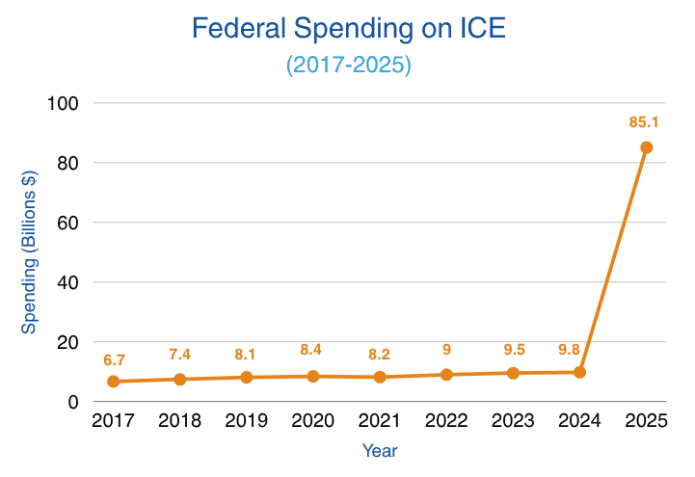
Graphic by Layla Sayed / Institute for Policy Studies. Source: NPR analysis of federal data.
- On June 10, 2026, Trump signed another immigration enforcement bill that provided nearly $70 billion more for ICE, Border Patrol, and the Department of Homeland Security through 2029.
This increased funding is aimed at expanding detention, deportation, and surveillance across the country. The impact has been felt dramatically among immigrant and non-immigrant communities alike.
The human consequences have already been severe. In January 2026, Renee Nicole Good, a U.S. citizen and mother, was shot and killed by an ICE agent during an immigration enforcement operation in Minneapolis. That same month, five-year-old Liam Conejo Ramos was detained by immigration officers in Minnesota. These cases, among many others, show the ways women and children, whatever their immigration or citizenship status, are particularly affected by ICE’s aggression.
- The scale of detention has also expanded. ICE held 60,311 people in detention as of April 4, 2026.
This administration often justifies expanded enforcement as a response to crime, but detention data show that of all those held in detention, 70.8 percent had no criminal conviction as of early July 2026.
For families, detention is often traumatic and destabilizing.
- Researchers estimate that more than 4.6 million U.S. citizen children live with at least one unauthorized parent or parent without firm legal status.
- They also estimate that about 205,000 children, including 145,000 U.S. citizen children, have likely experienced the detention of a parent.
- More than 22,000 U.S. citizen children are estimated to have experienced the detention of all parents living in their household.
- More than 1 in 7 adults in immigrant families with children reported that immigration concerns were increasing emotional distress for their children.
Increased immigration enforcement can also create a chilling effect, in which eligible families avoid public benefits for fear of immigration consequences. In 2025, nearly 1 in 5 adults in immigrant families with children reported that their family went without public benefits because of immigration concerns.
At the same time that H.R.1 cut or restricted access to Medicaid, SNAP, housing assistance, and other supports that help families survive, the federal government expanded funding for immigration enforcement.
“With the amount we’re now spending on rogue immigration agencies,” the IPS National Priorities Project reported, “we could instead…
- Fully restore this year’s cuts to SNAP ($18.6 billion) and Medicaid ($91 billion) from last year’s One Big Beautiful Bill Act.
- Provide medical care for more than one million veterans through 2029 ($71.6 billion).
- Establish universal preschool for kids across the United States ($35 billion).
- Make school lunches free for all thirty million children served through the National School Lunch Program ($6.38 billion).
- And power more than ten million households with solar energy through 2029 ($17 billion), investing in long-term renewable energy while American families grapple with rising fossil fuel costs.”
Conclusion
Families in the United States are facing a perfect storm. Food, housing, and healthcare costs are increasing faster than wages. Inflation and gas prices are high. Immigrant families are being torn apart. Critical supports that help families meet their basic needs have been drastically scaled back or eliminated. More cuts are looming.
We’re experiencing unprecedented disinvestment in our families while seeing unprecedented redistribution of wealth upwards to the nation’s wealthiest, the largest corporations, and the U.S. war machine.
To better support our families and communities, we know what works.
We saw a robust expansion of critical needs programs during the COVID-19 pandemic. Under pandemic-era recovery programs, poverty sharply decreased, health coverage expanded, evictions decreased, and food insecurity fell. Instead of renewing successful policies, Congress allowed these enhanced supports to expire. And the new administration has implemented further drastic cuts.
We’re going in the wrong direction.
We know that investment in food programs not only gives children the best chance of a happy, healthy life but also yields economic benefits almost double the investment. We know that for child development and stability into adulthood, children need a safe home that their parents can afford. We know access to healthcare is vital for survival and thriving, and we know that tearing apart families, denying them food, shelter, and access to emergency health care is devastating for immigrant families.
A different path is possible. Expand investments in families and communities, and we won’t just have to struggle to survive; we can thrive.
Subscribe to our newsletter
Further reading

A Perfect Storm: How Federal Policy Changes Are Increasing Economic Insecurity for America's Families
SYMPOSIUM ROUNDUP: Forging a Democracy That Works for All