Lessons from Atlanta’s Municipal Grocery Store Experiment


Introduction
On December 19, 2024, the City of Atlanta’s economic development corporation voted to approve the establishment of the United States’ first municipal grocery stores in a major urban center. The first Azalea Fresh Market opened in downtown Atlanta at 25 Peachtree Street last year, with another location coming soon to 2080 Campbellton Road in the city’s southwest suburbs. While neither is directly owned or operated by the municipal government, their funding mechanisms, organization, and impact still provide useful insights for policymakers committed to expanding food access.
History of the Azalea Fresh Market Program
| April 11, 2024 | Invest Atlanta opens applications to establish a municipal grocery store in collaboration with the city. |
| May 2, 2024 | Applications to establish a municipal grocery store in collaboration with the city close after being open for 21 days. |
| May 16, 2024 | The board of Invest Atlanta, Chaired by Mayor Andre Dickens, votes to lease 2080 Campbellton from EDCO Atlanta, a real-estate company. |
| December 19, 2024 | The board of Invest Atlanta, Chaired by Mayor Andre Dickens, unanimously approves $8 million in funding for the establishment of two grocery stories by Local Grocers, LLC. |
| December 20, 2024 | The City of Atlanta announces that the downtown location will be opened at 25 Peachtree Street. |
| February 20, 2025 | The board of Invest Atlanta, Chaired by Mayor Andre Dickens, unanimously approves $3 million in additional funding to provide for construction costs. |
| March, 2025 | Local Grocers and Savi Provisions CEO Paul Nair estimates that the downtown Azalea Fresh Market will open by March 2025 at the very earliest. |
| August 14, 2025 | Dope Coffee announces that it will open a location at each of Atlanta’s municipal grocery stores, beginning with the 25 Peachtree Street project. |
| September 8, 2025 | The Azalea Fresh Market opens for business, welcoming 728 customers on its first day. The 2080 Campbellton location is still under construction. |
| May 26, 2026 | City officials tour the 2080 Campbellton Road construction site. |
| June 18, 2026 | The City of Atlanta announces that the Azalea Fresh Market has served over 150,000 customers since its opening. |
| June 20, 2026 | A local news outlet reports that construction at the 2080 Campbell location is 30 percent complete, but is proceeding as planned. |
| October, 2026 | CEO Paul Nair estimates that more than 200,000 customers have been served and projects that the 2080 Campbellton location will open on October 28, 2026. |
The Private Operator
The downtown Azalea Fresh Market[1] is neither city-owned nor city-operated, despite what some outlets have reported.[2] Rather, the store is run entirely by a pair of private companies: the boutique grocer Savi Provisions and its associate company, Local Grocers, LLC. The city’s economic development corporation, Invest Atlanta, subsidizes the Azalea Fresh Market with grants and loans, but day-to-day operations are handled exclusively by Local Grocers. Savi Provisions advises the store on strategy and finances.[3]
The property that houses the Azalea Fresh Market is privately owned as well. Instead of using city-owned property to save on rental payments and property taxes, as some municipal grocery advocates in New York City have proposed, Invest Atlanta provided Savi Provisions with large subsidies to lease the 25 Peachtree Street location, the site of a former Walgreens.[4] In an interview with the Institute for Policy Studies, Savi Provisions’ CEO Paul Nair stressed that the Azalea Fresh Market is “completely privately owned” and that “the city [of Atlanta] is more like a helping hand.”[5]
Invest Atlanta has, however, imposed some requirements on the Azalea Fresh Market.[6] It must stay in business until 2034, and reserve certain amounts of shelf space for specific products: 50 percent for items intended for at-home preparation, 30 percent for perishable goods like dairy and meat, and 500 feet for fresh produce. The store is also required to accept SNAP and WIC benefits for eligible items.
Funding Mechanisms
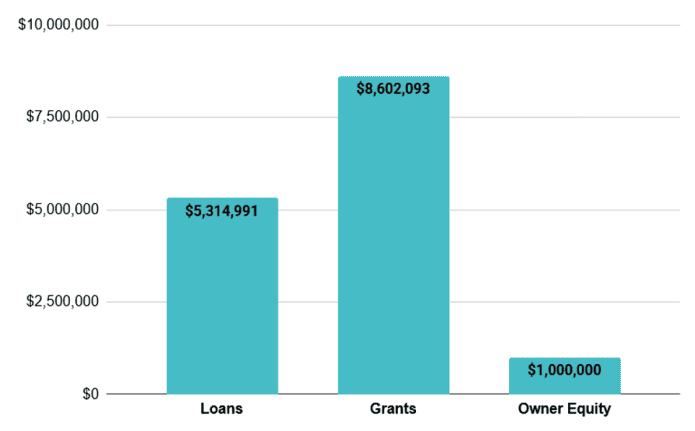
Azalea leadership estimates that the store needs about 3-5 years to become profitable, a fairly standard timeline for small businesses.[7] In the meantime, Invest Atlanta has supported the project through $13.9 million in one-time grants and loans. CEO Paul Nair of Savi Provisions has stated that his ultimate goal is to achieve financial independence for the store, asserting that his business plan is to not rely on subsidies, but to be “self-sustainable as soon as possible.”[8]
The largest source of funding has been Invest Atlanta’s Tax Allocation District (TAD) grants. TAD grants are governed by the Georgia Redevelopment Powers Act, which allows for local property tax revenues to be allocated for the “construction,” “renovation,” or “remodeling” of buildings, among other purposes.[9] Invest Atlanta has allocated $2.3 million to Savi Provisions and Local Grocers to pay for construction at the downtown location, as well as $6.1 million to lease and renovate the Campbellton Road location.[10] The absorption of construction costs by the City of Atlanta is one factor why Azalea is able to keep prices affordable.[11]
Unlike the TAD grants, some of the other funding sources for the Azalea Fresh Market must be repaid. Two loans of $2 million — one for each store — were awarded to Savi Provisions from Invest Atlanta’s Grocery Loan Fund, as well as nearly $900,000 from the Business Retention Expansion Loan Fund and $300,000 from the federally-funded Healthy Food Financing Initiative. These loans generally have low interest rates, making it easier to service the debt and decreasing the store’s financial strain.
| Additional Funding. Atlanta Mayor Andre Dickens has stated that the city is ready to provide additional funding for the Azalea Fresh Market if the need arises. In February of 2025, unforeseen construction issues prompted Invest Atlanta to authorize an additional $5.3 million in funding. $1.3 million was authorized for the “interior and exterior improvements” at the downtown project, while $4 million was authorized for the 2080 Campbellton Road Project. These allocations have raised the total cost of the Azalea Fresh Market project by 62 percent. |
Chart 1: Azalea Fresh Market Funding Sources by Type
Maintaining Affordability at Small Scales
Scale is critical in the grocery industry. Corporate giants like Walmart and Kroger leverage their size to extract special deals and discounts from wholesalers — the companies that sell produce to grocery stores — but small, independent grocers do not have this option, giving them a competitive disadvantage. This is one of the primary reasons that independent grocers struggle to compete and directly leads to the emergence of food deserts.[12]
Azalea Fresh Market joined an organization called the Independent Grocers Association (IGA) to circumvent this issue.[13] IGA is a network of independent grocery stores that pools its members’ buying power, using its combined scale to negotiate discounts from wholesalers. Azalea passes these savings down to consumers, offering prices low enough to compete with corporate grocery chains. The IGA is credited with enabling Azalea to maintain competitive pricing vis-à-vis Kroger.[14]
One of Azalea’s main suppliers is the Associated Wholesale Grocers (AWG), a cooperative wholesaler licensed with IGA.[15] AWG is one of the nation’s largest wholesalers, giving the Azalea Fresh Market access to well-known, private-label brands like Best Choice at a discount. Azalea also sources food from local farmers through a partnership with a program of the Georgia Department of Agriculture called Georgia Grown, allowing them to shorten supply chains and sell local produce at affordable prices.[16]
| Labor Standards and Wages. Savi Provisions received $100,000 to support the creation of well-paying jobs at the Azalea Fresh Market. Ordinary employees are paid at market rate, between $15 and $18 an hour. This is well above Georgia’s minimum wage of $7.25, but below Metro Atlanta’s living wage of $26 an hour. The workers are not unionized. |
Future Expansion
With revenue exceeding expectations and over 150,000 customers served by the summer of 2026, city officials have moved ahead with a second Azalea Fresh Market at 2080 Campbellton Road, the site of a former Super Saver Foods.[17] Originally planned to open alongside the downtown location, a number of issues — including tariffs, supply-chain constraints, and construction — have delayed the opening until October 2026, prompting Invest Atlanta to allocate an additional $4 million for the project.[18] These issues reveal that using the property of former grocery stores may not necessarily eliminate construction costs.
Whereas the downtown Azalea Fresh Market mainly serves a demographic of students and commuters, its counterpart on Campbellton Road will focus on customers with less disposable income. For that reason, items that are not eligible for SNAP/WIC like premade, hot meals will take up less shelf space at the second Azalea, and cheaper, private-label items will take up more.[19] Officials have also estimated that the Campbellton Road location will serve 1,750 customers per month.[20] They have also signaled that sustainability and profitability could be a greater challenge because residents have lower incomes.
Prices at the Azalea Fresh Market
The prices of essential items like eggs, bread, and milk at the Azalea Fresh Market are roughly equivalent to those of Kroger or Walmart. A dozen eggs, for example, sells for $1.69,[21] the same price listed at Kroger’s Ponce location.[22] Surprisingly, policymakers in Atlanta never intended for Azalea to offer dramatically lower prices than its corporate competitors. Invest Atlanta has not imposed any formal price guidelines on Azalea and, when asked about prices during a city council meeting, CEO Paul Nair promised only that the store would match Kroger, a goal it has achieved.
Most essential items at Azalea are included in “Paul’s Price Promise,” a list of 50-60 items that the store sells at “the lowest price possible,” in Nair’s words. During an interview with the Institute for Policy Studies, Nair described how these items are sold at close to wholesale price:[23] “Let’s imagine the margin is 20 percent, and your spoilage [is] 3 percent.[24] So what a store would do is take the [20 percent] plus 3 percent and mark it up 23 percent. We’re not doing that.” The store also sells made-to-order meals — very popular among students at nearby Georgia State University — to recoup losses it incurs on staple items.[25] There is also a student discount on groceries and ready-to-made meals.[26]
Prices at Azalea and Kroger as of May/June 2026
| Item | Azalea Fresh Market | Kroger Atlanta[27] |
| 12 Eggs | $1.69 | $1.69 |
| ½ Gallon Milk | $2.85 | $2.79 |
| Half Loaf of White Bread | $1.79 | $1.99 |
| Pound of Chicken Breast | $4.99 | $6.99 |
Policy Recommendations
The Azalea Fresh Market has successfully brought healthy, reasonably priced groceries to one of Atlanta’s most stubborn food deserts. The downtown location has served over 200,000 customers in total, and daily revenues have increased by 20 percent since its opening, a positive sign for long-term sustainability. This section provides a series of policy recommendations based on the successes and failures of Azalea.
- Join or Affiliate with a Purchasing Network. Municipal grocery stores can lower costs — and ultimately consumer prices — by partnering with supermarket networks like the Independent Grocers Alliance or National Co-op Grocers. These organizations leverage their member stores’ collective scale to secure bargains from wholesalers, allowing those stores to offer lower prices and compete with giants like Kroger without consumer subsidies from the City of Atlanta.
- Maintain the Same Private Operator When Opening Additional Public Grocery Stores. Municipal governments may lack the expertise to run a grocery store and prefer to contract a private operator to manage the day-to-day operations of the business. If city governments decide to expand into other locales and open new stores, it is recommended that they retain the same private operator because they can take advantage of increased scale and facilitate cooperation between the different grocery stores where they can share inventory and logistics.
- Public Funds Are Essential to Guarantee Affordability. The experience at Azalea demonstrates that public support from City government does not create market distortions. On the contrary, it has allowed for a grocery store to open and sell food at affordable prices in communities where there is limited access to supermarkets. The City of Atlanta’s willingness to take on expected and unexpected construction costs has freed the private operator from incurring an additional expense. Not having to service construction debt is a saving that is passed on to customers.
- Adopt Flexible City Funding. Policymakers can minimize risk by funding municipal grocery stores through mechanisms that provide flexible support long into the future. Any number of factors — recession, unexpected building costs, or crime — can force grocery stores to raise prices or close. Because the Azalea Fresh Market was funded through one-time incentives, however, Invest Atlanta would be required to vote and manually allocate more funding in case of hardship, which future board members may oppose. This introduces significant risk.
An emergency fund is one potential solution. The City of Atlanta could, for example, allocate $20 million for the Azalea Fresh Market to be used in case of emergency, creating a safety net for the store if revenues dip. In good times, the emergency fund would give Savi Provisions the confidence to invest their profits into more Azalea locations, higher wages, or a greater selection of produce. In bad times, it would allow the store to continue operating without raising prices or downsizing. The Azalea Fresh Market could last far into the future.
- Adapt to the Local Market. Policymakers should replicate Azalea’s attention to its market. The downtown location, for example, is carefully adapted to serve a customer base of mostly students and commuters. It offers made-to-order meals for rushed passers-by, a discount for students at nearby Georgia State University, as well as a dedicated study area.[28] In contrast, the 2080 Campbellton Road Azalea Fresh Market — located in a lower-income suburb of Atlanta — will offer fewer hot meals because they are not eligible for SNAP or WIC benefits. Policymakers should consider factors like the demographics, religion, and disposable income of their customers, all of which may affect their shopping preferences.
- Clear Price Guidelines. Prices at the Azalea Fresh Market exist in a gray zone. Azalea leadership has committed to keeping prices roughly equivalent to those of Kroger, but there are no official, publicly available pricing guidelines for the store. This means that there is no mechanism preventing Azalea from raising prices in the future, which it may be incentivized to do as city funding runs out over time.
Clear pricing guidelines could help address this issue. One possibility is to fix prices to a certain percentage of market rate (although this may be difficult to determine) or to those of Kroger or Walmart. Another possibility would be to establish a set list of prices and require the approval of a city representative to change them, or to have the city review prices on a monthly or annual basis through an audit process.
- Training for the City Employees. One of the reasons food deserts exist is because private sector grocers do not expect to reap a return in certain neighborhoods. Municipally owned grocery stores are, therefore, a viable option to address food insecurity and market failure.
However, cities and towns may lack the expertise needed to operate a grocery store and must rely on public-private partnerships. But for local officials who wish to have more than one city-supermarket, and wish to have it completely owned and operated by the municipal government, they should train their city employees in how to operate one through vocational programs and/or on the job training at the public-private partnership enterprise.
Endnotes
[1] Hereafter “the Azalea Fresh Market” unless otherwise specified.
[2] Daniella Genovese, “A Look at Atlanta’s First City-Operated Grocery Store,” Fox Business, January 3, 2026, https://www.foxbusiness.com/lifestyle/atlantas-first-city-operated-grocery-store-reports-early-success-downtown-food-desert; Miquéla V Thornton, “City-Run Supermarkets Aren’t New. But No One’s Tried Them in a City Like New York,” Bloomberg, July 10, 2025, https://www.bloomberg.com/news/features/2025-07-10/can-zohran-mamdani-lower-nyc-s-grocery-costs-with-city-owned-stores; Nathaniel Meyersohn, “Zohran Mamdani Wants to Build Government Supermarkets. American Already Has Them,” CNN, June 30, 2025, https://www.cnn.com/2025/06/30/business/zohran-mamdani-grocery-stores
[3] Invest Atlanta, Project Savi Fact Sheet (Version 9), https://go.boarddocs.com/ga/investatlanta/Board.nsf/files/DDYSRN73F5B5/$file/Project%20Savi%20Fact%20Sheet.V9.pdf
[4] Ibid; Donnell Suggs, “I Want to Revitalize Downtown’: Former Walgreens is Now Azalea Fresh Market,” The Atlanta Voice, August 27, 2025, https://www.theatlantavoice.com/local-news/new-supermarket-five-points-1cc13bda
[5] Interview with Paul Nair, CEO of Savi Provisions, by Aidan Rozema and Omar Ocampo, July 7, 2026.
[6] Invest Atlanta, Request for Qualified Contractors for Municipal Grocery Store Development, April 11, 2024, https://www.investatlanta.com/assets/mmo_rfp_4.11.24_ooRW6eM.pdf
[7] Andrew Lisa, “How Long Does It Take for the Average Small Business to Turn a Profit,” Yahoo! Finance, June 22, 2021, https://finance.yahoo.com/news/long-does-average-small-business-220030290.html
[8] Bryce Covert, “Zohran Mamdani Promised City-Owned Groceries. Atlanta Already Has One,” Bon Appétit, February 25, 2026, https://www.bonappetit.com/story/zohran-mamdani-promised-city-owned-groceries-atlanta-already-has-one
[9] “Georgia Code Title 36: Provisions Applicable to Municipal Corporations Only, Chapter 44 – Redevelopment Powers Law,” Justia US Law, 2024, https://law.justia.com/codes/georgia/title-36/provisions-applicable-to-municipal-corporations-only/chapter-44/
[10] Mirtha Donastorg, “Atlanta Officials Approve More than $8M to Bring Grocery Stores to Southside,” The Atlanta Journal-Constitution, December 19, 2024, https://www.ajc.com/news/business/atlanta-officials-approve-more-than-8m-for-two-new-grocery-stores/4GR2TLQGYFFQNALIF2SI5BJJLY/; Invest Atlanta, “A Peek Inside New Azalea Fresh Market,” Invest Atlanta [website], May 27, 2026, https://www.investatlanta.com/impact-insights/a-peek-inside-new-azalea-fresh-market-location
[11] Paul Nair, “I Am a Capitalist. I Also Run Publicly Funded Grocery Stores,” Progressive Grocer, October 14, 2026, https://progressivegrocer.com/op-ed-i-am-capitalist-i-also-run-publicly-funded-grocery-stores
[12] Keith Schneider, “Can the Only Grocery Store in Rural Michigan Town Stay Independent?”, The New York Times, January 14, 2025, https://www.nytimes.com/2025/01/14/business/small-grocery-stores-industry-consolidation.html; Stacy Mitchell, “The Great Grocery Squeeze,” The Atlantic, December 1, 2024, https://www.theatlantic.com/ideas/archive/2024/12/food-deserts-robinson-patman/680765/
[13] Independent Grocers Association, “About IGA,” IGA [website], https://www.iga.com/about
[14] “Azalea Fresh Market Surpasses 150,000 Customers, Expands Mission to Address Atlanta Food Deserts,” City of Atlanta, June 18, 2026, https://www.atlantaga.gov/Home/Components/News/News/15754/1338; Bryce Covert, “Zohran Mamdani Promised City-Owned Groceries. Atlanta Already Has One,” Bon Appétit
[15] Associated Wholesale Grocers, Associated Wholesale Grocers [website], https://awginc.com/; Associated Wholesale Grocers, “Meet the Brands,” Associate Wholesale Grocers [website], https://awginc.com/awg-brands/meet-the-brands/
[16] Zachary Bynum, “Downtown Atlanta Opened a New Grocery Store to Combat Food Insecurity. What’s happened since?”, CBS News, October 23, 2025, https://www.cbsnews.com/atlanta/news/azalea-market-downtown-atlanta-municipal-grocery-store-success/
[17] “Azalea Fresh Market Surpasses 150,000 Customers, Expands Mission to Address Atlanta Food Deserts.”
[18] Invest Atlanta, Project Azalea Fresh Market – Campbellton (Version 2), https://go.boarddocs.com/ga/investatlanta/Board.nsf/files/DR8KXK5402B0/$file/ADA%20-%20Azalea%20Fresh%20Market%20-%20CTAD%20%26%20ETAD%20Fact%20Sheet.V2.pdf
[19] Interview with Paul Nair.
[20] Interview with Paul Nair.
[21] Max Chafkin and Stacey Vanek Smith, “A Different Way to Lower Your Grocery Bill,” Everybody’s Business, May 29, 2026, https://podcasts.apple.com/us/podcast/a-different-way-to-lower-your-grocery-bill/id1812469316?i=1000770150486
[22] “In Store at Ponce,” Kroger, accessed June 15, 2026, https://www.kroger.com/.
[23] Bryce Covert, “Zohran Mamdani Promised City-Owned Groceries. Atlanta Already Has One,” Bon Appétit.
[24] Grocery shrink is inventory that is lost or not sold due to theft, food spoilage, torn or damaged packaging, or accounting errors that occur in-store. Grocery shrink markups are normally between 1.7 percent to 3.7 percent. Too Good to Go, “What is Grocery Shrink and What’s It Really Costing Your Store?”, Too Good to Go Blog, June 25, 2026, https://www.toogoodtogo.com/en-us/blog/grocery-shrink
[25] Will Parker, “Inside Atlanta’s First Government-Funded Supermarket,” The Wall Street Journal, November 25, 2025, https://www.wsj.com/real-estate/commercial/atlanta-georgia-public-state-grocery-store-d4e11ad8
[26] Azalea Fresh Market, “GSU x Azalea Fresh Market. Proud to support the Georgia State community with student discounts on groceries and made-to-order meals. Now accepting Panther Cards…”, Instagram Photo, January 30, 2026, https://www.instagram.com/p/DUJFRE9DrOh/
[27] “In Store at Ponce,” Kroger.
[28] Ashley M. Page, “How Atlanta’s New Azalea Fresh Market Is Flipping the Script on Food Access,” IGA [website], September 18, 2025, https://www.iga.com/insights/how-atlantas-new-azalea-fresh-market-is-flipping-the-script-on-food-access
Subscribe to our newsletter
Further reading

Lessons from Atlanta’s Municipal Grocery Store Experiment

High Flyers 2026: The High Cost of Private Jet Excess