FAQ: Why Is the U.S. Attacking Iran? And What Happens Next?


Why is the U.S. attacking Iran?
President Trump has not given a single, clear purpose for the war.
After initially calling for “regime change,” Trump administration officials are mostly downplaying that goal and offering others. On March 2, Pete Hegseth outlined three goals: the destruction of Iran’s ballistic missile arsenal, the destruction of its navy, and eliminating its ability to ever develop a nuclear weapon.
Later that day, Trump identified four goals: Hegseth’s three, plus eliminating Iran’s ability to “fund, arm, and direct” regional allies. Marco Rubio, before he briefed Congress on March 2, added the possibility of a U.S. role in shaping a new regime in Iran, saying, “I mean, we might. We’ll see how circumstances play out.”
So while it is very difficult to know their actual reasons, some things can be determined.
First, the U.S. and Israel share a goal of degrading Tehran’s military capabilities. This means reducing Iran’s ballistic missile and drone arsenals, destroying Iran’s non-military nuclear program to prevent an imagined, future nuclear weapon, and otherwise eliminating Iran’s power as an influential military and political player in the Middle East.
Second, this war serves as both a demonstration and a consolidation of Israeli supremacy in the Middle East and U.S. supremacy in the world. Iran is the U.S. and Israel’s strongest challenger in the Middle East, so this war is meant to remove that obstacle. In recent years, Israel has assassinated 17 Iranian nuclear scientists, bombed the Iranian consulate in Syria in 2024, and in June 2025 — with U.S. participation— bombed Iran for 12 days, killing over 1,000 Iranians. So this war is the latest in a long series of escalations by the U.S. and Israel.
Third, the U.S. is experimenting with the Pentagon’s new weapons and military technology. The Pentagon is debuting, for example, cheap new drones that are clones of the Iranian Shahed drone. The U.S. is also using the Maven Smart System, which combines data gathered by the tech firm Palantir with AI built by Anthropic (despite a very public dispute with the latter company) to generate targets for U.S. bombing. This is the first time that this tool has been used in a war.
Finally, Trump is using this war to burnish his personal legacy. Coming after the U.S. attack on Venezuela and abduction of its head of state Nicolas Maduro, Trump is promoting himself as a president who uniquely does not just talk about using military force, but acts. He is fond of saying that he does things that no other president has done. As the first U.S. president to attack Iran on this scale since the CIA supported a coup against the country’s leader in 1953, Trump is working to establish himself as an historically militaristic leader.
How long is this war likely to last?
No one knows how long this war will last.
On the day that the U.S. bombing began, Trump said: “I can go long and take over the whole thing, or end it in two or three days and tell the Iranians: ‘See you again in a few years if you start rebuilding’ weapons and nuclear capabilities.” Two days later, Trump added that the U.S. was prepared to fight Iran for “four to five weeks” or “far longer” to “terminate the military leadership” of the country.
The multiplicity of reasons Trump has offered for the war means he has numerous off-ramps to end the war — if he were looking for one. All he needs would be some version of “destroy their navy? We did that — war over.”
Is this war legal?
Absolutely not. This war violates both U.S. domestic and international law.
The Constitution is very clear that only Congress, not the president, has the power to declare war. Trump did not even consult with Congress, let alone rely on a congressional declaration of war before launching one against Iran.
In recent years Congresses have abandoned their constitutional prerogative, allowing presidents to initiate military force without even the pretense of claiming their power to declare war. Only after the current attack on Iran began did Congress — in overwhelmingly partisan votes — consider and reject War Powers Resolutions, which might have prevented or at least constrained Trump’s reckless and illegal war.
International law is equally clear. The UN Charter declares that no country may attack another country, with exceptions only if the Security Council authorizes military force, or in case of immediate self-defense when “an armed attack” occurs. Neither of those happened here. This war is illegal.
The Nuremberg trials following World War II determined that the “supreme international crime” is that of aggression — because war crimes, crimes against humanity, and genocide all stem from that fundamental crime of going to war illegally. The U.S. and Israel are waging a war of aggression against Iran.
The Iraq War was illegal too. But back then, President Bush at least recognized that international law required him to get UN authorization (although when he tried and failed to get Security Council approval, Bush went to war illegally anyway).
But Trump claims international law does not even apply to him. So this U.S. war against Iran is deepening the on-going delegitimization of the rule of law — something that must be taken seriously if future wars are to be averted.
Did Israel drag the U.S. into war with Iran?
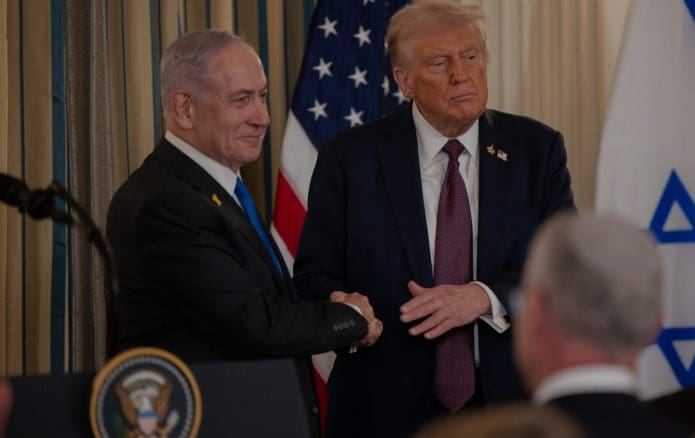
The U.S. and Israel have both had Iran in their gunsights for decades.
Israeli Prime Minister Benjamin Netanyahu has made attacking Iran the centerpiece of his political career for 30-plus years. And hawks in the U.S. have targeted Iran since the 1979 revolution there. Ultimately, Israel did not need to “drag” a reluctant Trump into attacking Iran.
“We knew that there was going to be an Israeli action,” said Secretary of State Marco Rubio on the timing of the attack. “We knew that that would precipitate an attack against American forces, and we knew that if we didn’t pre-emptively go after them before they launched those attacks, we would suffer higher casualties.”
Apparently it never occurred to Trump and his aides to tell Israel not to attack Iran and threaten to cut off all arms transfers if they did.
The current war against Iran reflects decades of close military partnership, escalating to new intensity between far right leaders Benjamin Netanyahu and Donald Trump. Both face political and legal challenges at home and both see war as a distraction from those problems, even while they both see the opportunity to consolidate Washington’s and Tel Aviv’s roles as global and regional hegemon, respectively.
The U.S. provides billions of dollars every year to the Israeli military — in 2024-25 alone, it paid about $22 billion directly to the Israeli military to enable its genocide against Gaza to continue. Washington collaborates closely with Israel on the production, testing, and use of surveillance and military technologies.
But Washington does these things to advance U.S. power, not because it’s being manipulated or coerced by Israel.
Does Iran have nuclear weapons?
No. It doesn’t, and it never did. Period, full stop.
Iran does have a civilian nuclear program, which it started with help from the United States. Starting in the mid-1970s, the U.S. negotiated with the Shah of Iran to invest in nuclear power, not least so U.S.-based power companies could get the contracts. The efforts never came to fruition, collapsing with the Shah’s government in the Iranian revolution of 1979. The revolution escalated U.S. opposition towards Iran. Claims that Iran was building a nuclear weapon circulated widely, despite a lack of any actual confirmation.
The UN’s nuclear watchdog, the IAEA, began inspections of Iran’s nuclear power capacity beginning in the 1980s. Since 2003, when evidence of early research into possible military use was found, those inspections have been far more intrusive and serious.
But also in 2003, the Iranian government issued unequivocal statements rejecting any intention of creating a nuclear weapon, identifying such weapons as a violation of Islamic principles. That position has remained ever since — and in the international inspections since President Obama’s 2015 Iran Nuclear Deal, no evidence of weaponization has been found.
As recently as August 2025, the U.S. intelligence community as a whole has agreed that “Iran is not building a nuclear weapon and that [the recently slain Supreme Leader Ali] Khamenei has not reauthorized the nuclear weapons program he suspended in 2003.”
The day before the U.S. and Israel started this war, Oman’s foreign minister told CBS News that Iranian negotiators had agreed to limits on Iran’s enrichment program so strict that it “will never, ever have a nuclear material that will create a bomb” and to subject their facilities to inspections from the International Atomic Energy Agency (IAEA). These levels of reductions were even more severe than those imposed in the 2015 Iran nuclear deal.
The day after the interview and just days before U.S.-Iran talks were to resume, the U.S. and Israel started bombing.
Are nuclear weapons a major threat in the Middle East?
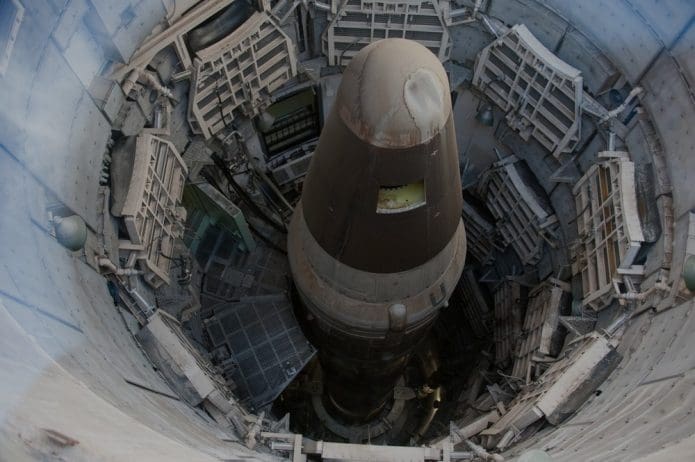
Yes. But the threat does not come from Iran, which does not have a nuclear weapon. It comes from the one existing nuclear weapons arsenal in the Middle East — which is in Israel.
Confirmed to the world by an Israeli whistleblower in 1986, Israel had long been known to have an advanced nuclear weapons program, with many nuclear bombs, at their research site in Dimona. The early testing, in the 1970s, had been in partnership with apartheid South Africa. (South Africa abandoned its own nuclear capacity in the context of the victory over apartheid in the early 1990s.)
Israel maintains a policy of “strategic ambiguity,” neither confirming nor denying its nuclear bombs, though both U.S. and Israeli officials have on a few occasions slipped and acknowledged it.
The Dimona arsenal is particularly dangerous because, since Israel has refused to sign the Non-Proliferation Treaty, it is not under any inspection regime by the UN’s nuclear watchdog or any other international observers. No one outside Israel knows how many bombs are there, what condition they’re in, or whether they’re capable of being used in war.
The very existence of that uninspected, usually unmentioned arsenal of nuclear weapons provides a constant threat to non-proliferation efforts in the region, and escalates the threat of a nuclear arms race across the Middle East.
Is it true that the Iranian government is repressing the country’s people?
Absolutely. The Iranian government has a long history of severely repressing political dissidents and ethnic and religious minorities. Recent years have seen nationwide uprisings in Iran — with particularly large and impactful ones in 2009 and the 2022 “Women, Life, Freedom” protests that began with the police murder of a Kurdish woman, Jina Amini, for “improper dress.”
The U.S. and Israel have consistently tried to take advantage of those protest movements, but there is little doubt that they are rooted in longstanding grievances among Iranians. The government has responded to these protests with severe repression, including mass detentions, torture, and executions.
This past December and January saw uprisings against the government in response to Iran’s dire economic situation, for which decades of devastating U.S. economic sanctions are largely responsible. That outrage is mixed with protesters’ wide-ranging grievances against the regime. The state responded by killing thousands of protesters.
Is Trump coming to the rescue of Iranians?
Absolutely not. The U.S. and Israel are raining bombs on Iranians and killing hundreds of civilians. As part of the opening wave of bombings, U.S. missiles struck a girls’ elementary school in Minab, killing at least 165 and wounding 100 — mostly children. Far from rescuing Iranians, the U.S. is murdering them en masse from the sky.
But U.S. policies were causing suffering for Iranians long before this war. Washington has imposed devastating economic sanctions on Iran since 1979.
These sanctions have disastrously undermined Iran’s healthcare system, including denying Iranians access to cancer drugs, treatments for people with blood diseases, heart disease medication, and medicines for people with rare illnesses — particularly children. Sanctions have also undermined vaccination programs and resulted in shortages of basic medical supplies like sutures. Most recently, sanctions have crashed Iran’s currency, sparking the uprisings in December and January.
Trump has also been deporting Iranians from the U.S. as part of his brutal crackdown on immigrants. Last September, Trump deported 55 people back to Iran in a deal his administration made with the Iranian government — the same government the president is now decrying — after detaining them for months and threatening to deport them to Somalia or Sudan. In December, Trump deported 55 more back to Iran. In January, Trump even deported a dozen people to Iran during the government’s crackdown on protesters.
Washington also joined Israel in its earlier air war against Iran in June 2025, which killed more than 1,000 Iranians — including children — and wounded more than 5,000.
How is Iran responding?
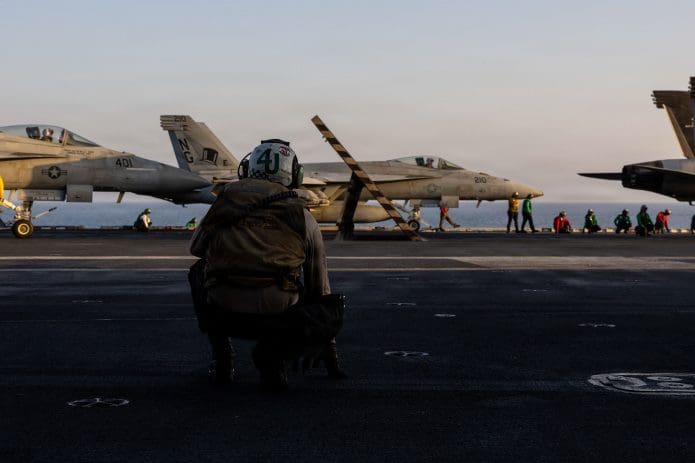
Iran is responding by using its diminishing arsenal of ballistic missiles and attack drones against Israel’s military capacity, as well as some civilian areas. At least 11 Israelis have been killed as of this writing, and hundreds wounded.
Iran is also targeting U.S. military bases in the Middle East where some of the planes, bombs, and pilots now bombing Iran have been based. It has many targets, since at least 13 U.S. bases, with 30,000 to 40,000 troops, surround Iran. Iran has targeted U.S. bases in Qatar, the United Arab Emirates, Jordan, Bahrain, and Kuwait. At least seven U.S. soldiers have been killed as of March 9 — six in a command center of a U.S. base in Kuwait, and one at a U.S. base in Saudi Arabia.
As a result, U.S.-allied Gulf states have joined the U.S. and Israel’s war footing — with Qatar, for example, shooting down Iranian aircraft with one of its own. Following a reported U.S. attack on a water desalination plant in southern Iran, Bahrain claimed an Iranian drone hit a similar plant there. If such attacks become routine, this becomes a water war, with desperate consequences for people across the region.
Iran has also hit some civilian areas and infrastructure in Saudi Arabia, Bahrain, Oman, Azerbaijan, and the UAE. NATO shot down an Iranian missile that appeared to be heading towards Turkiye’s airspace. And an Iranian drone hit a British military base in Cyprus.
Beyond Iran, what is the impact of this war on the Middle East?
Since the war in Iran began, Israel has continued its violence against Palestinians.
There is no ceasefire in Gaza, where the genocide continues with Israeli air and drone strikes and military raids killing Palestinians every day despite the claim of Trump’s ceasefire being in place. Israel has barred entry to and exit from Gaza, and virtually no humanitarian aid or even commercial food supplies have been allowed in.
In the West Bank, both the Israeli military and armed Israeli settlers have attacked Palestinians as well, with Israeli human rights organization Yesh Din reporting that settlers carried out at least 50 attacks across 37 Palestinian villages across the West Bank within the first four days of the Iran war.
Israel has also escalated its attacks on Lebanon, which Israel has been attacking almost daily despite a November 2024 ceasefire between Israel and the Lebanese group Hezbollah. In January 2026 alone — before the current war with Iran — Israel carried out at least 50 air strikes in Lebanon. It continued to carry out strikes through February, and has escalated its attacks since the current war with Iran began.
Hezbollah, an ally of Iran, responded on March 1 with rockets shot towards Israel. They did not reach their target, but on March 5 — echoing similar calls across Gaza during the genocide — Israel ordered all half-million or so residents of Beirut’s southern suburbs to evacuate, raising fears of an even greater Israeli assault and possible re-occupation of parts of Lebanon. By March 6 Israeli airstrikes had killed over 200 people in Lebanon. (As in Gaza, warning a civilian population to flee for their lives, especially when there is nowhere safe for them to go, nor any way to travel, does not make a deliberate attack on that civilian population legal.)
Other parts of the Middle East are also being impacted. Credible reports indicate that the CIA and Israel’s Mossad are arming and organizing Iranian Kurds who have been living in the Kurdish area of Iraq (which borders Iran) since being expelled from or fleeing repression in Iran.
Offering arms, support, and partnership to one or another Kurdish faction, promising to support them if they rise up against a rival regime — in this case Iran — is a longstanding U.S. tactic. Over and over again, Washington has embraced, endorsed, and armed Kurdish forces, only to abandon them when they are of no more value. It’s happened in Syria, Iraq, and will likely happen this time in Iran as well.
Could this conflict become World War Three?
More and more people are asking if this war has the potential to engulf countries outside of the Middle East, and the answer is yes.
In the first week alone, the war went from involving three countries — with the U.S. and Israel attacking Iran — to one that involved the bombing of seven more: Saudi Arabia, Bahrain, Oman, Azerbaijan, the UAE, Kuwait, Iraq, and Cyprus — and Turkiye shooting down an incoming missile. Jordan has not been bombed, but its airspace has Israeli and Iranian missiles flying through it. Israel is escalating its bombing and other violence against Palestine and Lebanon. The war has already engulfed nearly the entire Middle East and has spilled beyond.
When an Iranian missile was headed toward Turkiye, that activated NATO — a U.S.-centered military alliance of 32 states, which includes Turkiye — whose forces intercepted the missile. Those states are bound by treaty to join a war if one of their members is attacked.
Similarly, when a British base in Cyprus was hit, this raised the prospect of the involvement of the European Union, of which Cyprus is a member. A number of countries sent ships to Cyprus in response, including Greece, France, and the Netherlands, as well as Spain and the UK — both of which initially opposed the war.
There are very clear paths whereby European countries become more directly involved in the war. And given the dependency of Japan, China, South Korea, India, and other Asian countries on oil and natural gas that come from the Gulf, and the dependency of so many countries on shipping through the Strait of Hormuz, many states also may have a stake in this war if it continues.
How is the war impacting the global economy?

The war is already beginning to have huge impacts on the world economy. One-fifth of the world’s oil and liquefied natural gas is exported out of the Persian/Arabian Gulf, where Iran, Iraq, Kuwait, Qatar, the United Arab Emirates, and Saudi Arabia are all located. After just one week of the war, the global price of crude oil surged from $70 per barrel before the U.S. and Israel attacked to more than $100 per barrel. The last time oil prices were this high was 2022, when Russia invaded Ukraine.
Iran has threatened to attack ships or shut down the Strait of Hormuz. At least six cargo vessels have reportedly been attacked as they pass through the narrow waterway, resulting in the deaths of two sailors. Tanker and other cargo traffic through the strait has plummeted since the war began. Unable to export their oil, Iraq, Kuwait, the UAE, and Saudi Arabia have started to reduce the amount that they’re producing.
The jump in oil prices has affected the price of gasoline, with prices in the U.S. rising 17 percent since the war began. And as the price of fuel rises, that will drive up the cost to transport goods — including food and other basic needs — which will lead to companies charging higher prices. Components to make synthetic fertilizers for agriculture also pass through the Strait of Hormuz, compounding the impact for food prices.
Asia is especially vulnerable to the drop in fuel exports. Of the liquified natural gas that is shipped out of the Gulf, 83 percent of it goes to Asian countries. For Japan, 80 to 90 percent of the country’s oil comes from the Gulf, and that is true for 30 to 40 percent of the oil that China consumes as well.
How will this war end?
No one can know for sure. The Trump administration’s commitment to official regime change in Iran seems to come and go. But decapitation of the regime has already occurred, with the assassination of Ayatollah Ali Khamenei.
If the war is drawn out, one almost inevitable consequence would be the creation of a huge number of refugees, desperate to escape the violence of war. Those refugees will be seeking almost any way out of Iran, and the surrounding countries, particularly Turkiye in the first period, maybe Azerbaijan, Armenia next, are likely to face enormous refugee flows. (During Syria’s catastrophic civil war of 2012-15 over 4 million Syrians were forced to become refugees. Iran’s population is about four times that of Syria before its civil war.)
Finally, while Trump has laid out a vision of a post-regime change “new Iran” – pro-U.S., pro-Israel, and anti-Palestinian — with leadership handpicked by Trump like in Venezuela, that remains an illusion. Recently Iran’s Assembly of Experts, in a direct rebuff to Trump, announced their choice of Ayatollah Khamenei’s son Mojtaba Khamenei as the new Supreme Leader.
Far more likely than a handpicked regime would be a chaotic and violent failed state — a model more similar to Libya’s disintegration after the 2011 U.S.-NATO air attack, which led to arms caches all over the country being looted, fueling conflicts across Africa. That would be disastrous.
That’s one more reason why building a powerful anti-war movement to stop the current war immediately is so urgently needed.
What can we do?

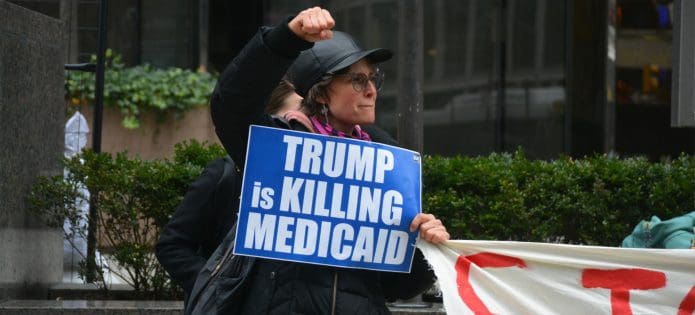
Our job is to build political power to demand an end to this illegal and dangerous war. That means pushing public opinion and pressure on policy-makers to raise the political price for supporting the war.
Even with a less visible anti-war movement than in 2003, Trump attacked Iran with only 18 percent of the population supporting war. While support increased modestly as the war began, this still appears to be the least popular U.S. war in modern history. Our challenge is to empower that big majority that already thinks the war is a terrible idea.
There will be more congressional pressure campaigns needed — to empower members of Congress to take their constitutional obligation seriously, to demand votes against new arms transfers to Israel, and to mobilize against the threat of this year’s $1 trillion budget rising to $1.5 trillion trillion next year.
Beyond pressing Congress directly, more mobilization will be needed. Already the call “no war” is being linked to the theme of the No Kings protest called for March 28. “No Kings, No War” must bring millions into the street. The heroic and historic protests against ICE — and the organizing of neighborhood-based solidarity teams to protect immigrants and other vulnerable people — all will gain strength by linking the militarization of ICE and other law enforcement agencies at home with the militarism of wars abroad.
We need a clear strategy linking the movement against fascism and authoritarianism with the movement against war and genocide. Failure is not an option.
Subscribe to our newsletter
Further reading

What Did the U.S. Attack on Venezuela Cost?
Tax Day 2026: The Average Taxpayer Paid $4,049 for War and Weapons