

VIDEO: Who Counts as a Human Being?


Below is a lightly edited transcript of the opening remarks at our third annual Wallace Symposium, called “Forging a Democracy That Works for All.” Watch and read more from the symposium here.
Tope Folarin: Hello everyone. My name is Tope Folarin, and I am the executive director of the Institute for Policy Studies. I would like to welcome all of you to the third annual Wallace Symposium. I also want to thank our outstanding longtime collaborators and co-sponsors: the Wallace Global Fund, The Nation, and We Build Progress. A special word of thanks, in particular, to the Wallace Global Fund, which will be closing its doors this year. They have been an extraordinary partner, and we are so grateful to them for making all of this possible. Thank you.
Two and a half weeks ago, this country turned 250 years old. There were fireworks over the National Mall, not far from here. There were speeches and songs and proclamations. At the same time, in cities across this country, armored vehicles roamed on residential streets, families kept their children home, and many of our neighbors wondered whether it was safe to go to work.
One birthday, experienced in two profoundly different ways, because 250 years into this experiment in democracy, we are still contending with the same questions that have hounded us since the beginning. Though much has changed since enslaved Africans were brought to these shores and forced to create wealth they could never claim, and since those early, unsettled days of the Revolutionary War, too much has, unfortunately, remained the same.
I have long believed that every single domestic policy battle we have can be reduced to one question: who gets to be an American?
In my view, our foreign policy, too, can be reduced to one question: who gets to be a human being?
I believe it is helpful to think about policy and politics in these terms, because it makes the stakes clear. Every policy conversation about SNAP or Medicaid, about tax increases and tax deductions, about war abroad and peace at home is actually about who deserves the benefits and privileges of living in this country and who does not. Who deserves to be protected, and who must die to preserve the lives of others.
Henry Wallace understood this. In May of 1942, just months after Pearl Harbor, Vice President Wallace stood before the Free World Association in the grand ballroom of the Commodore Hotel in New York, and addressed representatives of 33 nations. The year before, Life magazine publisher Henry Luce had famously called on the United States to make the twentieth century an “American Century” — to assume global leadership and shape the emerging world through American power and American ideals.
That night, Wallace offered a different answer. “Some have spoken of the ‘American Century,'” he said. “I say that the century on which we are entering — the century which will come out of this war — can be and must be the century of the common man.” And then, in the middle of a war against a regime built on racial supremacy, he said something remarkable, something that still startles when you read it today: “There can be no privileged peoples. We ourselves in the United States are no more a master race than the Nazis.”
Wallace refused to let a privileged few decide who counted as American—or whose humanity the powerful could recognize or deny. The common man he championed was not the common American — he was the common human being, in India and China and Africa as much as in Iowa. Wallace believed that a country is at its best when it affirms the full belonging of every American and the full humanity of every person.
Inspired by his words, we will spend this afternoon offering our vision of the kind of country and world we must build to protect and advance the interests of the common human being.
In just a moment, my colleague Sarah Anderson will tell you more about the new report we are releasing this afternoon, called Forging a Democracy That Works for All. In it, my colleagues and I lay out a concrete agenda for countering the three great concentrations of power that stand between us and the world we deserve: the power of billionaires, the power of corporations, and the power of the Pentagon.
After that, we will hear from the Wallace family, who have carried this legacy forward with such generosity, and from John Nichols on how Wallace speaks to our moment. We will also hear from organizers who are doing the work Wallace called for — defeating fascism and deepening democracy — in Indiana, in this city, and across the country, and from leaders across the labor and economic justice movements about how we can work together to advance a For All agenda. My colleague Bella DeVaan will spotlight our new Gilded Giving report on billionaire philanthropy, and this evening I will sit with Congressman Jamie Raskin and Sulma Arias of People’s Action to talk about the road ahead.
Before we go any further, I want to recognize the people in this room who give me the most confidence and hope about that road, our Wallace Fellows — they are a group of college students and graduates who have spent the past few weeks with us, funded by the generosity of the Wallace Global Fund. They have spent that time doing exactly what Wallace asked of his generation, refusing to accept that a privileged few should decide who counts. Fellows, would you please stand so we can recognize and thank you? Thanks so much.
And then tomorrow — and in the days, weeks, months and years to come—the road ahead will gain new travelers. In courthouses and civic halls and recreation centers across the country, many immigrants will rise, raise their right hands, and recite the Oath of Allegiance. In that moment, they will become American citizens, and then they will say the Pledge of Allegiance for the first time as Americans.
That is one of the great promises of this country: that a person can arrive from another part of the world and, through citizenship, take up the work of making this country their own. One of the proudest moments of my life was when my father asked me to help him prepare for his own citizenship exam. I was in second grade, and I could not have been happier. I taught him what I knew. I had memorized the Pledge of Allegiance, and I had just learned the Preamble to the U.S. Constitution.
Even now, as I speak with you today, I can still hear him repeating the opening words after me: “We the People of the United States, in Order to form a more perfect Union…”
Every generation inherits the work of forming a more perfect union. Today, that work is ours.
And now it’s my great pleasure to turn things over to Sarah Anderson, who will walk us through the agenda we are offering the country today. After Sarah, we’ll hear from Scott Wallace and Scott Fitzmorris, both from the Wallace Global Fund, and then from John Nichols, the executive editor of The Nation magazine. Thank you so much.
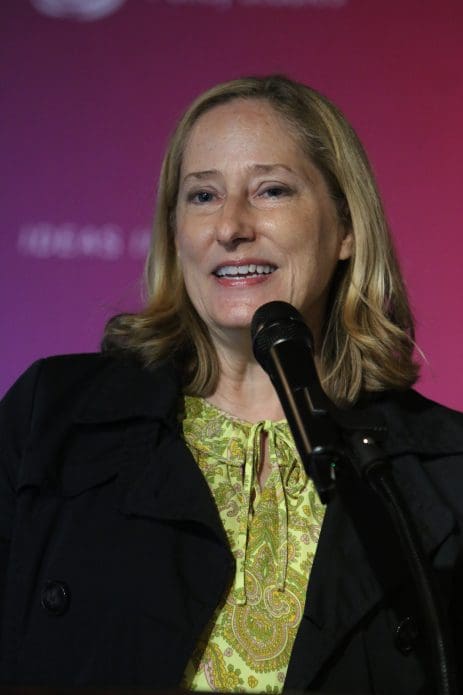
Sarah Anderson: Thank you, Tope.
We think we’ve got it bad these days, but when you think about what Henry Wallace’s generation went through — a Great Depression and a World War — you realize we’re not the first ones to face multiple crises. And in the face of all that, Wallace did not wax nostalgic about the “good old days.” He rattled the establishment by pushing a new course for the U.S. and the world that rejected racism, plutocracy, and militarism.
And so in that spirit, we sat down at IPS to develop this vision document.
Like Wallace, we’re internationalists. We’re working to build a world in which every human being can thrive, with universal rights to all the basics for a dignified life on a healthy and peaceful planet.
We see the main impediments to this vision as the excessive power of billionaires, unaccountable corporations, and the Pentagon. Together these three forces undermine democracy at home and around the world. And it will take powerful social movements — not just principled political leaders — to confront them.

And so, IPS uses our research, policy, and communications capacity to link with and build the movements that are taking on these three forces.
We list in this document many of our priorities. I’ll just flag a few where we’re kinda zealots, frankly.
On billionaire power, one problem we’ve gone deep on is private jets. My colleague Chuck Collins was even brave enough to criticize Taylor Swift for the 81 private jet trips she took as she was preparing for her wedding. It takes courage to stand up to the Swifties!
But we’ve calculated that private jets emit 10-20 times more pollutants per passenger than commercial planes. At a minimum, we should tax these carbon hogs for the 1 percent and end all fossil fuel subsidies to fund a just transition.
On corporations, some of us have a deep passion for going after the ones that are extracting wealth from their workers and their communities to pump up their CEOs’ paychecks. We’ll be coming out soon with our annual Executive Excess report, which has provided fodder for worker organizing and policy battles for several decades.
I’ll give you a sneak preview: the low-wage company with the largest pay gap is a firm that makes technologies for AI data centers. The CEO made 2,884 times as much as his median worker last year.
On this issue, the FDR administration was actually for a maximum wage. We believe we can make big steps in that direction by using taxes and government contracting to penalize companies that have huge pay gaps and violate labor and environmental standards.
On Pentagon power, well, we’re pretty blunt about it: We think we should cut the military budget by half. Since our founding in 1963, IPS has been a leading voice for a foreign policy centered on international law, human rights, and justice over militarism.
And the wins on this front don’t come easily so I want to give a shout out to my foreign policy colleagues for two recent measures of progress: the Senate vote to block the National Defense Authorization Act and more than 100 House Democrats voting against more military aid for the Netanyahu government.
How about a hand for them and all the peace activists in the room?
Taking positions like those in our vision document doesn’t always make you popular. And I’m not just talking about the Swifties.
But we’re fine with the pushback, because we take a long view of history. We know that when Marcus Raskin and Dick Barnet created IPS in 1963, they were standing on big shoulders. Like the New Dealers before them, they countered the oppressive forces of their day with inspiring alternatives and strong backbones to defend our political and economic democracy.
We hope you’ll find inspiration today from the discussions to come.


