

VIDEO: 3rd Annual Wallace Symposium Keynote Conversation


Below is a lightly edited transcript of the keynote remarks at our third annual Wallace Symposium, called “Forging a Democracy That Works for All.” Watch and read more from the symposium here.
Tope Folarin: I’m so excited about this conversation! I’ve been looking forward to it for quite some time. As John said, the Congressman will be here shortly, but I thought we’d start before he got here, so we can sort of surprise him with where we’ve gone.
I will introduce Sulma very quickly, and then we’ll jump into the conversation. Sulma Arias brings over 20 years of organizing experience to her role as the executive director of People’s Action and the People’s Action Institute. Sulma’s organizing work spans many issues, including immigrant rights, voting rights, and economic justice, and her practice has always centered directly-impacted people and their efforts to build power. I should also note that she serves on the board of the Institute for Policy Studies, so she is one of my bosses, and I will now be on my best behavior.
Sulma, I wanted to start by talking a little bit about your trajectory. You talk about this a fair bit, and that’s your own story and how you came to know organizing. You immigrated to Kansas from El Salvador as a child, and you entered organizing through Wichita’s immigrant communities. First, helping to translate, and eventually leading, campaigns for driver’s licenses, tuition access, and immigrant rights. You have said this, and I’ve been on panels with you before, and I’m always struck when you say that someone saw potential in you before you necessarily saw it in yourself, which is really compelling, and it’s part of the work that we’re trying to do at IPS. And it’s something I have benefited from in my own life as well in all kinds of ways. But I wanted to ask you now: what did those early experiences teach you about the difference between speaking for a community and helping people recognize their own power?

Sulma Arias: Wow! Starting with a deep question. It’s so good to be here. Every time I enter these spaces—by the way, congratulations, IPS team and fellows, Tope. What an incredible group of people. I love this conversation. I was reflecting this morning as I was meeting with an incredible woman leader that I had breakfast with. The fact that I can wake up every morning after—by the way, you were saying 20 years. I need to update that as it’s been like almost 30 years now—almost 30 years, I can wake up and I’m very clear about the role of organizing and my role as an organizer.
No matter what role, right now I’m the executive director of People’s Action, I choose to lead in that space and with that organization because an organizing revival to me is all about getting to the basics. And that is the thing that is transformational, even in this very dark moment, if we believe in that human power, human connection is the thing that drives the world, democracies, governments. I wake up excited about that, and as an organizer, I am very clear that’s my job.
Even as I sit here on the stage with the amazing Tope, and with others, I wake up every day thinking about and being curious about people and what people are. The curiosity to me is still exciting, and I have days of loaded Zoom calls and hard conversations, challenges, and I still think there is a power in human beings such that the next day I’m going to wake up and I want to know what you’re thinking, and I want to know why you think that way.
That’s what somebody saw in me—and I didn’t agree with the organizer—when, in 1991, I had just had a child, and I was deep into the evangelical church. I had come to the United States, and I was in Wichita, Kansas, taking part in the Summer of Mercy in the pro-life movement. And I still see organizing as the ability to connect to each other and where they come from—and the reason why I say I had no power to change the conditions around me was because my framing was around, oh, when we get to when you get to heaven, all this suffering is going to end.
Organizing and liberation theology, once I discovered them, taught me that actually people have more than than to just wait until the afterlife to have a life that’s fair, to be able to have a driver’s license, to be able to afford basic health care, and to be able to actually have a say in how we shape democracy in this country. And that is the life that I am committed to now because I think it works. I’m a testament to that.
Tope Folarin: It’s always compelling to hear you talk about that, and thank you for explaining your trajectory a little bit now. I wanted to talk a little bit more about the organizing work that you do. You have argued that progressives need to move beyond the familiar left-right paradigm and begin with honest conversations about what matters in people’s lives, and that’s a throughline in the conversations we’ve had today—about the importance of going beyond typical ideological perspectives. People’s Action conducted deep canvassing conversations with more than half a million voters before the 2024 election, and if I’m not mistaken, your research found that these conversations could shift attitudes, even when they did not immediately determine an election. What actually happens in a successful conversation with someone who may distrust progressive politics or distrust politics altogether?
Sulma Arias: I still organize in Kansas, the middle of the country, right? I mean, you grew up in a red state. There’s a place in Kansas, in Wichita, called Mort’s. It’s a place where everybody, no matter what job you did that day, everybody goes to that bar, and it’s the only place that I’ve encountered across the country that you share tables. So you could come to Morts, and it’s a cigar bar, but you can sit anywhere. You will end up sitting with—if you’re an organizer and you’re organizing in Kansas, and you just did an action on the contractor who wasn’t paying their workers—you may end up sitting with them at Mort’s. So there is a tension and also a beautiful opportunity to engage in conversations afterwards with people that you don’t necessarily agree with on everything.
And what I tell organizers in this moment is that our job, especially right now, is that we don’t have to agree on everything. Maybe we don’t agree on ten things, but can I move you on five things? Can we move on six things? And we can create change that way. We can bring tons of people, and that’s the opportunity that we have now.
And I’ve seen it. I’ve seen it in 30 years of organizing in red states, but also all over the country. And in 2016, I was at Community Change then, and I remember having the conversation about how this is a template. We organized tons of people around the fact that in 2012, when we were trying to prevent the election of Kris Kobach—Kris Kobach was the secretary of state and now attorney general—we were able to connect the dots between the fact that almost 250,000 people had been taken off the voter rolls. And it was done by villainizing immigrants. But guess who those 250,000 people were? Mostly women, mostly white women, rural Kansans. And you have the opportunity to connect people where you’re not a single issue voter. You actually believe in responsibility, and you talk about the things that people are actually talking to you about. Someone said when you listen, you as an organizer turn that listening and what you heard into opportunities that can connect back to people where you can organize them. And that’s what works in Kansas and works everywhere.
Tope Folarin: Absolutely. I hear the Congressman’s here, so please join us on stage, Congressman Jamie Raskin. I don’t want to. Should I throw a question at you right now or do you need a moment? I’ll have a lot of buildup, to give you an opportunity to hang out a little bit.
I had a very interesting thing happen to me a few days ago. One of my mentors, he’s a guy named James Hudson. He emailed me and said, “Tope, I need to have lunch with you before the symposium.” And I said, “Okay.” So we had lunch a couple days ago, and James is wonderful, he’s an icon here in D.C. and has done a lot of work in the business and law communities. And he was formerly chair of the Morehouse College Board. So somebody who’s been personally helpful to me. And he said, “I want to talk to you about Marc Raskin and how helpful he was to me when I was growing up.” And he talked about how IPS funded a number of civil rights luminaries, sometimes sort of secretly, other times more openly, and gave them space at IPS to think and strategize.
And he also talked about the fact that Marc moved his family to Adams Morgan at a time when the neighborhood was predominantly Black, perhaps all Black. And he said—this was the funniest part of the conversation—he said, “When the Raskins moved in, we said, ‘What the hell are they doing here? Why are they here?’” And they weren’t quite sure what was going to happen. But then, you guys showed this incredible commitment to being part of that community and helping people out. So I just wanted to ask you about that experience of growing up in that community and how that may have shaped you. I hope the story’s right. You’re giving me interesting looks. Like perhaps it’s not right. If it’s not, I’ll retract the question. But in general, talk about how Marc shaped your understanding of the world and how to interact with people that are perhaps different in superficial ways, but obviously the same, because they’re fellow human beings.

Rep. Jamie Raskin: Well, thank you for having me, Tope, and I’m delighted to be here with everybody. Thank you for telling me that sweet story about my dad. He was really good to me too. So you can tell that to Jim Hudson. I’ve got so many things to say about my dad, and I wasn’t really prepared to go into so many of them, but my dad was interesting because he was somebody who really made no distinctions among anybody—global, local, left, right, center, as you’re saying, and I think he imbibed that spirit of Dr. King, that all life is interrelated, that all humanity is involved, but a single process. So he didn’t have doctrinaire ideas that he imposed on human beings or human relationships, and so—do you really want me to start talking about my dad? I’ve got some stories as people know, but I would leave it at that level of generality.
If our topic is still democracy, I’ll say this: that I think that that my dad was a great champion of democracy as not as necessarily just a system of rules and laws, but democracy as a project, a project of progressive empowerment and inclusion of everybody in the human circle, and a recognition and identification of everybody’s needs, values, and beliefs as being part of the conversation.
I will say that my dad’s approach to democracy, I’ll speak for myself, my approach to democracy would be very different from my dad’s, in that I would actually vote and participate in electoral mobilizations and all those kinds of things. And I think that my dad was supportive of that, but he was not really caught up in the electoral process, although he had lots of things to say about it and was of great value and utility to people in it. And I would say it’s probably the same thing with the legislative and parliamentary process, that he had a lot of very valuable insights and contributions to make. But I think he worked on Capitol Hill for a year or two years before then he went to the the Kennedy Administration and he lasted there for about a year or maybe a year and a half before he founded the Institute for Policy Studies and found his real home, which is in a place of action and big ideas about concretizing the values of democracy for everybody.
Tope Folarin: Thank you so much for that. Absolutely. We honor Marc all the time as a co-founder of IPS, and obviously he was incredibly helpful to many of us, and you are as well. And we’re so delighted to have you here, Congressman. But to go back to democracy and be more explicit about it: Sulma, I think we’re all concerned about the future of democracy and this crisis moment that we’re in, and this crisis is often described through elections and courts and national institutions, but your work begins with people in their communities, right? With their fears, their frustrations, their relationships, and their capacity to act together. What are organizers learning on the ground about this moment? What’s their perception of the moment that we’re in right now, and how has this crisis changed the way you think about whom to reach, what kind of power to build, and how urgently movements must act?
Sulma Arias: Yeah, another loaded question. John talked about the Organizing Revival, and organizing, I learned early on, is all about understanding the landscape. Doing a power analysis is part of that. One of the disciplines of organizing is understanding power and always doing a power analysis. You can have all that you want to do in terms of your ideology, but you but it’s almost like a math equation. I’m not the greatest mathematician. But there is a thing about: do I have enough power to win what I need to do, and can I bring people along? It’s always going to be about that.
In 2022, when I took over this role, we had just come out of the 2020 election. We had also just come out of COVID, and there was a sense that we were asking that question. So we just gave it our all to do a big push, and you could sense—I was talking to our directors, 41 affiliates in 30 states, and they were saying—we need to get back to some of the basics. And what that means for us is we need to connect back to people. We need to make sure that we’re going deep, and that we have a base, that we grow our base, and that we build power.
Because when you’re in constant mobilization mode, and I can tell you more about the difference between mobilization and organizing, but there are two things that are true at the same time. I think one of you said you can walk and chew gum at the same time. It’s because we’re dealing with a moment where we both need to go very big, we need to build for scale, and we need to connect across differences. We need popular demands, even if there’s only five things that we can agree on, we need mass movement right now.
But we also need organizing for long-term sustainability. And the work of convincing people, going deep, building leaders, that takes time. Somebody was also discussing that incredible report on where we are with organizing and the lack of any real funding for the long-term, slow conversations that happen at places like Mort’s in Wichita, Kansas.
There’s the slow and the fast, and the challenge that we have right now as organizers is that in a moment when we have to go deep, we also have to go wide and big. And so that means that institutionally, we need to aggregate our power. Because what we have seen in our collective power analysis—this is where the Organizing Revival comes in. In ‘22 we published a report on the state of organizing, and it was called The Antidote to Authoritarianism. It’s a call for an organizing revival. What we’re saying is that at the same time that we need popular demands and we need to go big and organize everybody, we also need to sustain and maintain the deepening, what’s going to sustain the organizing that we know can transform people like me.
Okay, in ’91, I was standing at the frontlines of the pro-life movement. Almost 30 years later, I’m here, fighting for a real multiracial democracy. That takes time. We’re in a moment where we need both. We need to aggregate our resources, we need to aggregate our power. And that’s exactly what’s been happening for organizations that believe in base building and membership organizing. We’ve been aggregating our efforts so that we can create—just like the other side is doing, right?—we need to bring our efforts together so that whatever institutions we run, our efforts are able to do more. We have to move quickly because the other side is moving very fast and things are changing super fast. So while we move quickly, we also need to go slow. How do you go quick and slow at the same time? You need organizers who are focused on people.
Tope Folarin: Absolutely, thank you so much for that. Congressman Raskin, I want to ask you that same question from a different perspective. You’ve spent your career working through constitutional law. We’ve all heard you speak so eloquently about the Constitution and about our institutions as well. At a moment when many of those institutions are themselves under strain because of the moment that we’re in, how has this crisis changed your understanding of what they can still accomplish, and where must organized citizens and movements carry the work when formal institutions prove unable or unwilling to defend democracy?
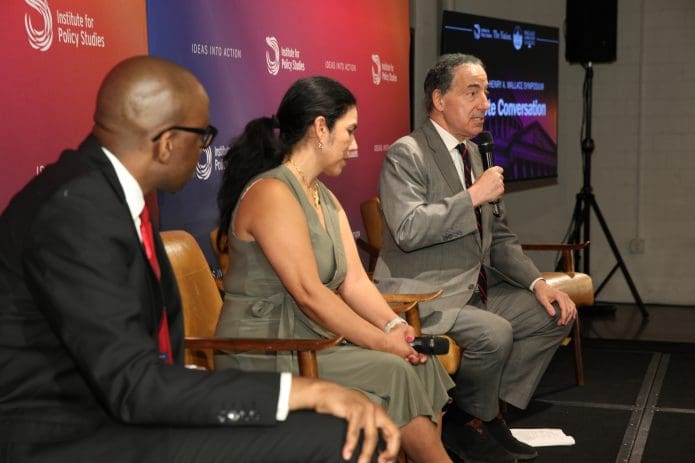
Rep. Jamie Raskin: Like democracy itself, the Constitution is not self-executing, as we can see. I mean, if the president takes a $400 million jet from Qatar and it violates the Foreign Emoluments Clause, nothing happens unless we’re able to activate a constitutional mechanism or a popular movement to push a constitutional mechanism to make something happen. And it’s true with illegal wars, unconstitutional wars, undeclared and unauthorized wars. It’s true with the president imposing the largest tax in American history, usurping the spending power of Congress.
What we need is a reinvigoration through mass political organizing, not fanatical extremist sectarianism, but rather popular political organizing to bring people together at the level of school boards, state legislatures, the House of Representatives, the U.S. Senate, Supreme Court courts across the land. We’ve got to be organizing to make these things real.
At the same time, you know, democracy is always an unfinished project, which is something you know I learned from my dad. So it’s not that the Constitution we have is perfect or was ever perfect. We need to be moving things forward, right? It’s 2026. It’s time for us to start electing the president of the United States the way we elect senators and representatives and mayors and councilmembers and governors. Whoever gets the most votes wins. And the electoral college is an accident waiting to happen every four years, and we need to keep moving democracy forward.
You know, John Dewey said that the only solution to the ills of democracy is more democracy. And what we’re suffering from today is not democracy. It’s all the impediments and the blockades of democracy that are out there. One of the things I agree with Donald Trump about is statehood—but not for Canada, and not for Greenland, and not for Panama—for Washington D.C., the the only national capital on planet Earth that’s not represented in its own legislature. And for three and a half million American citizens in Puerto Rico who don’t even have the right to vote for president. So let’s start in our first 100 days of the new Congress making Washington and Puerto Rico states, which will be a great thing for the people of those much trampled jurisdictions, but also a great thing for America itself. So that’s why I’m saying that in response to your question, Tope, we’ve got to defend all of the institutions that are under attack, but we also have to be on offense in terms of expanding democracy and freedom in America.
Tope Folarin: Thank you so much for that, and we’ll be moving to questions shortly.
Rep. Jamie Raskin: I would love to have some recognized questions.
Tope Folarin: So think of some questions to ask. Sulma, I’ll turn to you. Your recent writing, which I’ve really enjoyed reading and learned a great deal from, argues that movements must move from scattered resistance towards disciplined, mass non-cooperation. Talk a little bit about the Organizing Revival. It’s brought hundreds of organizations together, and trained more than a thousand organizers. One of its coordinated campaigns has targeted companies that profit from the machinery of mass deportation. What separates a protest that expresses justified outrage from a campaign that actually accumulates power?
Sulma Arias: I think one of the things we figured out in the Organizing Revival space and the conversations that we’re having is something that Gail Cincotta, one of the co-founders of People’s Action, used to say: “We found the enemy, and it’s not each other.” And we realize that it’s pretty much the same thing. In the Organizing Revival space and the networks that are part of, we figured out that not only do we have to consolidate our capacities, we also have to think strategically about the win and how you build disciplined campaigns.
With the closing of the hospitals, we just had a call with our affiliate directors where we’re thinking about what is the political strategy that we can take on based on our power analysis and our capacity. One thing to understand when we’re building a campaign, a disciplined campaign, is the fact that the closing of rural hospitals that is happening in Colorado is not disconnected from the building of detention facilities. And one of the issues and problems that we’ve had as a movement, as organizations, and as organizers, is that we silo everything and we desegregate our power instead of connecting all these things. Because all of these things are connected, and they all connect to who’s extracting people, letting workers starve, and letting people die because they don’t have insurance—the ones who are benefiting are the same.
Tope Folarin: Thank you for that. Congressman. I wanted to go back and ask you a little bit about institutions once again. A lot of us here are disappointed in the way that Congress has conducted itself during this moment. And I wanted to ask, as somebody who’s an expert on a lot of these issues, if you have a sense of where Congress has surrendered its most consequential power, whether that’s to declare war, or control spending, or protect the civil service, or conduct oversight, or something else that I’m not listing, and which power should it reclaim first in the future?
Rep. Jamie Raskin: All of the above. The first thing we need to do is to get the conceptual categories right. Most of the population is walking around with the idea that the president of the United States is at the top of the pyramid, and maybe Congress should do a stronger job of oversight of the president’s agenda. The whole thing is so upside down. We had a revolution against a king here, right? And we can be proud of the fact that we overthrew a king and a monarchy, and the union of church and state. We overthrew that, and we launched an experiment in democratic self-government, and we should be proud of the fact that happened.
Even though there’s all kinds of profound flaws and sins that were part of that process, if you look at the the Constitution, you know the the preamble of the Constitution itself is a refutation of the Trump Administration: “We the people of the United States, in order to form a more perfect union, establish justice, ensure domestic tranquility, provide for the common defense, promote the general welfare, and secure to ourselves and our posterity the blessings of liberty, do hereby ordain and establish the Constitution of the United States.”
In the very next sentence is the first sentence of Article One, which says all legislative power is vested in a Congress of the United States, and then you get page after page of all the powers of Congress that are set forth: the power to regulate commerce domestically, internationally, the power to declare war, the power to raise taxes, the power to spend money. So everything Trump has been doing has been in absolute defiance of that proper sequence of things. And you get to Article One, Section Eight, Clause Eighteen, and all other powers necessary and proper to the execution of the foregoing powers.
And then you get to Article Two, which is like this big, and the critical sentence in it is that “a president shall be removed from office upon impeachment for and conviction of treason, bribery, and other high crimes and misdemeanors.” And sometimes my colleagues, including a lot of my beloved progressive friends, will get up and they’ll say, “You know, mr. President, we’re three co-equal branches,” and I just want to scream. I’m like, first of all, co-equal is not even a word. Okay, that’s like extremely unique. That doesn’t exist. So the proposition is we’re three equal branches of government. I don’t think so because why do we have the power to impeach, try, convict, remove, and disqualify for life the president, and he doesn’t have the power to impeach, try, convict, and remove us?
What’s the job of the president? If you read the Constitution, you know some people say, “Well, commander in chief.” Yeah, of the army and navy in times of actual conflict, and and the militias if they’re called up for service, not of the government or of the country—of the army and the navy. But in any event, what’s the job of the president? “To take care that the laws are faithfully executed.” To execute the laws of Congress, not to thwart them, not to divert them, and this has been a problem not just with Republican presidents or Donald Trump, but with some Democratic presidents too. If we want to revive and reinvigorate democracy in America, we’ve got to restore the role of Congress as the preeminent branch of government, as James Madison put it.
Tope Folarin: Here, here. Here, here. I believe we have some questions from our Wallace Fellows now, so I’ll throw it to you.
Emma Buretta: Thank you so much for all of your comments. We really appreciated them. I’m Emma Buretta. I’m a Wallace Fellow with the Climate Policy Program and the Communications Team.
Layla Sayed: Hello, thank you all. My name is Layla Sayed. I’m a Wallace Fellow with the Criminalization of Race and Poverty team. So our current political climate right now, and the challenges all of us in this room are facing, are really forcing us all to look inward, oftentimes out of fear, even though there’s like a desire for the opposite. As young people who are part of progressive movements, we want to shift that and pull people in.
Emma Buretta: So we’re curious what your advice is on building intergenerational power for youth like us.
Sulma Arias: I will go first. I don’t think we’re doing the best that we can. Matter of fact, I was just in a conversation with a young man who’s starting—it’s incredible, his energy just comes through the email—and we’re getting ready to talk to him about this moment and how we can counter Turning Point USA. And what’s happening there is urgently needed, more than ever, and we need to do better.
But I think the way that we counter that—I have three beautiful, amazing daughters. The oldest is an attorney, and the youngest is 27. Between my husband and I, it’s five millennials and Gen Zs, and everything they care about is exactly what we’re fighting for. The biggest issue they care about is affordability. Like they can barely afford to leave the house. Lucky for us, they’re not with us. But they are struggling, and they call us every week to make ends meet. So in organizing, and the way that I approach this, it’s all about listening. What do they care about, and how can we connect the dots with exactly the systemic change that we’re trying to fix.
And for them—and if we’re paying attention, and I hope that if you’re an organizer in the room that we are—is the fact that it is about affordability. In organizing, the main question is where does it hurt? And for every millennial and young person that I know, there’s that fear that when you graduate from college, it’s hard to find a job, and it’s really hard to find a good-paying job. Therefore it’s hard to either move out of the house or even achieve the fact that you’re ever going to own a home, that you’re ever going to be able to pay your student loan debt, and that’s got to change. And there is opportunity to organize around that.
Rep. Jamie Raskin: So it’s wonderful to meet you guys, and thank you for being part of the Wallace Program, and thank you to Scott Wallace and the Wallace family for making that available. That demonstrates an investment in the young people in the future, which I think is a responsibility that we’ve all got. I started a program called Democracy Summer. We have nearly 2,000 young people across the country this summer involved in seminars online. Coming up we’ve got Heather Cox Richardson, Betty Thompson, and Tim Snyder who are talking. And then they spend the rest of the weeks out organizing. They’re registering voters. They’re campaigning for Democrats across the country.
But the point you make is a profound one, the one you started with, about people looking inward and people looking outward. And there is a mental health crisis among young people in America right now that we need to be paying much closer attention to at the governmental level, but also at the political level. My son Tommy, who we lost six years ago, I think felt a lot of those things during COVID-19. But he was somebody who was incredibly empathic and engaged, and as a law student, felt very intensely the climate crisis, the rise of authoritarianism, anti-semitism, racism, fascism around the world, and that, in addition to all the problems of affordability and artificial intelligence create a terrible convergence of pressures and stresses on young people.
So we got to make that a central part of what we’re doing. And I guess what I say to the kids in Democracy Summer is that we’ve got to get out of the way so you guys can begin to take leadership, but we still have a lot to teach you, and we still have a lot to learn from you as you come in. And it is going to be, as you say, that intergenerational dynamic that creates effective progressive politics in an extremely complex and challenging time, where a lot of people just freak out and think that participation in politics is going and yelling at somebody and disrupting an event. That is not effective politics in America in the 21st century, nor effective organizing. So we agree on that. But I’ll just tell you one more thing, Well, Sulma, I’ll just turn it back over since I’ve spoken. I’ve got a lot to say about that subject, but please check out Democracy Summer.
Tope Folarin: Thank you for those excellent questions. I believe we have some questions in the audience.
Audience Member: I’m a federal worker, and I’m working with other federal workers to try to organize. But one of the things I think a lot about is how we can have some of the most perfect policies pass through Congress, and then they hit a wall of lead paint that is decades and decades of laws that have complicated the implementation of those policies in the Executive Branch. I joke that my nemesis is the Paperwork Reduction Act, which makes it so very difficult to—It takes four to six months to get any sort of survey out to the public in order to try and make government more democratic and get the opinions of the American people on how to implement a policy. So I’m I’m curious what you think about the idea of thinking through the history of our laws and really stripping back the ones that aren’t working anymore for our modern democracy, our digital age, etc.?, To make sure that if we get the chance to have good policy passed or structural reform passed in the next couple of years, those things can be implemented quickly, so that the results can be shown quickly without hitting these walls of the past like lead paint.
Rep. Jamie Raskin: Will you just explain that lead paint thing?
Audience Member: Laws from the 70s, from the 80s, from the 90s that create poor incentive structures and everything in the federal government.
Rep. Jamie Raskin: Oh I see, the legislative sediment that just builds up eventually. Let me just say one quick thing, which is that this might be the silver lining of this period of right wing authoritarianism and efforts like DOGE to completely destroy the law, the civil service, and public employees, which is: we’ve got an opportunity to rebuild it all.
We need a third Reconstruction in America after the first and after the second. And the second one was stronger and more enduring than the first, but it’s been dismantled as we’ve seen with the Voting Rights Act in the Callais decision in Shelby County v. Holder. We need a third reconstruction that is going to be thoroughgoing, that will move as quickly as possible, deliver results to people, and put America on a steady democratic freedom course for the entire population. That’s the challenge.
We need people to be going into government and people who understand particular agencies and bureaus to be there to make this process happen. Bureaucracy can be a huge impediment and an enemy, and we have to figure out a way to turn the government towards the purposes of empowering the people. At the same time, we have to not disenchant and alienate everybody about government in a democratic society. The government’s us. It’s us. The right wing loves just tearing down the government and saying it’s all hopeless. Then they take over what’s left of it for their own purposes, whether it’s a billion-dollar ballroom or a 1.5 trillion-dollar military budget.
Sulma Arias: Yeah, I agree. And democracy is about the engagement of people every day. And I think maybe the silver lining and a lesson for all of us is that the policies that we enjoy right now, we could lose them at any time. And we gotta say that. And I don’t know if Pranita Gupta or Mary Beth Maxwell are in the room, but that’s exactly what we’re talking about there. Policy, people need to own and understand and fight for it, and then we need to continue to build. Because organizations like the one I represent here and the one that I lead right now were started right after the civil rights movement in order to protect and expand what had been won, and here we are about to lose them all. So what have we been doing that we haven’t built on or protected them? It is a moment, as I was saying, to really think about how we continue to engage people, because it’s not just “Oh we want this policy,” and it’s done. I understand that the process of implementation is hard, but it’s also about the constant mobilizing and organizing of people that care about the issue.
Layla Sayed: Okay, so we’re going to take two questions at a time. I think there’s one question over here.
Audience Member: My question is for everyone here. Trump has already told us he is hell bent on stealing the midterms, which would defeat our efforts. There are things we can do before and during the elections to block him. I could suggest some of those things that can be done, but I like to keep my questions short. So, would you all be willing to urge your state, federal, state, and local representatives to talk about this threat nonstop, and to start implementation of these measures, right away, that can block Trump’s plans right now?
Rep. Jamie Raskin: Yes.
Audience Member: Well, you ask your colleagues to do that as well.
Rep. Jamie Raskin: Yes.
Audience Member: Thank you.
Sulma Arias: And let me just say that on the organizing side, back to the questions, on the voting rights that we enjoy and that a lot of people don’t take advantage of. As organizers, we are finding out that as we lose them, there are plans happening right now to organize in every state to actually have an economic strategy around what’s happening, and so there is a lot more organizing happening there than there has ever been because we understand what’s at stake.
Rep. Jamie Raskin: Yeah, and then let me just add to this. For those people who are lawyers or election experts who want to get involved at the level of defending elections in the states against attack, and it’s not going to happen, it’s been happening for the last two years—as they try to close polling places, they try to throw people off the voting rolls if they didn’t vote in the last election. There are a million ways to try to steal an election. They’re trying all of them.
If you’re a lawyer or an election expert and you want to work on that, we can put you in touch with people in every state of the union to do it. And if you’re not a lawyer, my recommendation is the best defense and guarantee that we’re going to be able to resist electoral corruption and fraud and attempts to steal the election, like in 2020, the best defense is a landslide election. Turn out the vote and organize people to go and vote. We’ve got to make it too big to rig.
Tope Folarin: Okay, I think we need to get to the next question. Thank you so much for that.
Layla Sayed: So we’re going to take a question from Zoom because there’s a ton of unanswered questions there. Here’s one from Karen Dolan. So the Supreme Court has increased the executive branch’s power shamelessly, and the question is, what is the remedy?
Rep. Jamie Raskin: Another great question. All right. Well, look. Obviously, we don’t control the House, the Senate, or the White House at this point, but we have begun to lay out a whole series of things we can do.
AOC and I put in a bill on Wednesday to impose the $50 gift ban that governs everybody in Congress on the Supreme Court too. Why are there Supreme Court justices who are getting hundreds of thousands of dollars or millions of dollars from these billionaire sugar daddies? They each have somebody who sends them all over the world on cruises and pays for their nephew’s private school tuition. We’d go to jail for that, right? So you know that’s something that’s just obvious.
The Supreme Court is the only Supreme Court in the land. We’ve got 51 of them, it’s the only one that’s not governed by a binding ethics code. So when we’ve got the votes and we can put it together, we’ve got to pass what we’ve been talking about, which is a binding ethics code on the Supreme Court. So that if somebody thinks that Justice Alito or Justice Thomas has a conflict of interest, it’s not up to Justice Alito or Justice Thomas to decide whether or not they’ve got a conflict, which is the rule that they’ve got right now. So it’s an extremely permissive, lax system that is governing the Supreme Court.
But of course, all that stuff, in some sense, is just symptomatic of the deeper rot which we get in the jurisprudence, the actual case adjudications at the Supreme Court, with decisions like, you know, the presidential immunity decision—inventing out of thin air a new right of presidents to commit felony crimes in office and not be prosecuted for it if it’s under the hypothetical auspices of their office. I mean, where did that doctrine come from? It’s not textualism. It’s not in the Constitution. Members of Congress have an immunity. That’s the speech and debate clause. So the framers knew how to write an immunity into the Constitution if they wanted it. But there’s not one for the president. It’s not originalism. Nobody was talking about that, so the stork brought it or something. I mean, who knows where that came from?
So, what are we going to do about all of that? Well, you know, every time we talk about it, they say, “Well, you know, the liberals, the progressives, they want to do court packing.” On the contrary, we want to do court unpacking. They’ve been packing and stacking the Supreme Court and the rest of the federal judiciary for many years. Remember when Justice Scalia died in 2020? No, wait, no, when did he die? It was 2016. So he died in 2016, and they held the seat open for 11 months. They said “we’re not going to fill it,” and they said “eleven months was too close to the next election. So we’re not going to fill it. It’s too close. We’re going to let the people decide.” Of course, Barack Obama had been elected to one of those bona fide four-year presidential terms, and he had nominated my constituent Merrick Garland to serve. Mitch McConnell said, “No, there is not going to be a hearing. There is not going to be a vote in the committee, and there’s not going to be a vote on the floor.” They held it open for eleven months.
And then in 2020, that’s when Ruth Bader Ginsburg died, just two months before the election. Early voting had started in some states, and you know the reporter who interviewed him said, “Well, you’re not going to actually try to fill this seat in the last seven or eight weeks of the term, are you” And he just started laughing. He said, “Oh, that was just a rule for the Democrats. Of course, we’re going to do it.” And then they barreled through the nomination of Amy Coney Barrett. So there are at least two seats right there that were filled, one by Gorsuch and one by Barrett, that should have been filled by Democrats. And a majority of that right wing block on the court, which has been dominating the jurisprudence, a majority were appointed by presidents who lost in the popular vote. So there’s real questions about the legitimacy of the Court.
I’ll just give you one thing to think about. We’re not deeply into this right now, because the Republicans control everything. But it used to be that every Supreme Court justice was a circuit rider. They would ride the circuit and sit in on cases and do administrative work back in their federal circuit. And so there were always a number of justices equal to the number of federal circuits. Well, we’ve got thirteen federal circuits in America, but we’ve got nine Supreme Court justices. That means at best, four entire federal circuits have nobody on the court, and in fact, it’s much worse than that. Right now, we’ve got five justices who are basically from New York City. We’ve got one justice for each borough, okay, and the vast majority of the public is not represented on the court. I think that opens up a serious conversation about whether we think you know everybody should have representation on the court, from around the country. And that’s something that we can look at when the political conditions are right.
Sulma Arias: Yeah, and I just want to add something quickly. I know the question is about Trump and the executive powers in the United States, but I want to remind us of the worldwide fascism and authoritarianism that we experience. I want to remind you that in El Salvador, Bukele has imprisoned close to 80,000 people with no due process, and six million people who make up the country are, for the most part right now, okay with it–including some of my family members. A few days ago, Daniel Ortega just announced “we will never have elections” to the cheering applause of people.
What I want us all to understand is that these are not just hypothetical conversations in this country. We are in danger right now, in danger of losing everything that so many people have fought for in this country. And we have to act quickly because that’s what’s at stake. And it could happen here, just like it’s happened everywhere.
Tope Folarin: Okay, we’re running short on time, so if there are any other questions, let’s bundle them, maybe two or three at a time.
Scott Wallace: I just wanted to thank Jamie so much for coming, and for using your energy to energize us. And you talked about Article One versus Article Two. I want to invite you to put on your vision hat and tell us if Article One reigns supreme anytime soon. What does the contract with America, what does the agenda look like, to do everything we’ve talked about here today?
Rep. Jamie Raskin: Yes, I should say I saw John Nichols on the way in from The Nation, and I’ve got an article in The Nation’s special 250th issue about some of the things I talked about for more detail.
I’ve just got to preface my answer to your question, Scott, by saying, number one, we’re all out campaigning all the time, everywhere. We’ve got to win for the reasons that you just said. I mean, everything is on the line right now. The whole country is now looking to the results of the November election,
This reporter said to me, “do you think you’re going to win?” And I’m like, look, I’m not in the prognostication business. I’m in the mobilization business. So I’m out trying to make it happen. And you know, and this is where we’re spending our time now.
And the other thing is that we proceed democratically within the caucus. So I can give you an answer speaking only for myself, not for the Judiciary Committee Democrats, much less for everybody in the caucus or the leadership. But we’ve been through a time of hellish corruption and authoritarianism, violence and incompetence, all mixed together. And so there’s clearly an agenda that’s an emergency agenda of addressing all of those things, exposing those things, and trying to establish as much accountability, as much disgorgement, as much restitution, as much compensation to the American people as possible.
At the same time we need to move forward on the things that we’ve been defending through this nightmare—including isn’t it time for us to get healthcare for every American citizen? Isn’t it time that we make that happen? So again, you know, in terms of prioritization, I can’t speak to that because that really is going to be like a collective process. But I’m seeing tremendous convergence and tremendous consensus among Democrats around the country, and on Capitol Hill, that we need to decisively break from the right-wing authoritarianism that has been menacing everybody’s rights and freedoms and justice and the rule of law in America.
We need to repudiate all of the corruption in terms of the billions of dollars coming from foreign states and foreign corporations, and so on. And then we’ve got to try to get the country back on a path towards democracy, freedom, healthcare, housing, human rights for everybody. That’s where we’re going.
Emma Buretta: We have a few questions.
Tope Folarin: We have less than five minutes left, so maybe we’ll…Yes, okay, that’s fine. We want to respect your time.
Audience Member: Quick question, Jamie. Jill Gay. How do we counteract all the gerrymandering that’s been taking place?
Rep. Jamie Raskin: Thank you so much, Jill. Well, look, the Democrats for more than a decade have been trying to abolish partisan gerrymanders in the country, and the For the People Act Act had a first plank, which was mandatory, independent, nonpartisan redistricting around the country. So, guess who voted for it? All the Democrats. Guess who voted against it? All the Republicans did.
And then Trump announced that he wanted to move from gerrymandering every ten years to gerrymandering every two years, and he wanted the Republicans in Austin to squeeze out another five congressional districts. By the way, it looks like we’re not going to allow them to get away with that, and at least two of those districts are going to elect Democrats when we get to November.
But in any event, then we had to decide, what are we going to do? And I was on the side of they have set the table for this, and we’ve got to play by the rules that exist. We’ve got to redistrict back as vigorously and as aggressively as possible. I was totally for Prop 50 in California. I was campaigning in Virginia, and the people of Virginia voted to redistrict. And of course, another outburst of right-wing judicial activism shut it down. We had a state senate president in Maryland who opposed redistricting, and people were saying two wrongs don’t make a right. And I’m like, look, we’re not disenfranchising anybody. We are simply playing under the rules they created so we can put in a pro-democracy majority.
So in any event, assuming that we mobilize past the wall of gerrymandered districts which they’ve given themselves—I just got back from North Carolina, where there’s a Democratic governor, a Democratic attorney general, a Democratic secretary of state. We’re winning all the statewide elections. We’re going to win the U.S. Senate seat, and the congressional delegation is 10 Republicans and four Democrats. Now, why would that be? It’s simply because if you control the means of gerrymandering, in other words, if you’ve gerrymandered yourself into power in the state legislature, then you get to draw the districts. A sixth grader could do it in such a way as to essentially eliminate the opposition or to gerrymander them into oblivion.
So, what is the real solution when we get back in? We’ve got to go much further than we were before. It’s not just nonpartisan single-member districts, which are really at the heart of all this. We need nonpartisan-drawn multi-member districts with ranked-choice voting, proportional representation, so we can have real democracy in the country. Because if you get 60% of the vote in Mississippi or Alabama or Arkansas or Tennessee, okay, you should get 60% of the seats. You shouldn’t get 100% of the seats. The people who get 40% of the seats should get 40% of them. That’s a principle that we should apply all across the country.
Tope Folarin: I think we’re at time, so we’ll pause there. I want to thank my panelists, Congressman Raskin and Sulma Arias. It’s wonderful to have this conversation with you. We really appreciate your presence here. Once again, I want to thank the Wallace Global Fund. Without them, none of this would be possible. A sincere thank you and congratulations on a job well done to all of you.
I want to thank all the panelists that appeared today, and that contributed their time to this conversation. We’re so grateful to all of you. To all of you who came out, thank you so much for coming out. To my staff at the Institute for Policy Studies, wonderful job across the board. We’re so thankful. I think we have a reception afterwards, so please stay with us and have a nice day and rest of your week. Thank you so much.


