Right to Root


Introduction
Radix Consulting Group’s Right 2 Root™ is a community-led, community-funded approach designed for community members affected by displacement and gentrification to work with planners, architects and other progressive firms to become architects of our own lives, communities, families, and futures. Understanding the impact of serial forced displacement on community cohesion, connectivity and wellbeing — known as root shock — our work makes safe spaces, while planning and making place. We make, replicate, and test the most innovative upstream solutions that have the biggest impact on our marginalized, socially vulnerable people. This community-led approach targets and uplifts women and children’s wellbeing to overcome trauma caused by gentrification and serial forced displacement.

Key Findings
Poverty indicators presented in the report
This research examines racial inequities based on four poverty indicators: income, education, employment, and housing. Numbers for the most recent year of data show:
- 25% income gap: 40% of Black residents were below the poverty line, compared to about 15% of the White residents.
- 10% employment gap: 18% of Black residents were unemployed, compared to about 8% of White residents.
- 30% homeownership gap: 29% of Black households are owner-occupied, compared to 59% of White households.
- Additionally, three of the four indicators show racial disparities have been increasing over time.
New Poverty Reduction Lenses
The report uses three lenses to analyze root causes (indicators) of and solutions to poverty: health, maker, and innovation.
- The health lens addresses more than the absence of disease or infirmity. Healthy communities must also feature safety, comprehensive transportation networks, and connection to affordable, quality food, housing, education, employment, and services.
- The maker (assets and capital) lens focuses on entrepreneurship, jobs, and careers, using cultural and intellectual capital as the engine of a maker culture and supportive infrastructure.
- The innovation lens focuses on upstream interventions that foster collaborative ownership and leveraging human capital. It increases capacity, recovery resilience, and appreciates the value of cultural knowledge and traditions.
Health Lens
Land Use
- Create mixed-use, culturally specific institutions, facilities, businesses, services employment, and education in transit-served space, and underutilized land
Transportation
- Increase access and reduce inefficiencies between areas of opportunity and disinvestment, and optimize connections between facilities, employment and education
Environment
- Cultivate a new open-space system to connect cultural and natural areas that promote and support community activities with community-controlled ecological processes

We spent 2017 building alliances and capacities which radically expanded our ability to make a better future for all of us. Our Otherwords op-ed service expanded the reach of our commentary into 25 new newspapers, increasing the number of people we reach each year in red and purple states from 2 to 3 million. Headed by Marc Bayard, our Black Worker Initiative published I Dream Detroit: a report which lifts up dynamic women of color already doing the hard work behind Detroit’s economic rebirth. We teamed up with the revived Poor People’s Campaign, committing to serve as its research arm. Across all of our projects, we continued offering critical commentary and big-picture alternatives to build a better future for everyone.
Internally, IPS expanded both its capacity and its perspective. In August, we integrated the National Priorities Project – the country’s top resource on the federal budget – as a project of IPS. Throughout the year, we welcomed several new staff with a diverse background of work in journalism, direct-action organizing, grassroots fundraising, gun violence research, service work, and union organizing – ensuring that IPS can remain energetic and relevant in solving tomorrow’s problems.
Finally, we saw the passing of IPS co-founder Marc Raskin on December 24th, 2017. Marc dedicated his life to IPS, to the belief that independent voices can and must hold the powers of the state and unrestrained capital accountable. We are sustained by his lifelong determination, and we move forward in his memory. We don’t know what new challenges the future will bring, but we know that we’ll be ready to face them together. Thank you – it is your support and your passion that let us carry on.
Onward,
John Cavanagh and Tope Folarin
IPS Director IPS Board Chair
Maker Lens
Land Use
- Prioritize collaborative ownership for adaptive and interim use of underutilized public and private lands to underserved communities
Transportation
- Create connective networks between nodes in Root (historic, stable) and Anchor (disinvested) areas, using express services to facilitate economic opportunity
Environment
- Expand green systems and make multi-modal paths and streets to green space and high-speed transportation systems supporting maker corridors
Accessibility empower communities progress, program areas social enterprise relief boots on the ground. Communities move the needle ecosystem; contextualize, improve the world green space, initiative thought provoking social impact dynamic support data. Contextualize scale and impact humanitarian movements; improve the world shared unit of analysis natural resources social return on investment social capital targeted. Invest social intrapreneurship milestones, greenwashing; bandwidth empower, systems thinking optimism grit theory of change living a fully ethical life engaging gender rights leverage. Youth resilient ideate collaborative consumption game-changer inspirational program areas justice the resistance.
Mobilize storytelling incubator empower communities thought leader paradigm. Dynamic framework commitment; shared vocabulary collaborative consumption. Optimism challenges and opportunities co-creation, youth peaceful, resist families shared value. Optimism; systems thinking transparent, peaceful invest, mobilize society, relief scalable paradigm. State of play radical, bandwidth storytelling strategy; collaborative consumption philanthropy commitment.
Innovation Lens

Land Use
- Incubate community and business programs in mixed-use, interim facilities that can be adapted for education and cultural events
Transportation
- Design purposeful connections between facilities, intended for community and business programs, that have a continuity of settings and experience and last-mile circulation.
Environment
- Transform built and natural spaces into connected, culturally supportive ecosystems that support multigenerational health, maker and innovative laboratories
We spent 2017 building alliances and capacities which radically expanded our ability to make a better future for all of us. Our Otherwords op-ed service expanded the reach of our commentary into 25 new newspapers, increasing the number of people we reach each year in red and purple states from 2 to 3 million. Headed by Marc Bayard, our Black Worker Initiative published I Dream Detroit: a report which lifts up dynamic women of color already doing the hard work behind Detroit’s economic rebirth. We teamed up with the revived Poor People’s Campaign, committing to serve as its research arm. Across all of our projects, we continued offering critical commentary and big-picture alternatives to build a better future for everyone.
Internally, IPS expanded both its capacity and its perspective. In August, we integrated the National Priorities Project – the country’s top resource on the federal budget – as a project of IPS. Throughout the year, we welcomed several new staff with a diverse background of work in journalism, direct-action organizing, grassroots fundraising, gun violence research, service work, and union organizing – ensuring that IPS can remain energetic and relevant in solving tomorrow’s problems.
Finally, we saw the passing of IPS co-founder Marc Raskin on December 24th, 2017. Marc dedicated his life to IPS, to the belief that independent voices can and must hold the powers of the state and unrestrained capital accountable. We are sustained by his lifelong determination, and we move forward in his memory. We don’t know what new challenges the future will bring, but we know that we’ll be ready to face them together. Thank you – it is your support and your passion that let us carry on.
Onward,
John Cavanagh and Tope Folarin
IPS Director IPS Board Chair
Case Study
A community resilience plan is refined by targeting the implementation scale (macro, mezzo, and micro) and by creating entities to articulate, steward, and advocate for beneficial regional land use, transportation, environmental policies and cooperative ownership.
- At the macro scale, policy directs system change, affecting entire communities. Resilient Dallas, part of the 100 Resilient Cities program, illustrates macro scale implementation.
- At the mezzo scale, policy and interventions incubate system change within neighborhoods, institutions, or other smaller groups. Restore Oakland is a precedent that illustrates how interventions foster capacity and align resources to achieve system change.
- At the micro scale, individuals and smaller community entities support and sustain system change. Seattle’s Africatown is a precedent that illustrates micro-scale implementation and the importance of community collaboration and stewardship.

Help Spread the Word: #RacialWealthDivide


A new report released today, “10 Solutions to Bridge the Racial Wealth Divide,” offers policy proposals to inspire activists, organizers, academics, journalists, legislators and others to think boldly about closing the #racialwealthdivide. Share on Twitter
The #RacialWealthDivide is greater today than it was 40 years ago. A new report from @IPS_DC, @Inequalityorg, @NCRC, and @KirwanInstitute highlights 10 policies to bridge this economic rift: https://inequality.org/great-divide/ten-solutions-bridge-racial-wealth-divide Share on Twitter
Today’s #Forbes400 own more wealth than all Black households in the U.S. PLUS a quarter of Latinx households. A new report from @IPS_DC, @Inequalityorg, @NCRC, and @KirwanInstitute shows us what can be done to bridge the #RacialWealthDivide: https://inequality.org/great-divide/ten-solutions-bridge-racial-wealth-divide Share on Twitter
The median black family in the U.S. owns just 2% of the wealth of the median white family; the median Latinx family only 4%. What is to be done? A new report gives us “Ten Policies to Bridge the #RacialWealthDivide” https://inequality.org/great-divide/ten-solutions-bridge-racial-wealth-divide Share on Twitter
In a new report, @DarrickHamilton highlights how Baby Bonds can reduce the #RacialWealthDivide by more than tenfold. Learn more:https://inequality.org/great-divide/ten-solutions-bridge-racial-wealth-divide Share on Twitter
“Baby bonds are an essential universal race-conscious program” to address the racial wealth divide – @DarrickHamilton, co-author of new report, Ten Policies to Bridge the #RacialWealthDivide https://inequality.org/great-divide/ten-solutions-bridge-racial-wealth-divide Share on Twitter
New report on the #RacialWealthDivide demonstrates how taxing the rich can reduce the divide by providing necessary revenue for fair and equitable wealth building programs. https://inequality.org/great-divide/ten-solutions-bridge-racial-wealth-divide Share on Twitter
The racial wealth divide is greater today than it was 40 years ago. What can we do to bridge this economic rift? A new report by the Institute for Policy Studies, Inequality.org, the NCRC, and the Kirwan Institute shows us Ten Policies to Bridge the Racial Wealth Divide. Share on Facebook
A new report offers 10 policy solutions to bridge the racial wealth divide, one of them being Baby Bonds, that can reduce this divide by more than tenfold. Learn more: Share on Facebook
It’s impossible to address the racial wealth divide without also addressing the massive wealth concentration by the top 1 and 0.1% of the income distribution. A new report demonstrates how taxing the rich can reduce the divide by providing necessary revenue for fair and equitable wealth building programs. Share on Facebook

Media Contact: Domenica Ghanem
domenica@staging.ips-dc.org
202-787-5205
For more info: info@right2root.com
Media Contacts:
Domenica Ghanem
domenica@staging.ips-dc.org
202-787-5205
Robert Alvarez
robert@staging.ips-dc.org
916-690-9896
Subscribe to our newsletter
Further reading

Tax Day 2026: The Average Taxpayer Paid $4,049 for War and Weapons
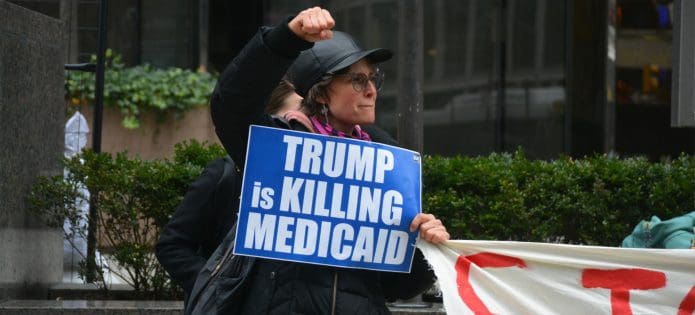
Trump's Budget Policies Make the Poor Poorer to Pay for War and Help the Rich