Billionaire Blowback on Housing


Introduction
Across the United States, communities are facing an acute housing affordability crisis. Rents and homelessness are rising while home ownership feels increasingly out of reach for millions.
What’s driving that crisis? In a word, inequality. Increased corporate control over our housing market — by billionaire investors and their for-profit entities — are driving these trends and placing significant barriers to the preservation and creation of permanently affordable housing.
You’re personally experiencing this crisis if you’re among the over 653,000 U.S. residents who are unhoused — or the many more who are doubled-up in crowded housing, unable to leave a bad living situation, or who cannot afford to live independently.
You’re experiencing it if you’re among the 22.4 million households — half of all renters — who spend more than 30 percent or more of your income on rental housing. You’re experiencing it if your wages aren’t keeping up with your rent, if your neighborhood is flooded with Airbnbs, or you can’t compete with affluent or investor home buyers to get a place of your own.
You’re experiencing it if you have an absentee corporate landlord, a government-subsidized “affordable” apartment that’s increasingly unaffordable, or a long commute because you can’t afford decent affordable housing near your work or school. Even if you own a home in a mobile park, you may be worried an investor could buy the park and hike your pad fees.
You may blame your housing challenge on your personal failure or a bad local market. But all of us are caught up in a larger housing system that is out of kilter and distorted by the participation of a class of ultrawealthy investors.
Typical solutions involve simply building more housing. But a focus on expanding housing supply through for-profit development misses this key driver of the housing crisis: as wealth concentrates in the hands of billionaire investors, their predatory investment and wealth-parking in luxury housing defines our housing markets today.
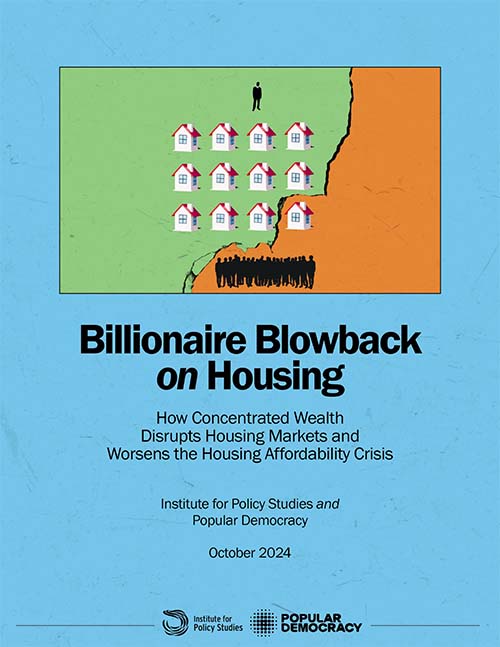
We call the consequences of billionaires’ increasing control over real estate the “billionaire blowback.” This report, jointly published by Popular Democracy and the Institute for Policy Studies, highlights the role of the billionaire class in driving our housing emergency — and outlines the policy solutions we need to protect the public interest.
Much more detail and citations are available in the full PDF, but a summary follows here.
Key Findings
• Predatory billionaire investors have bought up an unprecedented share of single-family homes, apartment buildings, and mobile home parks to extract more rents from already economically squeezed residents.
○ For instance, Blackstone is the largest corporate landlord in the world, with over 300,000 residential units across the United States. Blackstone owns 149,000 multi-family apartment units, 63,000 single-family homes, 70 mobile home parks with 13,000 lots, and 144,300 beds of student housing in 205 properties. Blackstone also recently acquired 95,000 units of subsidized housing.
○ Corporate landlords and their billionaire investors are targeting communities of color in particular with rent increases and high rates of eviction. Their actions exacerbate race, gender, and economic inequality, as displacement harms the most economically vulnerable people in our communities.
• In cities and communities across the country, homelessness is growing — but vacant homes actually outnumber unhoused people several times over.
○ Nationwide there are 16 million vacant homes — that’s 28 vacant homes for every unhoused person.
○ Wealthy investors are buying up properties but holding them vacant to profit from real estate appreciation. They make money not from rents, but from treating real estate as a luxury asset to park their wealth in.
• Billionaire investors are entering the short-term rental industry, removing a substantial portion of rental housing from the market.
○ For instance, in one Dallas council district, returning entire home short-term rentals to the housing market would make 62 percent more rental units available.
• Billionaire investors are helping skew new development towards being increasingly high-end.
○ Although housing production has actually exceeded our nation’s growth in households, new construction is increasingly unaffordable to low-income households.
○ Nationally, we have sufficient and even an excess of housing for the wealthy, alongside not enough housing priced at rates affordable to low-income households in need.
• Billionaire-owned private equity firms have entered the government-subsidized affordable housing sector.
○ They receive tax breaks and public benefits to invest in affordable housing and exploit programs like the Low-Income Housing Tax Credit. But too often, they are not providing working-class families with dignified and truly affordable homes.
○ Instead, they exploit their role as investors to profit from rent increases, eviction, and neglect, as well as from raising rents to market rate when affordability restrictions expire.
• Corporate landlords and billionaires are profiting from low-income tenants and mobile home residents by increasing rents while neglecting maintenance and repairs.
○ Through algorithms and exorbitant rent hikes, corporate landlords are inflating rents to artificially higher prices.
○ Rising rents are a primary driver of homelessness.
• Wealthy buyers are bidding up land and housing prices, inflaming gentrification and resulting in huge increases in the cost of housing.
○ First-time homebuyers and people of color who have historically been excluded from the market are competing against billionaire private equity funds and wealthy buyers who make swift cash offers.
• Billionaires have influenced government housing policy, striving to give themselves tax breaks, oppose tenant protections, and expand their housing acquisitions even further, at the expense of the public, low-income residents, and communities of color.
Recommendations
Lawmakers at the federal, state and local must act to defend our communities against the billionaire blowback in housing, starting with providing stronger protections and housing options for unsheltered people and low-income tenants.
A key system intervention is to expand the social housing sector: community-controlled or publicly owned housing that is outside the speculative market, such as quality public housing and other forms of nonprofit-owned housing. In our definition, social housing is:
• Permanently and truly affordable, prioritizing those with the lowest incomes most in need.
• Publicly owned or under democratic community control.
• Never resold for profit. For-profit investors are barred or severely restricted.
We must tax the rich and regulate billionaires’ harmful behaviors, while directing funds to this protected permanently and deeply affordable social housing sector.
State and local policymakers do not have to wait for action from the federal government. They can protect residents in existing affordable housing and generate revenue for affordable housing through a number of interventions. These include:
• Protecting tenants from billionaire landlords and hyper-extractive gentrification and displacement.
• Ending the criminalization of the unhoused and establishing “Housing First” programs to rapidly provide permanently affordable and supportive housing to the unhoused, without prerequisites.
• Requiring ownership transparency so we know who is buying our neighborhoods.
• Limiting the corporate ownership of housing.
• Giving tenants the “first option to buy” apartments and mobile home parks when they come up for sale — and public funding and support structures to make these buy-outs possible.
• Taxing luxury real estate transactions (aka “mansion taxes”) and dedicating the funds to expanding the supply of non-profit and social housing.
• Controlling short-term rentals to protect the long-term rental housing market.
• Prohibiting keeping units vacant for long periods of time.
• Promoting public land banking, public banking, and using public pension funds to resource and finance social housing.
• Promoting the transfer of expiring affordable housing, property with tax liens or habitability violations, property owned by abusive corporate landlords, and other corporate-owned properties into the permanently affordable social housing sector — while keeping residents in place.
• Creating local Offices of Social Housing and Social Housing Development Authorities to support the above, with the input of tenant unions, unhoused people’s organizations, and other impacted community members.
Subscribe to our newsletter
Further reading

High Flyers 2026: The High Cost of Private Jet Excess

Gilded Giving 2026: Philanthropy Under Oligarchy