America’s 20 Largest Low-Wage Employers and the Affordability Crisis


Introduction
While CEO pay at large U.S. corporations remains in the stratosphere, low-wage workers are struggling with both rising costs and the gutting of our social safety net —with 7.5 million Americans expected to lose Medicaid and 4 million to lose SNAP benefits to offset tax cuts for corporations and the rich under the so-called “Big Beautiful Bill.”
Solving the current “affordability crisis” will require safety net repairs and better ways to control basic costs. But to fix this problem for the long-term, we need to put an end to the poverty wage business model that is all too prevalent in Corporate America.
This report analyzes the 20 largest employers of low-wage U.S. workers, a group we’ve dubbed the “Low-Wage 20.” Together, the Low-Wage 20 companies employ approximately 6.7 million people in the United States. Their median worker wages in 2024 ranged from $9,602 (Ross Stores) to $47,607 (MGM Resorts) — compared to an average CEO compensation of over $18 million.
In this report, we find that most of these firms pay their workers so little that employees are forced to rely on public benefits like SNAP and Medicaid. Yet their CEOs make, on average, nearly 900 times more than their median employees — and their companies often spend billions on stock buybacks, artificially hiking their stock prices (and with it, CEO pay) instead of raising pay for workers.
Yet with lawmakers slashing the safety yet that these workers rely on — to fund yet more corporate tax breaks — it’s more important than ever to find ways to make these companies pay their employees equitably.
Our full findings and methodology are available in the full-length PDF. A summary of our key findings and recommendations follows here.
Key Findings
The Low-Wage 20 are using public assistance as corporate welfare.
These companies’ low-wage business models have left many of their workers with no choice but to rely on public assistance. The need for more equitable pay practices at these firms is even greater in the face of deep cuts to federal anti-poverty programs.
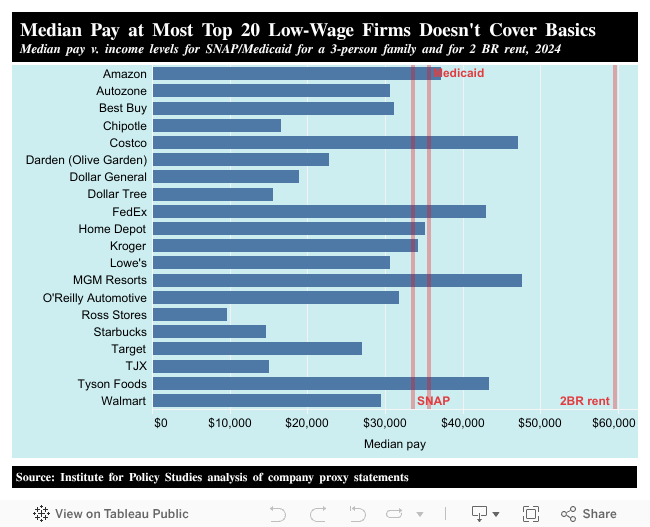
- 15 of the Low-Wage 20 reported median pay in 2024 below the $35,631 income limit for a family of three to be eligible for Medicaid in most states.
- 13 of these 20 firms reported median pay below the $33,576 threshold for a family of three to be eligible for SNAP food aid in 2024.
- In Nevada, Walmart had 4,574 employees — 29.3 percent of their employees in that state — enrolled in Medicaid in 2024. Extrapolating this data to the national level suggests that Walmart likely has around 468,800 employees on Medicaid.
- Amazon, the second-largest U.S. private sector employer, had 8,951 employees on Medicaid in Nevada in 2024, making up 48.4 percent of all Amazon employees in that state. If Nevada is representative of Amazon’s national practices, then roughly 577,000 Amazon employees are likely on Medicaid.
- Four state governments (Colorado, Massachusetts, Illinois, and Michigan) have disclosed SNAP data revealing that Walmart had a total of 10,920 employees enrolled in this food aid program in these states. Amazon had the second-largest number of employees on SNAP, with 9,633, followed by Dollar Tree, with 5,021.
The Low-Wage 20 are contributing to the affordability crisis.
- Half of Low-Wage 20 firms reported a decline in their median pay between 2019 and 2024, after adjusting for inflation. Average median pay for the group dropped 4.6 percent, from $30,474 (in 2024 dollars) to $29,087.
- All 20 of these firms reported 2024 median pay below $59,600, the income level needed to afford the U.S. average rent for a two-bedroom apartment.
- 7 out of the 20 firms have median pay below $25,533, the average price of a used car.
- 16 out of the 20 have median pay below the $44,961 average annual cost for tuition and fees at a private college and 7 have median income lower than the $25,415 average cost of attending a public university as an out-of-state student.
The Low-Wage 20 are enriching CEOs while paying poverty wages.
- Average CEO pay at these 20 low-wage firms hit $18.6 million in 2024, just shy of the $18.9 million average for S&P 500 CEOs as a whole. Their average CEO-median worker pay ratio stood at a staggering 899 to 1, compared to the S&P 500 average of 285 to 1.
- At least 16 U.S. billionaires owe their wealth to companies in the Low-Wage 20. These individuals, which include both current and former top executives and dynastic heirs, include eight associated with Walmart, two with Amazon and Tyson Foods, and one each with Home Depot, Best Buy, Starbucks, and Chipotle.
- The Low-Wage 20 companies combined spent $260 billion on stock buybacks between 2019 and 2024. This financial maneuver artificially inflates the value of CEO stock-based pay while siphoning resources from worker wages and other productive investments.
- With the $32.5 billion these firms spent on buybacks in 2024 alone, they could’ve lifted more than 1 million workers making the Low-Wage 20’s average median wage of $29,087 up to the $59,600 income level needed to afford the U.S. average rent for a two-bedroom apartment.
- Half of Low-Wage 20 companies spent more on stock buybacks to pump up short-term share values than on long-term capital investment between 2019 and 2024.
The Low-Wage 20
| Low-Wage 20 Company | CEO | CEO pay | Median pay | CEO-worker pay ratio | U.S. employees | Stock buybacks, 2019-2024 ($million) | |
| 1 | Amazon | Andrew Jassy | $1,596,889 | $37,181 | 43 | 1,192,263 | 6,000 |
| 2 | Autozone | Philip Daniele | $9,198,465 | $30,637 | 300 | 122,935 | 17,515 |
| 3 | Best Buy | Corie Barry | $16,150,300 | $31,141 | 518 | 75,170 | 6,671 |
| 4 | Chipotle | Scott Boatwright | $19,140,000 | $16,666 | 1,148 | 127,820 | 3,135 |
| 5 | Costco Wholesale | Ron Vachris | $12,354,831 | $47,092 | 262 | 219,000 | 2,754 |
| 6 | Darden Restaurants | Ricardo Cardenas | $12,004,427 | $22,755 | 527 | 186,000 | 2,567 |
| 7 | Dollar General | Todd Vasos | $2,152,357 | $18,951 | 114 | 185,804 | 8,964 |
| 8 | Dollar Tree | Michael Creedon | $9,246,835 | $15,602 | 592 | 209,517 | 3,098 |
| 9 | FedEx | Rajesh Subramaniam | $12,398,210 | $42,990 | 288 | 370,000 | 7,731 |
| 10 | Home Depot | Edward Decker | $15,574,678 | $35,196 | 443 | 419,600 | 37,861 |
| 11 | Kroger | Rodney McMullen | $15,631,028 | $34,213 | 457 | 409,000 | 9,647 |
| 12 | Lowe’s | Marvin Ellison | $20,164,912 | $30,606 | 659 | 268,000 | 46,611 |
| 13 | MGM Resorts Intl | William Hornbuckle | $15,819,584 | $47,607 | 332 | 63,000 | 9,565 |
| 14 | O’Reilly Automotive | Brad Beckham | $2,829,492 | $31,854 | 89 | 89,648 | 14,506 |
| 15 | Ross Stores | Barbara Rentler | $16,994,251 | $9,602 | 1,770 | 107,000 | 5,355 |
| 16 | Starbucks | Brian Niccol | $95,801,676 | $14,674 | 6,666 | 211,000 | 18,185 |
| 17 | Target | Brian Cornell* | $20,407,603 | $27,090 | 753 | 440,000 | 13,499 |
| 18 | TJX | Ernie Herrman | $23,482,528 | $15,002 | 1,565 | 273,717 | 11,182 |
| 19 | Tyson Foods | Donnie King | $22,773,094 | $43,417 | 525 | 119,901 | 1,631 |
| 20 | Walmart | Doug McMillon** | $27,408,854 | $29,469 | 930 | 1,600,000 | 35,322 |
| TOTAL | 6,689,375 | 261,799 | |||||
| AVERAGE | $18,556,501 | $29,087 | 899 | 13,090 | |||
Notes: All data are for 2024, except for stock buybacks figures, which cover the 6-year period of 2019-2024.
*retired February 1, 2026. **retired January 31, 2026.
Sources: CEO pay, median pay, pay ratio: corporate proxy statements and AFL-CIO Paywatch database. U.S. employees: 10-K reports and proxy statements, with the exception of Amazon and TJX. For those firms we found the figure for 2024 U.S. employees in their EE-O1 reports. Stock buybacks: WSJ Markets data.
Median Pay at the Low-Wage 20 vs. the Basics
Recommendations
In this time of high economic anxiety for those at the bottom of the income ladder, it’s more important than ever that corporations share their wealth equitably. Policymakers at all levels of government should take action to help build worker power and lift wages so that everyone in the world’s richest country can afford basic necessities.
Adopt “Bad Business Fees.”
“Bad Business Fees” would impose significant fines on companies that pay wages so low their workers are forced to depend on public assistance.
Under a model for a state-level Bad Business Fee developed by Jobs with Justice, elected boards of community stakeholders would decide how the revenue is spent. Options could include subsidizing worker wages so that they do not need to use social safety net programs, covering the cuts to those safety net programs, or otherwise meeting the needs of low-wage workers and their communities.
This would strengthen democracy on multiple fronts, notes Adam Shah of Jobs with Justice in a recent op-ed. “First,” he explains, “it ensures that states and localities can maintain basic protections regardless of what happens at the federal level. Second, it promotes the practice of democracy by giving communities direct control over how public money is spent — replacing cynicism with real civic power. Third, it would strengthen the economic portion of our democracy. Companies would be incentivized to work directly with and respond to their employees’ requests for fair wages and adequate benefits, giving workers the voice and dignity they deserve.”
As one step forward, state governments should adopt disclosure laws along the lines of the Nevada statute that requires the publication of an annual report listing major employers in the state and the number of their employees enrolled in Medicaid. Ideally, these laws would require disclosure of all employees, whether they are working full or part time, and cover additional public aid programs.
Strengthen labor rights protections.
When employees of Low-Wage 20 corporations try to unionize to bargain collectively for higher pay, they typically face aggressive anti-union tactics and weak enforcement of their rights. The most obvious examples: Amazon and Starbucks workers who voted to unionize four years ago are still waiting for their employers to negotiate first contracts, despite numerous National Labor Relations Board rulings over rights violations.
Policymakers at the federal and state levels should consider comprehensive labor reforms that expand worker rights to organize, penalize employer violations, facilitate first-contract negotiations, and prohibit employer interference in organizing, among other improvements.
Another promising approach would involve denying corporate tax deductions for expenses related to union-busting activities, such as so-called “captive audience meetings” and anti-union advertising campaigns.
Raise the minimum wage.
The U.S. Congress has not raised the federal minimum wage for 16 years, the longest period of wage inaction in history. Thirty states and D.C. have raised their state minimums above the federal floor. But that still leaves a significant share of the U.S. workforce in states where the minimum wage is still stuck at $7.25 per hour.
Minimum wage hikes not only help those at the bottom of the wage scale. They also tend to boost pay for those higher up the scale, such as Low-Wage 20 employees who are likely making more than $7.25 but still not earning enough to cover basic costs.
Tax corporations with huge CEO-worker pay gaps at higher rates.
Higher tax rates on companies with wide CEO-worker pay gaps would create an incentive to both rein in executive pay and raise worker wages, all while generating significant new capital for vital public investments.
Members of Congress have introduced several bills that would impose tax penalties on companies with huge pay gaps, including the Tax Excessive CEO Pay Act, the CEO Accountability and Responsibility Act, and the Curtailing Executive Overcompensation (CEO) Act.
Two major cities, San Francisco and Portland, Oregon, already apply such taxes on corporations operating in their jurisdictions, and campaigns are underway to increase the existing San Francisco tax and introduce a new “Overpaid CEO Tax” in Los Angeles through ballot measures in 2026.
A 2024 survey found that 80 percent of Americans favor a tax hike on corporations that pay their CEOs over 50 or more times more than what they pay their median employees.
Tax and restrict stock buybacks.
A 1 percent federal excise tax on the repurchase of corporate stock went into effect in 2023. A Senate bill, the Stock Buyback Accountability Act, would quadruple this excise tax. Another Senate bill, the ALIGN Act, would ban executives from selling their shares within a year of a stock buyback announcement to cash in personally.
Use federal contracts and subsidies to encourage pay equity.
Policymakers at the federal, state, and city levels could do more to use the power of the public purse to ensure that public investments are not supporting poverty wage business models.
In 2021, the Biden administration issued an executive order to establish a $15 hourly minimum wage for federal contractors, adjusted annually for inflation. They also used the leverage of new subsidies for domestic semiconductor production to discourage grantees from spending resources on stock buybacks. In 2025, the incoming administration revoked the $15 minimum for federal contractors, a move that underscored the importance of codifying such policies in legislation.
Subscribe to our newsletter
Further reading

Tax Day 2026: The Average Taxpayer Paid $4,049 for War and Weapons
Trump's Budget Policies Make the Poor Poorer to Pay for War and Help the Rich