FACT SHEET: The High Moral Stakes of the Government Shutdown


The fight over the government shutdown is a health care fight.
The federal government has been shut down since lawmakers failed to meet an October 1 funding bill deadline. Since then, members of Congress have been locked in a stalemate over national priorities.
Republican leaders have failed to muster sufficient votes to pass a “Continuing Resolution” to temporarily keep the government open. The Democratic counterproposal calls for two major fixes to the looming health care crisis created by budget legislation adopted this past summer:
- Extend ACA credits: Over 24 million Americans are enrolled in the Affordable Care Act (ACA) Marketplace, and 93 percent of them benefit from enhanced premium tax credits that help middle-income individuals and families afford their coverage. Congress did not extend these tax credits in the “One Big Beautiful Bill” that President Trump signed into law on July 4.
If these credits are allowed to expire as scheduled at the end of this year, an estimated 4 million people are expected to lose coverage altogether, and the other 20 million enrollees will see average premiums more than double. The ripple effect of millions of people losing their coverage includes dramatic spikes in premiums for those with private insurance.
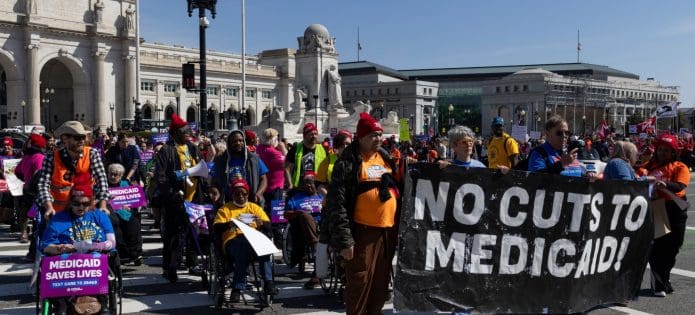
- Roll back Medicaid cuts: The “One Big Beautiful Bill” guts Medicaid by slashing $1 trillion over the coming decade. The CBO estimates that 7.5 million Americans will lose their coverage as a result of the cuts and changes to the Medicaid program. This includes losing long-term care and nursing home care.
According to a KFF Health poll, nearly 80 percent of Americans care more about extending health care subsidies than keeping the government open without them.
Shutdown impacts
Federal employees:
- About 750,000 federal employees have been put on unpaid leave, and hundreds of thousands more “essential” federal employees are required to keep working without pay until funding resumes.
- The nation’s 1.3 million active duty members of the armed services could also start missing paychecks if the shutdown does not end soon.
- ICE has remained fully operational — except for the staff responsible for inspecting detention centers to ensure they meet federal standards for the safe and humane treatment of immigrants.
- Employees of private federal contractors are not guaranteed back pay once the shutdown ends. Federal employees have received such pay in the past, but a leaked memo from the Office of Management and Budget reveals that the administration is considering flouting longstanding law and denying back pay for some government workers.
- President Trump has also called the government shutdown an “unprecedented opportunity” to push through mass firings of civil servants, a move that would face legal challenge.
Nutrition assistance:
- WIC: The Special Supplemental Nutrition Program for Women, Infants, and Children, commonly referred to as WIC, provides essential food assistance to low-income mothers, infants, and young children. It will run out of federal money this month if the government remains closed, affecting 6 million recipients.
- SNAP: October benefits are secure for this critical food aid program, which serves more than 40 million Americans per month. But if the shutdown continues, it’s unclear whether the USDA would use its limited reserve funds to cover some costs — and for how long.
Infrastructure funding as a bargaining chip:
- Trump has vowed to use the shutdown to punish political foes, including the New York-based Democratic leaders of the House and Senate and Illinois Governor J.B. Pritzker. In moves that are likely illegal, the White House is denying $18 billion in congressionally approved infrastructure funding for New York and freezing over $2 billion in Chicago transit projects.
A moral stand on the shutdown
Lawmakers who are refusing to negotiate a resolution to our country’s health care affordability crisis are showing where they stand on our national priorities. They clearly care more about protecting tax cuts for billionaires and massive spending on ICE and the military than they care about health care for the rest of us. Instead of inflicting policy violence on the most vulnerable, Congress should harness America’s abundant wealth to create a moral economy that works for all of us.
Download
Subscribe to our newsletter
Further reading

What Could Indianapolis Fund Instead of Giving Big Tech $395 Million in Tax Breaks for Data Centers?

Tax Day 2026: The Average Taxpayer Paid $4,049 for War and Weapons