Who Would Pay the Biggest Price for Postal Privatization?


Summary
Privatization of the U.S. Postal Service would have wide-ranging effects on customers, employees, businesses, and our broader economy. This report focuses primarily on one nearly certain result: a dramatic increase in parcel delivery prices.
Unlike the for-profit carriers, the Postal Service has a universal service obligation. As outlined in multiple statutes, this requires USPS to provide affordable deliveries to all Americans, regardless of where they live or work. A recent Wells Fargo analysis indicates that USPS parcel pricing was approximately 25 percent to 60 percent below FedEx and UPS prices, depending on product type, in the fourth quarter of 2024.
Without competition from this public service, for-profit firms would jack up delivery fees on as many customers as possible. Who would be hit hardest? Most likely those who live or work in ZIP codes where private carriers already impose surcharges because deliveries to these addresses are less profitable.
Our analysis finds that UPS and FedEx area surcharges now apply to retail customers sending parcels to addresses in ZIP codes where 102 million Americans live. Not surprisingly, these include addresses in Hawaii, Alaska, and rural and remote areas. But they also include many small towns and neighborhoods just outside major cities. These higher delivery rates are just a taste of what would come if the Trump administration succeeds in privatizing USPS.
Download this report as a printable PDF here.
Revived push for postal privatization
During his first term, President Trump appointed a task force on the future of the Postal Service that included the Treasury Secretary and the Directors of the Office of Management and Budget and the Office of Personnel Management. In June 2018, OMB recommended postal privatization in a report on overall government restructuring. In December 2018, the task force issued its report, calling for privatization of wide swaths of the Postal Service, reducing delivery days, closing post offices, ending collective bargaining for postal employees, and drastically increasing prices on package service and the mail.
The privatization push lost momentum, however, as Americans across the political spectrum voiced strong support for the agency and its public mission. The essential role of USPS became even clearer during the pandemic, when postal employees effectively managed unprecedented levels of mail-in election ballots and deliveries of vital goods, from medication to cleaning products and food. USPS has also delivered more than 900 million Covid test kits, helping the nation emerge from the depths of the public health crisis.
In recent years, Congress has passed two bills to help stabilize USPS finances — Covid relief funding in 2020 and the repeal in 2022 of a burdensome requirement to pre-fund postal employee retirement health benefits. Both bills passed with strong bipartisan support.
Nevertheless, immediately after his re-election in November 2024, President Trump began once again to promote the idea of privatization. As of late February, the Washington Post reported that he intends to issue an executive order to disband the Postal Board of Governors and place USPS under the control of the Department of Commerce – presumably as a first step towards privatizing all or parts of the agency.
Billionaire Elon Musk, who has exerted enormous influence over the Trump administration, told an audience of Wall Street bankers on March 6 that he also favors USPS privatization. The Wells Fargo equity research team recently produced a report laying out a step-by-step path towards this goal. The report explicitly states that this action “would be positive” for private carriers FedEx and UPS.
In what the Wells Fargo team describes as the “required five steps” to privatization, step four involves increasing USPS parcel delivery rates by about 30 percent to 140 percent to “generate economic parcel profits on a standalone basis.” In other words, the hog would need to be fattened up before the slaughter. The team’s step five: “Federal government would raise proceeds from buyer(s) or investors in return for the divestiture of some or all of the USPS.”
Private firms already impose area surcharges on vast swaths of the country.
Delivery vehicles often jockey for space on crowded streets as multiple companies deliver packages to the same U.S. households. Of the major carriers, only the U.S. Postal Service has had a commitment to providing universal service without geographic area surcharges.
For packages not in flat rate boxes, USPS delivery charges are based on weight and the distance between the origin and destination points — not on the recipient’s address. In September 2024, USPS did introduce new rates for deliveries to certain rural ZIP codes. But these rates only apply when the shipper uses the discounted merchant rates negotiated by online retailers like eBay and Etsy or purchases postage through shipping software companies like ShipStation and EasyShip. The differentiated rates do not apply when a customer deals directly with USPS.
This report analyzes the far more substantial array of surcharges that FedEx and UPS add to their advertised base retail rates for parcel customers using their own packaging (rather than flat rate boxes). Amazon has dramatically expanded its own delivery network, even surpassing FedEx and UPS in parcel volume in 2023. However, the e-commerce giant’s delivery costs are typically folded into the price of purchased goods.
According to our analysis of information on UPS and FedEx web sites, these firms charge area surcharges for deliveries to approximately 62 percent, or more than 25,000 of the nation’s 42,000 ZIP codes. The Institute for Policy Studies calculates that these surcharge areas are home to approximately 102 million people, or approximately 31 percent of the U.S. population.
Predictably, the private carriers impose the most expensive surcharges on shipments to Alaska and Hawaii. The highest fees on deliveries in the 48 contiguous states are “remote surcharges” that apply to about 8 percent of ZIP codes covering mountain communities, ranchlands, and other far-flung areas where 3.8 million people live. Another 35 percent of ZIP codes, rural areas with a combined population of 35 million, face “extended area surcharges.” The lowest location-based fees, simply called “delivery area surcharges,” apply to another 19 percent of ZIP codes, mostly in suburban areas and small towns, with a combined population of 19 million.
| 2025 Delivery Area Surcharges | |||
| ZIP Code Categorization | UPS | FedEx | USPS |
| Non-contiguous U.S. | |||
| Alaska | $43.25 | $43.00 | $0.00 |
| Hawaii | $15.35 | $14.50 | $0.00 |
| Remote area surcharges in the contiguous U.S. | |||
| Commercial and residential | $15.35 | $15.50 | $0.00 |
| Extended area surcharges in the contiguous U.S. | |||
| Commercial Delivery | $5.35 | $5.25 | $0.00 |
| Residential Delivery | $8.30 | $8.30 | $0.00 |
| Delivery area surcharges in contiguous U.S. | |||
| Commercial Delivery | $4.20 | $4.20 | $0.00 |
| Residential Delivery | $6.15 | $6.20 | $0.00 |
Sources: FedEx and UPS. Surcharges cited here and in examples below reflect published retail rates for 2025 (excluding any promotional discounts) for customers using their own packaging (rather than flat rate boxes). Large volume shippers commonly negotiate discounted rates.
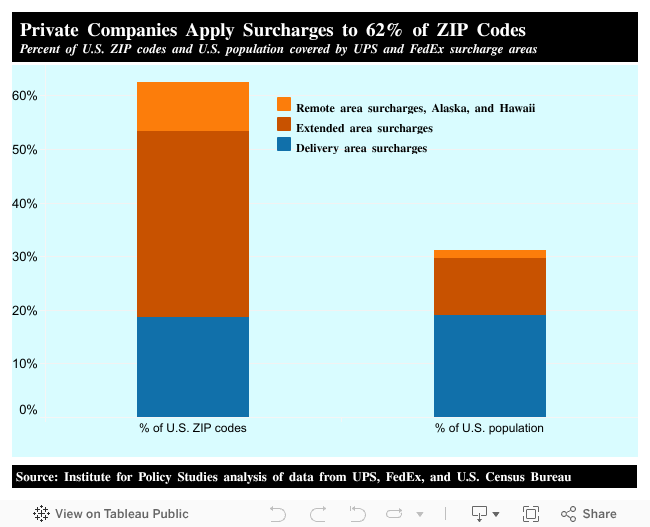
Source: Institute for Policy Studies analysis of data from UPS, FedEx, and U.S. Census Bureau.
Suburban area surcharges
Many of the communities subject to delivery area surcharges are not what most people would consider remote. For example, the private companies often slap area surcharges on deliveries to ZIP codes just outside major cities, such as the ones below.
| Examples of communities near major cities where UPS and FedEx apply area surcharges | |
| ZIP Code | Distance to Major City |
| 85339 — Laveen, AZ | 8 miles to Phoenix |
| 84044 — Magna, UT | 12 miles to Salt Lake City |
| 37189 — Whites Creek, TN | 8 miles to Nashville |
| 78617— Del Valle, TX | 6 miles to Austin |
| 41059 — Melbourne, KY | 8 miles to Cincinnati |
| 62240 — East Carondelet, IL | 7 miles to St. Louis |
Private companies pile additional fees on top of delivery area surcharges.
The table below compares cost estimates for FedEx, UPS, and USPS to deliver a three-pound parcel (the weight of a couple books or a pair of shoes) using a customer’s own packaging or a carrier-produced medium-size box from Chicago to five residential addresses representing different area surcharges.
As the table reveals, the private corporations are already charging substantially higher standard retail rates than USPS for deliveries to each of the surcharge areas. In addition to area surcharges, the private carriers also impose extra charges for fuel (based on distance) and residential delivery (reflecting the higher costs for companies that, unlike USPS, aren’t already visiting homes every day). The Postal Service applies none of those surcharges.
| Rates and fees for delivery service between Chicago and residences in various surcharge areas | |||||
| Delivery area surcharge: Chicago-Laveen, AZ | Extended area surcharge: Chicago-Colton, WA | Remote area surcharge: Chicago-Wasta, SD | Hawaii surcharge: Chicago-Kula, HI | Alaska surcharge: Chicago-Bethel, AK | |
| FedEx | |||||
| Standard rate: | |||||
| Base rate | 44.76 | 44.76 | 33.73 | 101.52 | 101.52 |
| Fuel | 10.76 | 10.43 | 10.46 | 22.15 | 25.99 |
| Area surcharge | 6.20 | 8.30 | 15.50 | 14.50 | 43.00 |
| Residential delivery | 6.55 | 6.55 | 6.55 | 6.55 | |
| Total standard rate | 68.27 | 70.04 | 66.24 | 144.72 | 170.51 |
| Flat rate (“One rate”) | 19.00 | 19.00 | 19.00 | 19.00 | 23.00 |
| UPS | |||||
| Standard rate: | |||||
| Base rate | 35.98 | 35.98 | 35.52 | 86.45 | 86.45 |
| Area surcharge | 6.15 | 8.30 | 15.35 | 15.35 | 43.25 |
| Fuel | 8.64 | 9.02 | 10.19 | 19.23 | 24.18 |
| Residential delivery | 6.55 | 6.55 | 6.55 | 6.55 | 6.55 |
| Total standard rate | 57.32 | 59.85 | 67.61 | 127.58 | 160.43 |
| Flat rate (“Simple rate”) | 20.40 | 20.40 | 20.40 | 99.00 | 126.90 |
| USPS | |||||
| Priority mail | 21.10 | 21.10 | 15.95 | 23.95 | 23.95 |
| Flat rate box | 19.15 | 19.15 | 19.15 | 19.15 | 19.15 |
Note: All rates are for deliveries with an expected delivery time of three days, except for Hawaii and Alaska. For all three carriers, we used published retail rates as of March 13, 2025 for a 3-pound parcel using customer’s own packaging or a medium-size, carrier-produced box. For FedEx, standard rates are for Express Saver (3-day) delivery, except Hawaii and Alaska rates are labeled “2-day delivery” but lack guaranteed delivery dates. For UPS, rates are 3-day Select except Hawaii and Alaska rates are UPS Ground, with expected delivery to Hawaii in one week and no specified delivery time to Alaska. For USPS, rates are for Priority Mail and a medium-size flat rate box. We assumed customer drop-off at a FedEx or UPS service location. As noted below, USPS does not charge to pick up packages during regular carrier routes.
On flat rate deliveries, the for-profit carriers are offering rates that are comparable to USPS. The Postal Service was the first to offer this service, introducing flat rate boxes in 2004, followed by the launch of FedEx’s “One Rate” service in 2013 and the UPS “Simple Rate” program in 2019. Many small e-commerce retailers appreciate the shipping cost predictability that flat rate pricing provides. However, these flat rates come with various restrictions on size and weight and may not always be the most economical option.
Unlike FedEx and UPS, USPS does not charge extra for Saturday delivery. The universal service obligation of USPS includes a commitment to deliveries six days a week to every U.S. address. The Postal Service Reform Act of 2022 codified this commitment in law.
Unlike for-profit carriers, USPS offers free package pick-up services.
USPS mail carriers pick up packages of less than 70 pounds that are ready for delivery from residences at no charge during their regular delivery routes. Since they are visiting residences every day anyway, this adds little extra cost for the public service. By contrast, as the table below indicates, FedEx and UPS charge substantial prices to pick up parcels ready for shipment from homes and workplaces.
| Fees for Picking Up Packages from a Rural Residence | ||
| Monday-Friday | Saturday | |
| FedEx | $4 per package | $16 per package |
| UPS | $21.30 | $21.30 |
| USPS | $0 | $0 |
Note: Based on pick-up service from a farm four miles outside a small central Minnesota town (zip code 55355). USPS offers free pick-up service during carriers’ regular mail delivery routes. If a customer needs to schedule a pick-up, USPS charges a fee.
Free pick up is a particularly important service for customers who cannot easily travel to a post office or a UPS or FedEx store or drop off location because they don’t have a means of transport or for physical reasons. This is one way USPS makes it a bit easier for elderly Americans and those with disabilities to stay in their own homes and maintain connections with the outside world. USPS also offers a “Carrier Alert” service, which allows people with special needs to register to have a symbol placed on their doors, indicating that letter carriers should report any signs of distress to local social service agencies.
Rural areas would be hit hardest by privatization.
While people living in rural areas account for only 16 percent of the U.S. population, rural areas account for 88 percent of the area served by the Postal Service and 57 percent of post offices. On top of increased package delivery rates, rural communities would also likely face the shuttering of many of these rural post offices and the related loss of postal jobs that pay decent wages with benefits. If USPS loses the package revenue it currently uses to cover the cost of first class mail, our universal mail delivery service could also be in jeopardy.
- Many rural residents get medicine and other essentials through the mail.
Across the country, an estimated 20 percent of all Americans over 40 who are prescribed medication for a chronic condition get their prescriptions exclusively through the Postal Service. An even greater share of the rural population relies on mail order prescriptions since so many pharmacies in rural communities have shut down. Veterans, more than one-quarter of whom live in rural communities, receive 84 percent of their prescriptions through the mail. Aside from some medicines that require refrigeration, USPS handles nearly all of these deliveries to veterans. Under the Covid-19 pandemic, USPS delivered medicine, food, and other essentials to a much larger swath of the U.S. population. Even in normal times, Alaskan villages, Maine islands, and other hard-to-reach areas rely on USPS for food and other vital goods.
- Rural residents without broadband rely more on USPS for bill paying and other first-class mail needs.
As recently as June 2023, more than 14 percent of rural households lacked access to broadband, according to the FCC. This suggests that rural residents are more likely than other Americans to pay their bills by the mail. Overall in the United States, 14 percent of utilities bills and 27 percent of government taxes and fees were paid for with checks as of 2022. USPS also allows sending of greeting cards and other first-class mail not handled by UPS or FedEx.
- Rural voters benefit significantly from “vote by mail.”
During the 2024 general election, the Postal Service delivered more than 99 million ballots to or from voters. Rural voters rely particularly heavily on the mail-in option, in part because physical polling sites are often long distances from their homes. Nationwide, half of rural county polling sites serve an area greater than 62 square miles, compared to just 2 square miles for urban sites. Vote by mail is particularly important for seniors, who made up 20 percent of rural residents ages 65 or older in 2022, compared to just 16 percent of urban residents.
Privatization abroad has led to higher prices, reduced service, and layoffs.
Between 2000 and 2015, a number of governments fully or partially privatized their state-run postal services, with varying degrees of regulation. While the vast size of the United States territory and economy makes international comparisons difficult, these countries’ experiences provide cautionary tales. A new Brookings study finds that in the European Union, countries with partially or fully privatized postal systems had higher price increases between 2012 to 2021 than countries that have kept their systems public.
The UK’s Royal Mail, for instance, was fully privatized between 2013 and 2015. British customers have seen service standards fall and prices rise, with UK stamp costs more than doubling in the last decade. Today, a first class stamp in the UK costs £1.65, or $2.15. In the United States, you can still send a letter from Miami to Anchorage for just $0.73. In Denmark, the private corporation that operates the national postal system recently announced that it will end letter delivery altogether, leaving it up to the free market to fill the void.
Some privatized systems have also reduced the frequency of mail and package deliveries, particularly to remote areas. In Italy, for instance, the private corporation that runs the postal system delivers to rural areas only on alternate days.
Privatization has also had harmful effects on postal employees. In Belgium, for example, the private corporation that runs the postal system has been steadily replacing civil servant delivery employees with lower-paid “auxiliary” employees.
Despite prevalent misinformation, USPS is not a burden on taxpayers.
Postal privatization advocates often claim the U.S. Postal Service can offer lower delivery rates than private corporations only because this public entity doesn’t pay taxes on earnings and relies on taxpayer subsidies. In reality, with the exception of emergency Covid funding in 2020, USPS has operated as a self-funded agency since the 1970 Postal Reorganization Act.
Many other governments provide funding to cover the cost of universal service obligations, but this is not the case in the United States. The Postal Regulatory Commission reports that this cost for USPS, including all the deliveries and services and free or discounted rates the agency would not otherwise provide, amounted to $6.1 billion in 2023.
The agency is supposed to receive public funds to cover the cost of free mailing privileges for the blind and overseas voters, but these costs have not been fully reimbursed. USPS currently receives just 0.1 percent of its total revenue from Congressional appropriations.
Conclusion
If the U.S. Postal Service is privatized, our country’s time-honored commitment to universal postal pricing and delivery will be in jeopardy. Freed of the constraint of public competition, private carriers would charge as much as they could get away with and deliveries to certain areas of the country may no longer be available. The estimated 102 million Americans living in places the private companies already charge extra fees – and those wishing to communicate and trade with them – would pay the biggest price.
Businesses, from online retail shops to manufacturers shipping parts to customers in need, could face sharply higher shipping costs, leading to higher prices for their customers or lower profits for their businesses. Small businesses would be hit especially hard, since they don’t have the clout to negotiate the same level of shipping discounts as big corporations.
Postal privatization would also destroy a vital and truly democratic public service. This extensive, centuries-old network helped build up America’s democracy and economy by spreading information and goods to every corner of the country. Over its 250-year history, USPS has continually reinvented itself in response to changes in technology and the evolving needs of our society.
Rather than selling this public treasure off to the highest bidder, we should explore opportunities for strengthening the Postal Service to deliver even better services to the American public in the 21st Century. In addition to the growing package delivery market, many options are available for generating new revenue, from expanded financial services to installing monitors on delivery vehicles for gathering data on public safety and environmental risks.
With its extensive and valuable human resources and infrastructure, USPS has a strong foundation on which to continue providing a vital public service for all Americans for generations to come.
Subscribe to our newsletter
Further reading

High Flyers 2026: The High Cost of Private Jet Excess

Gilded Giving 2026: Philanthropy Under Oligarchy