

VIDEO: Rep. Pramila Jayapal: “Strength Always Emerges in the Times of Worst Crisis”


Below is a lightly edited transcript of an address by Representative Pramila Jayapal at our second annual Wallace Symposium, which brings movements together to fight fascism and envision a more equitable future.
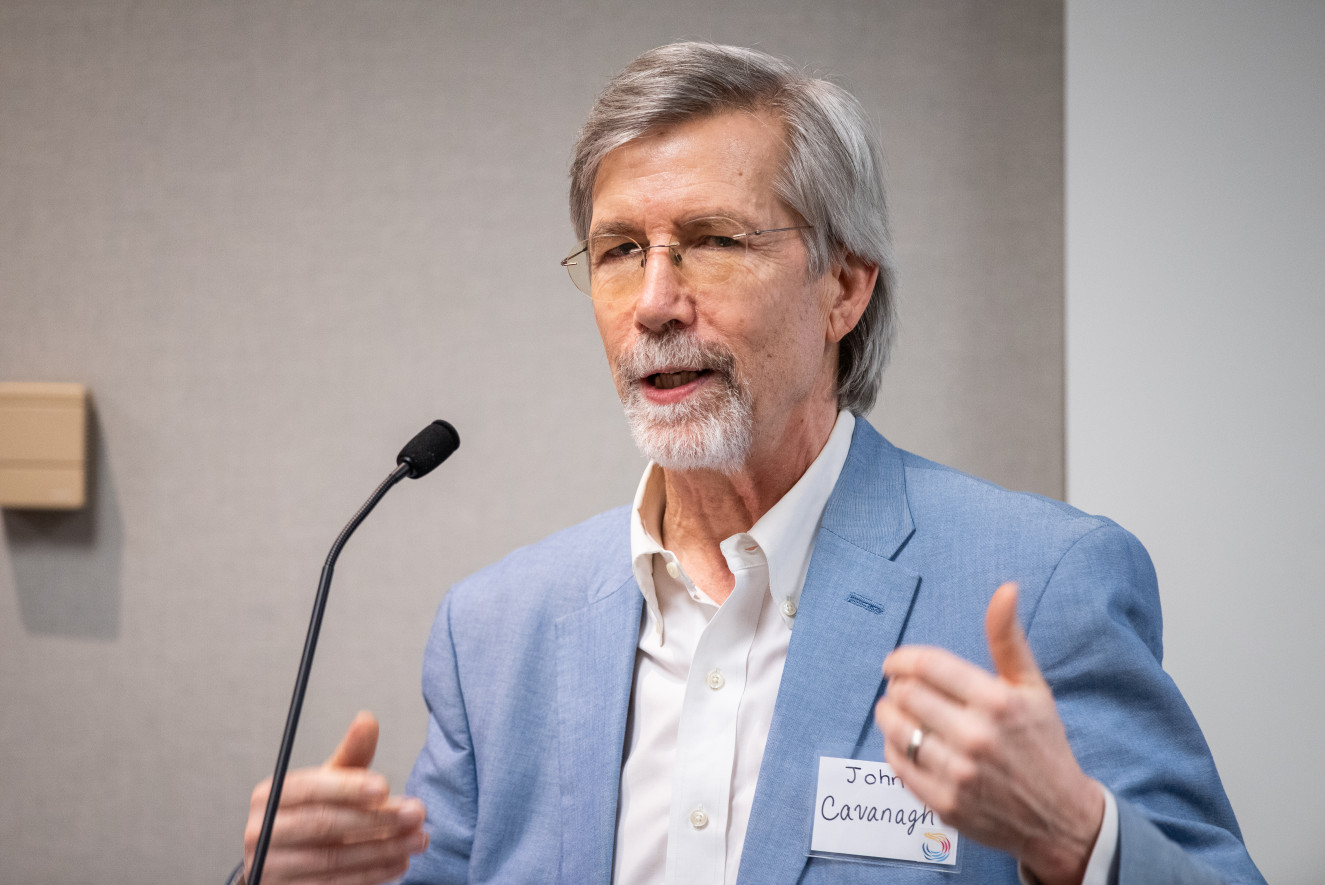
John Cavanagh: So at IPS we assert that we can win over millions of people with ideas and proposals and policies that come from the bottom up, ones that are crafted with input from the people most affected. You’ve been hearing about that today. And to win against the authoritarian onslaught we face, we also need a unique kind of leader.
We need leaders who are devoted to this kind of people-centered policy, who come out of organizing backgrounds, who know how to break down walls between progressive movements and how to inspire people to organize and build across those movements. Congresswoman Pramila Jayapal became a clear model of this kind of leadership, as she has moved from piloting one of the most dynamic immigrant rights groups in this country to the Washington State Senate and then to the U.S. Congress in 2016.
As an organizer in Congress, she quickly teamed up with Representative Mark Pocan to become co-chairs of the Congressional Progressive Caucus, where she reorganized it for greater power, and she became the driving force for revitalizing a Congressional Progressive Caucus Center that brought together outside power with inside power.
She crafted the visionary Medicare for All bill by seeking input from thousands of people who were victims of this country’s broken healthcare system. And she used the same inclusive model on immigration, on monopoly busting, on labor rights and now on foreign policy. We at IPS were particularly proud to partner with her in the remarkable National Domestic Worker Bill of Rights and the Third Reconstruction Resolution that we did with Rev. Barber and the Poor People’s Campaign.
So please join me in welcoming a person who has taught us how outside power linked to receptive and visionary leaders on the inside can win real change: Representative Pramila Jayapal from Washington.
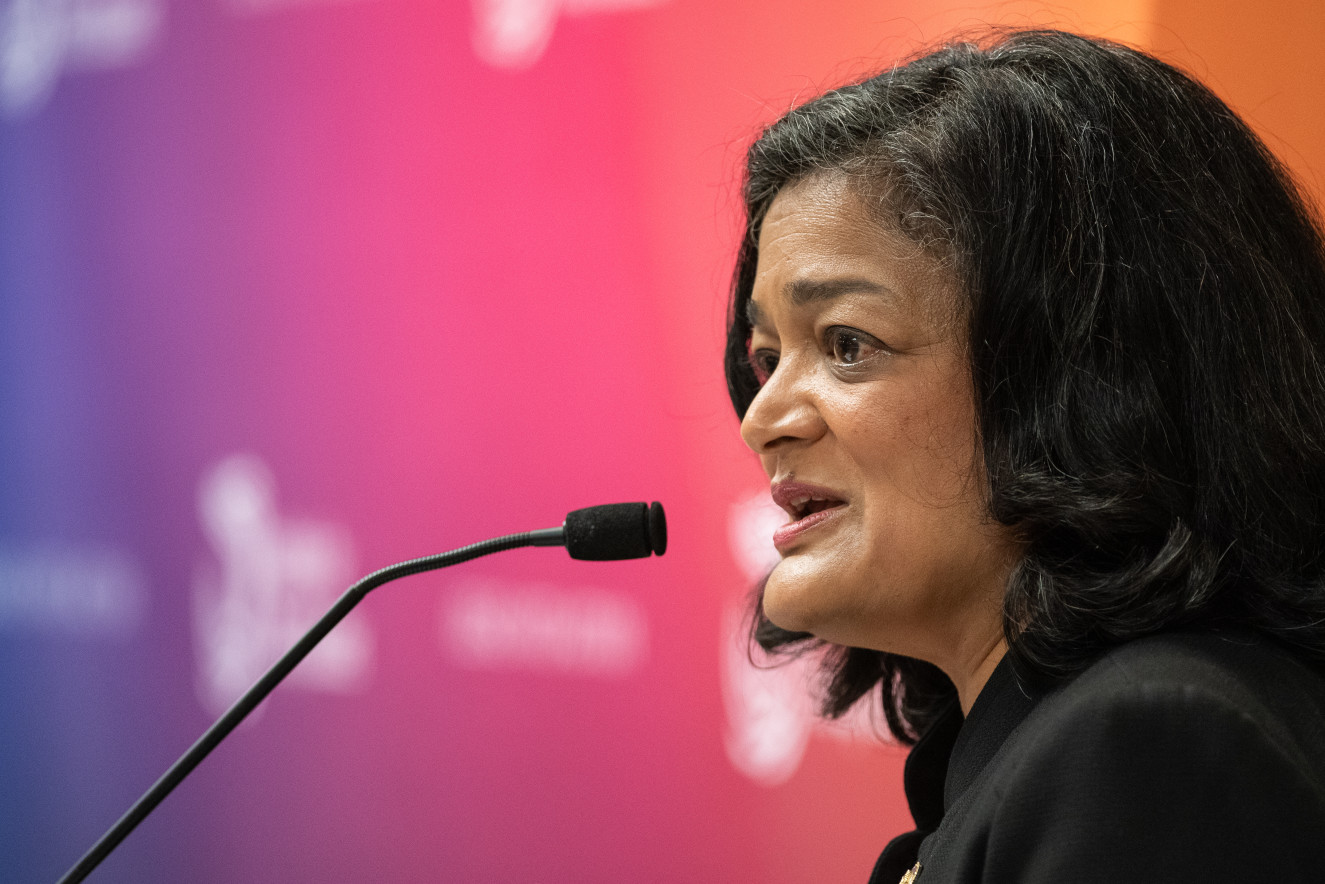
Congresswoman Pramila Jayapal (02:09): Oh my goodness, wow, I should leave right now. Thank you so much. And thank you, John, for that beautiful introduction, very generous — but really for the work that you have done over the years, over the decades, with IPS, with all the partners in the room. I mean, this is where I feel at home, because I know that our values and our work are aligned, and I am just so grateful for all the strategizing. Whenever I have a problem that I can’t figure out, I call John, and he helps me to strategize it and think about what the solutions are.
And I think IPS has so seamlessly brought together all of these different issues. I mean, listening to the end of that last panel, thinking about the intersectionality of everything we do and how it really is all interconnected. I think that’s a very unique thing that IPS had long before people even started talking about it. So thank you IPS, thank you John. Thank you all of you that are in the room today. I know we have Public Citizen, The Nation, the Wallace Global Fund, who have all been part of pulling this together.
It is really profoundly powerful to be here working on a bold future on the anniversary of the great John Lewis’s passing. I think about that a lot, because John was a hero for me, like he was for so many others. I of course knew of him long before I had the opportunity to meet him and work with him, and my understanding coming from India and the non-violence movement of Gandhi to the United States and the civil rights movement and non-violence movement of Dr. King, and John’s particular role as a young organizer in that movement was so incredibly inspiring.
And I remember in 2003 I was running my immigrant rights organization, and we did the Immigrant Workers Freedom Ride across the country. And we ended up in New York City, and we had about 250,000 people, which was a lot of people at that time. I was a pretty new organizer, and they told me that I was going to speak right before John Lewis. And I almost lost my lunch, because standing there next to the great John Lewis was incredible.
Ultimately, in Congress, John taught me a lot about how to be in the world and how to fight with ferocity, but also with gentleness, and also about how to use anger, how to use it to its best effect as an organizer. And during family separation and under the Trump administration, again, I’m a brand new member of Congress, had worked on immigrant rights, John would come to me and say, “What can I do? What can I do on family separation to stop this? What are we going to do?”
And so we organized a couple of civil disobedience events to get arrested, thinking that we were going to get arrested for nonviolent civil disobedience, but the D.C. police wouldn’t arrest John Lewis. So it put a little bit of a crimp in our plan. But I think it is wonderful to have the shoulders to stand on of John and so many others.
And I think that question of “what can I do?” is the question that is on so many people’s minds, whether it’s my constituents in town halls, whether it’s in airports. No matter where I am, that is the question that I get asked. And we have a room here of some of the great organizers and strategists of the progressive movement. And I think we’re asking that same question, because we all see the multiple crises that are unfolding under our eyes. And you’ve had panels on so many of these things today, so I won’t go into any one individual thing.
But when we think about entire agencies, the government infrastructure being destroyed, of agencies that serve people; when we think about masked men being sent into the streets to kidnap and disappear people of all legal statuses; when we think about our own military being used against our own people on U.S. soil; and the concentration of wealth and power into one person, supported by pillars of millionaires and billionaires and the biggest corporations that prop him up — I think we know how urgent this moment is. And I think that the truth is that democracies fall in a matter of months, not years, and authoritarians can accumulate power extremely quickly, as we’ve seen in the last six months.
And all of us, and I include myself in this, I think Americans were pretty complacent about democracy and what it takes to sustain democracy, and I think there was this idea that we have checks and balances built in. We’re very unique as a country. We have these checks and balances. Nothing’s going to go over the edge. The checks and balances require that you have two parties, the majority party and the minority party, who respect those checks and balances, who respect the Constitution, who respect the separation of powers.
Article I is much, much bigger. If Jamie Raskin were here, I think he’s going to be here later, you can ask him, get him riled up by saying, “aren’t we three co-equal branches of government?” And then listen to him go off about how “no, Article I and the powers of Congress are much greater than Article II and the presidential powers. We’re not co-equal. We’re actually first.” I gave Jamie’s speech for him.
But I think that it’s important to recognize that that power, that check of Congress and the check of the judicial system, actually required that the majority party not cede Article I powers to the President, that the Supreme Court not be stacked with corrupt justices who put their own pockets and luxury vacations ahead of the Constitution.
And so, our opposition strategy has to be multifaceted. First, we have to make sure that Democrats do not agree to be complicit in any of this. We don’t give our votes for it. We use whatever power we have in Congress and our platforms to fight back. As the top Democrat on the Immigration Subcommittee — a particularly cruel and brutal moment for for all of us, certainly for immigrants of all legal statuses — I’m holding a series of shadow hearings because I can’t get hearings of my own, but shadow hearings called “Kidnapped and Disappeared” to try to shed light on these things.
We are filing amicus briefs, we are working with our movement allies on the ground, we’re doing everything we can. We will, of course, work with any Republicans — but none of them have seemed to grow a spine about putting their constituents first, putting the Constitution first, so it’s extremely difficult to work with people who have given their power to the cult leader.
And that is why, when you have an authoritarian president, a Congress that gives up its power, and a Supreme Court that is consolidating its own power, even overturning multiple federal court decisions to allow the President to consolidate his power — then the only check left is the American people.
And I’m an organizer, as John said, so I think about everything from the perspective of what the people’s role is. And maybe there were people who thought you could just elect a Democratic Representative, and then your job was done. No. We actually need to build the movement, and that is why I launched what I call The Resistance Lab.
It’s a two hour training on how to fight back effectively against authoritarians and dictators, and it uses models and examples from our own history here in this country, but also from around the world, of countries around the world that have fought against authoritarians and won with people’s movements. It’s a shift in mindset about how to build an opposition movement that is a mass movement of the people that is actually not just bigger and stronger and more vocal, but actually willing to take risk in a way that perhaps you had not anticipated before.
In the labor movement — big shout out to any of our labor allies that are in the room – we might call this getting people strike ready. I call it getting people strike ready and street ready. And really having people have a shared understanding of the frameworks of nonviolent resistance. We go through Dr. King’s six principles of nonviolent resistance, because we know it’s not just the right thing to do, it’s more effective than violence. But we also understand how dictators and authoritarians are propped up.
And then, once you understand those shared frameworks, what do you actually do about it? How do you move yourself to real action?
I think that it has been interesting to see that we have, of course mostly Democrats, but we also have Republicans who come on to these trainings. And we’ve trained, by the way, in just three and a half months, we’ve trained 11,000 people in all 50 states, and we have a Resistance Lab 1.0 and a Resistance Lab 2.0 where we are really helping people to move into action and keeping track of all the work that they’ve been doing. The next one is on September 7th.
I hope you all will figure out how you can drive more people to it and participate in it and help build that. That’s all part of the opposition part of our work. We are an opposition party, that is absolutely what we are, and we have to embrace that role. But we are not going to win back our democracy, the midterms — well maybe we’ll win back the midterms — but we’re certainly not going to win back the country without being a proposition party.
And that proposition part is sometimes the hardest part, because it actually requires us to think very differently than how we have thought before. And the first thing is people do need a villain, and they do need to be able to put the blame where it belongs. And IPS and all the people in the room are so important to this, because that is about saying it’s not immigrants and trans kids who are raising your rent and your grocery prices. It’s the billionaires, it’s the megacorporations, it’s the concentration of power and wealth in this country. And so we have to point out who the villains are, be willing to do that, and we have to be willing to protect the most vulnerable amongst us.
We have to fight back, but we also have to fight forward with real solutions, and we need to be authentic about taking on the rigged systems that have prevented us from doing these things already. If you just play into the same framework, we will have no voting rights as they gerrymander and rig every state in the country. We will continue to make old arguments about why the filibuster is somehow a great piece of Senate deliberative process, when in fact, all it’s ever been is a remnant of Jim Crow and an enabler of policy that benefits the minority. So we have to figure out how to change these rules, including getting money out of politics and reforming the Supreme Court.
If we want to take back the majority, we also have to tell the American people with urgency how they can wake up in the morning and feel better about their lives. Bernie Sanders used to have a line in his campaign. I was the chair of his Washington State campaign in 2020 and the chair of his healthcare task force. And he would say, “we have to think about the people who take a shower at the end of the day, not just at the beginning of the day, right?” The people who are working those jobs that take them through the night, and they come home and they’ve got to wash it all off before they can even go to bed.
And we have to make sure that it’s not only one group of people that are identified as poor people, we have to fight for poor people, we have to fight for working class folks who may just be above an old poverty threshold that was set, but they’re still struggling, and they feel like they’re not being heard. And that combination together to say to people — what we want is not actually that complicated, we don’t need a lot of figuring to know what our message is — it’s that in America, you should be able to work one job instead of three, and earn enough to have a roof over your head, food on the table, send your kids for higher education (and apparently, now public education, because that’s going to be taken away from us) but send your kids for education, have health care when you need it, where you need it, from the day you are born to the day you die, and retire with security. And yes, we’d like to have a planet to live on and for our kids and our grandkids to survive on.
In order to do that, we are going to take on the people who have concentrated all the wealth and power, because that is where the real problem lies.
So our work, I think, is also, as John Lewis taught us day in and day out, that we stand up for the least amongst us, that we stand up for the poor, for the vulnerable, for the sick, for the hungry, for the immigrants that are in the shadows, for the bullied. They’re all part of us, regardless of what president they might have voted for. And I like to think about it just in terms of myself. People say, “what issue are you focused on?” And I’m like, well, I’m not a mom on Monday, an immigrant on Tuesday, a worker on Wednesday, and a woman on Thursday. I am all of those things all of the time, and we are going to fight for all of those things all of the time.
I want to say something about our agenda as well, because this is different than other times in history. If we do take power, when we do take power, whether it’s in two years, four years, we will have a country that has had so much destruction done to it that it won’t just be building back better, tweaking a little. It will be completely building anew.
That is both terrifying and it’s also the opportunity we have to really think about big solutions, big universal solutions. I think that that work is going to be really important because the destruction that’s happening with the federal workers that have been fired …we just did a great event yesterday on federal workers giving their testimony about what’s happening in their agencies, agencies that are destroyed, the smashing of our healthcare system, a foreign policy that’s in shambles, more war and instability around the world, with a bigger and bigger defense department that is channeling all those massive taxpayer dollars into profits, really building a system that rests on weapons of war instead of tools of peace.
And so for us, the task is, how do we re-envision what justice and freedom actually look like? How do we actually build the systems that we want and that prioritize working people and poor people from the get go? And how do we communicate our authenticity and our commitment to fighting, despite it being hard, despite it needing to change the way things are done to the people that need to hear us?
And so in a strange, bizarre way, or maybe this is just what I tell myself to wake up every morning, I feel like this terrible time that we’re in is also bringing our progressive values and policies into the mainstream in a new way. I was really proud to endorse Zohran Mamdani in New York City before the primary and have him here yesterday and see the exciting new coalition that came out to help him win so decisively this Tuesday. The CPC PAC put a lot of effort into electing Adelita Grijalva in Arizona.
We’re super excited about her joining us. And so there’s this moment that we can seize to build something really different.
And I know we are already strategizing on this moment around universal healthcare. As John said, I’m the lead sponsor of the Medicare for All bill, and we think this is a moment to really push universal healthcare, because whatever we have of healthcare is being destroyed, and we’re really working to do that actively. We’ve got to do that in every area.
We’ve seen how the structures that concentrate wealth and power succeed. So let’s disassemble those now with clear and universal programs that center poor and working people, and let’s build structural power in the sectors that we know will fight for working people, like collective bargaining and increasing the collective bargaining power of unions to really have the kind of power that they should have.
When we take back the House next year — we also have to do the work now, I was just talking to our leader about this — to use our majority to demand something very different, to embolden Democrats to use our power fully and not get pulled back into a narrative of compromises that only get us small wins but huge losses.

And so I’ll just end with this. These are really hard, hard times, and the pain and the suffering are real. Fox News was making fun of me because I went on TV and I said that every airport I’m in, every street I’m in, somebody comes up to me and sobs on my shoulder, literally, about what is happening to them. It brings me tears right now, and they made fun of me, saying,”nobody’s sobbing on her shoulders,” but that is what is happening. People are seeing people die. They feel helpless. They feel powerless.
And of course, those are the tools of the oppressor — to make you feel helpless and powerless. So our job is to do it differently. To certainly feel the weight of this brutal, cruel world that we are living in, but as organizers, we also know that strength always emerges in the times of worst crisis. That crisis is that moment that drives us to dig deeper, to see things differently, to take different risks, to build things that we had never thought of before, to integrate gender justice, racial justice, economic justice. And that is the opportunity that we have.
When we realize how heavily dependent we are on each other, when you see these communities coming out to save people who are being kidnapped and masked and taken away from their homes, there’s a new community that is emerging of collectivism. When we realize that dependence and we are forced out of our comfort zones, and we reach down deep, that’s the new strength we have. We find real courage — because courage, I always have to remind myself, courage is not acting when you feel no fear. Courage is acting in the face of fear.
And so this moment allows us to tap into things in ourselves that we never had any idea that we were capable of. When we fight for the promise of freedom with the urgency it deserves, when we take risks that put someone else’s safety over our own, that’s the moment we’re in. John Lewis would always say, “Never give up. Never give in.” Any of you who were at any march with John Lewis, he would always say that. We’re never going to give in, because we are not going to be silenced. We are going to show our power.
Let’s show our country just how beautiful it is when black, brown, white, indigenous, poor, rich, immigrant, non-immigrant, rural, urban, trans, gay, straight, are all able to live with true freedom. That’s our power, power that is stronger and more coordinated than their hate. And love that is much, much greater than all the torrents of cruelty that are around us. That’s the future we’re fighting for, and I am so glad to be in it with all of you. Thank you so much.


