

VIDEO: Envisioning a New Role for the U.S. in the World


Below is a lightly edited transcript of this panel at our second annual Wallace Symposium, which brings movements together to fight fascism and envision a more equitable future.
Khury Petersen-Smith: This panel is called envisioning a new role for the U.S. in the world. And it is worth noting that Henry Wallace, as Franklin Roosevelt’s Vice President, opposed the idea that the U.S. role in the world should be one of exceptionalism and domination.
In 1942, in the middle of World War II, Wallace gave a major speech in which he said, “There can be no privileged peoples. We ourselves in the United States are no more a master race than the Nazis.” That is a pointed statement, and it’s egalitarianism, and dare I say, humility, is certainly welcome today — especially in Washington. It is a reminder that the traditions and currents that Wallace moved in presented visions of a more just society that did not stop at the borders of the United States, but considered the question for those of us here and our place in a world community.
So we have a fantastic panel to explore that topic today, and I’ll introduce our speakers in the order that they’ll speak, and then we’ll have time for discussion.
First, we’ll have Phyllis Bennis, the founder and co-director of the New Internationalism Project at the Institute for Policy Studies. Phyllis is an expert on international law, U.S. militarism, and Middle Eastern politics, and the author of numerous books, most recently Understanding Palestine and Israel, which I don’t have a copy of, but I have this promotional card. And this book came out earlier this year.
Next we’re going to have Cathy Feingold, who is the director of the AFL-CIO’s International Department. Cathy is the Deputy President of the International Trade Union Confederation.
And last, certainly not least, we’ll have Keane Bhatt, who is the Policy Director of the Congressional Progressive Caucus. Yeah, we can applaud our panel.
So as throughout the day, if you have questions, you’ll be able to write them down, and they will make their way up here, and we can receive them during the discussion. So with that, I want to start with my questions, and we’ll start with Phyllis.
When we think about a new role for the U.S. in the world, a lot of words come to mind, but one is accountability. We need to demand a U.S. that is accountable for its actions past, present, and future. I wonder if you can comment on this through the lens of international law, particularly in light of Israeli violations of international law in Gaza and the U.S. violations through its unconditional support of Israel. How do you think progressives in the U.S. should be approaching international law in regard to holding the US accountable?
Phyllis Bennis (2:51): Thanks, Khury, and thank you all for coming back after lunch. It’s great to have these earlier conversations raising so many questions and ideas for how we think about the issues that we’re supposed to be talking about now.
Before I get to the specifics of the issue of accountability, which I think is a fundamental challenge for all of us these days in foreign policy issues around the world, there’s something even bigger than that that we just have to take note of because it’s still in process, and we don’t really know yet what it’s going to mean. And that is the notion that this is really a new phase of world history that we are entering. It’s a phase of a reduction, some voluntary and a lot not, of U.S. domination in parts of the world. It’s a shift away from debates over how to control other countries and other regions, towards the question of whether we should be doing that at all, particularly by military means, or whether other non-military options will do the job.
And if that’s the only debate, whether we dominate the world by weapons, or we dominate the world by our culture and economy and whatever, that’s a real limitation to the debate, right? But we’re in this moment of a real shift in what the world looks like. The nations of the Global South are increasingly coming together to say: this is not a position that we’re prepared to accept going forward. And I think that as we look at the issue of accountability, we have to take that into account. So I say that just as a kind of a note of caution, in a sense, about how everything is changing around us.
So on the question of accountability, on the one hand, we can look at the history of the institutions that were created in the wake of World War II, when we saw the United Nations was created, the international financial institutions were created — the whole history of the post-World War II period where there was so much talk about the rule of law — the Geneva conventions were created, the Genocide Convention, the Apartheid Convention, all of these were products of that which were led by the U.S. and its allies, but with significant weaknesses.
So despite a lot of effort by a lot of people in this country, a lot of very powerful people, it turns out that people in this country actually think that international law is pretty important. People like the UN, despite all efforts to discredit it, defund it, all of those things. International law is still a powerful reality. It’s a powerful phenomenon in our world, but with two very important limitations.
One is about who is vulnerable to international law, who can be held accountable under international law, who can be brought up on charges in the various courts, all of those things are limited by the structures of international law. So they were designed to do that. It’s not like they’re failing. The International Court of Justice, which is the legal arm of the United Nations, is not failing when it doesn’t have an enforcement outfit. It was designed that way, right? So the question of who can be brought up on charges, who is under the jurisdiction of international law, is one serious limitation, one serious challenge.
It’s also, we should note, these days people don’t even talk about international law. They talk about “the rules-based order,” right? This is the new line. It’s like, wait a minute, whose rules, whose order? You know, international law, for all its weaknesses, it exists. There’s books you can read and say, oh, that’s international law. You may not like it, you may not be able to enforce it, but it’s there, it exists in the real world. The other one doesn’t exist. The rules-based order. What rules? The rules are what we say they are at any given moment. So that’s another component of that weakness.
The other weakness is specifically enforcement, because there is no police force that stands for international law. The International Court of Justice doesn’t have a police force. They don’t have an army. You know the old saying about how many divisions does the pope have, as a way of diminishing the role of faith based organizations, among other things? Yeah, well, the ICJ doesn’t either. They don’t even have a process server, for God’s sakes. You know, I spent years as a private investigator serving papers on people around LA, and they don’t even have that. It’s kind of nuts.
But there are challenges now, and this is the other part of what I want to say briefly. There are challenges to those limitations that are now underway. And the example that you asked me to refer to, Khury, is specifically that — the issues of Israeli violations of a host of international laws and international humanitarian law, the laws of war, and the role of the United States in enabling those violations.
So the challenge, in terms of who is able to use these instruments, has already been made by South Africa. When South Africa said, “we as an African country are going to take the lead in holding Israel accountable for violations of the Convention Against Genocide in the International Court of Justice,” it was not only important because it challenged Israel’s violations, but because the challenge was brought by an African country, by the country that had overthrown apartheid after a long struggle supported by people all around the world. That was a huge break. It wasn’t any longer the white colonial countries that had the control of the International Court. So that was a huge challenge that the South Africans have made possible.
The other question is that of enforcement. As I said, the ICJ doesn’t have an enforcement outfit, right? So what gets imposed is not necessarily going to be just abided by, because somebody says, “oh, well, the International Court said it, so we better do it.” It doesn’t work that way. Power doesn’t work that way. And power in the United States in particular has never worked that way.
So what we’re looking at is a situation where movements, social movements around the world, and some governments, have taken on the role of being the enforcers of international law. We now have the preliminary ruling of the International Court of Justice on the South African claim against Israeli genocide in Gaza. And in their preliminary ruling, they issued six separate demands that were required of Israel. All of them have been ignored and violated, and the court has not been able to do much about that.
The court also issued just this last summer, last year, an advisory opinion at the request of the General Assembly of the UN that said that the entire Israeli occupation is entirely illegal and must be ended immediately. In response to that, there was an effort at the Security Council to pass a resolution calling for implementation of all of that, both of them. And of course, being the Security Council, it has a veto, and the U.S. once again cast its veto to prevent accountability. This is an old habit.
In fact, if you look back from 1970 to the present, one-third of the vetoes cast by the United States were cast to protect apartheid South Africa from being held accountable, and half were cast to protect Israel from being held accountable for its violations. It’s not a great history to be very proud of, I would say.
But what happens now is we know what works. We know the model to make this work, and, the reason we know it is because it worked in the 1980s and into the early 1990s, in the anti-apartheid movement against apartheid South Africa, where a very similar situation kept occurring at the United Nations. The International Court would make a ruling, the people would take it to the Security Council, let’s pass a resolution reflecting this, there would be a veto, always by the U.S., sometimes by the British as well. It wouldn’t get passed. It would go to the General Assembly. A similar resolution would be passed with enormous majorities, and tiny minorities voting against and a few countries, usually most of the Europeans, abstaining, over and over and over again. So the resolutions were passed with huge majorities, but the US would say, “well, we don’t really care, because the General Assembly does not have enforceability. It’s just advisory.”
But it turned out that movements all around the world were at that point taking very seriously their obligation to move forward on using those resolutions as tools to pressure their own governments. And one after another after another, small countries that the U.S. didn’t really care about, and then all the way up to the big, powerful countries that were allied with the U.S. began to pass their own laws: imposing banking sanctions, imposing sports sanctions (that was a big one), imposing all kinds of restrictions, arms embargoes, right from the beginning.
And suddenly — it didn’t seem so sudden at the time for South Africans still living under apartheid — suddenly you had enough pressure coming to be borne by the United States that they were forced to give in and allow the movement in this country, led by the the Black Caucus of the Congress, a number of black church organizations, and incredible anti-apartheid organizations all around the country, who were pressuring the U.S. to impose sanctions as well, and they finally did it. And that turned the tide and set the stage for what the South Africans were doing on their own. So we know it works.
You know, when President Mandela said that things are impossible until they become inevitable, he was speaking from experience. He knew that it worked, and that’s our job today. We still have international law. We still have the structures of international law. They’re being used by governments, which means it’s inherently limited, but we as movements don’t have those limitations. So that’s the answer to this, that enforcement comes from us.
We are the enforcers. And our colleagues and comrades and counterparts all around the world are already doing this. They’re ahead of us. They’ve pressured enough governments that The Hague Group just had a meeting the last two days in Bogota, in Colombia, led by the President of Colombia and the President of South Africa, who were the co-chairs of the meeting attended by over 30 countries, mainly at the foreign minister level, or the equivalent, to debate what should actually be done.
Now, only 12 of those countries signed on so far to the unified decision they had made about what was required, starting with an arms embargo. That’s our first job, because if we had an arms embargo against Israel, the genocide that is now underway in Gaza, let alone the illegal attacks elsewhere in the region, from Syria to Lebanon to Iran, would not be possible. We have that in our power. We are the enforcers of that international law.
So when we look at what the future can hold, for me, this is what it comes down to. We don’t have to accept at face value the things that we are told are not enforceable. We can enforce them. We know it can be done. Thank you.
Khury Petersen-Smith (16:06): Thank you, Phyllis. Cathy, you’ve spent your career building labor solidarity with unions all over the world. Can you speak to what role unions can play in advancing a progressive internationalism that is good for workers and for climate?
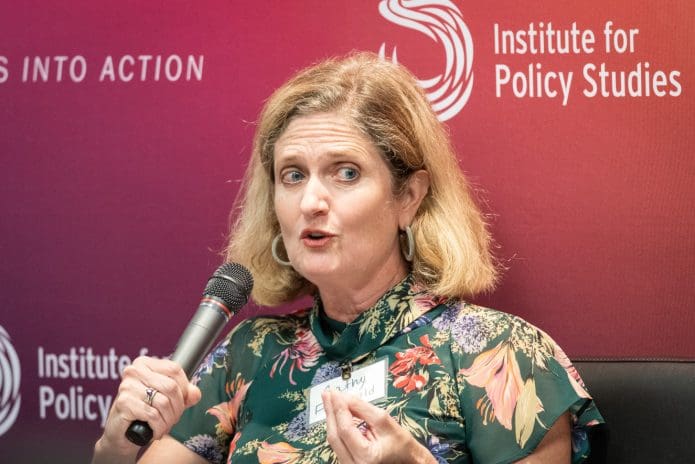
Cathy Feingold (16:23): Great. Thanks so much. And what a great panel to be a part of, and thanks for kicking us off.
I feel like the labor movement is built to take on the challenges of the moment right now. I sit in the space of both the domestic labor movement, where we represent 15 million people — and we are currently on a bus tour, if people aren’t focused on that, all throughout our country, talking to working people about what is happening in this country. I know you talked about a lot of those issues this morning. And then the global labor movement represents over 200 million workers around the world, and we are the largest non-governmental, non-military and non-religious organization in the world. So just to sit that there.
And yet, being the largest, we’re not big enough. And that is one of the challenges.
And so the first thing I would say about this moment, something that I have spent a lot of time doing is: we absolutely must be building, expanding, and deepening our partnerships and alliances, both in the U.S. and globally. Now is the time to do it. They cannot be transactional partnerships. They need to be deep and transformative. So I think that is one thing that our infrastructure allows us to do. We are in every country of the world, from Brazil to South Korea, where we have learned from those comrades about the fight back.
South Africa, they have been through this before, Poland…we’re spending a lot of time also exchanging strategies. We did internal education for our movements about what happened in South Africa and South Korea. I mean, if you want to talk about the South Koreans getting out by the millions. They know what it’s like to go back to militarization, they know you’ve got to fight. And so the labor movement, we are learning from our siblings around the world. So one is we need to build these new alliances.
But we’re clear that we are in a moment like we haven’t seen before. And to even try to say, “what have we done before? We can do it the same way” is not going to work. I would say we are in a moment of extreme rupture, as you said, and for us, a new form of anti-worker opposition which is taking power. And the way we see this anti-worker opposition is through the merger of technology, billionaires, state power, and the rise of the far right.
Ruptures in the global economy that folks have probably already talked about…We have climate change. We have new technology. We’ve always engaged with new technology. But artificial intelligence is different. It’s posing new challenges, and it’s being implemented over the heads of working people and with impacts on our environment. So that’s a huge challenge and it has limited safeguards. And there’s a growing distrust in democratic institutions by working people around the world. They’ve asked, “what have they delivered for us?”
And I think that’s a huge challenge we as a movement have to take on. And the right-wing politicians are rejecting democracy and its institutions, the institutions that should be delivering for working people. And then, of course, all of this has led to enormous inequality, which we see in our own country around the world.
And you know, today I was just mentioning to a few people, we’re hosting the leadership of the German and the Canadian labor movement, and we’ve already dug in this morning talking about the shifting alliances. They’re like, “we can’t trust your government anymore.” So what are the shifting alliances? We have the shifting of post-Cold War alliances that many of us grew up with, right? The EU was our friend, and Canada was our friend, and now they’re saying, “I don’t know if we can be friends.”
Now in the labor movement, we can be friends — and that’s what’s so powerful. We are going to continue to build our alliances with the Germans, the Europeans, and the Canadians to figure out what is the new model we need. But it’s a time of massive change.
The other two challenges which are very anti-worker: the elimination of foreign assistance around the world. I’m on my way to South Africa. Just the impact there with trade policy, the removal of PEPFAR funds, which impacted 200,000 working people. The union was working nurses of COSATU, the South African Labor Federation, who were part of that program. So this is real. These are people’s lives. These are working people’s lives. So the removal of development assistance, and then just the chaotic trade and tariff policy, which doesn’t allow anybody to plan or know what exactly is going to happen the next day. You wake up and there’s tariffs over here. Not strategic, and we’re not hearing anything about investment in clean energy or in the communities of working people. Those are some seriously big challenges.
So what are we doing to take them on? First, we’re prioritizing unity in the labor movement. That sounds pretty easy. It’s not that easy all the time. We have 63 affiliates in the United States. So I always say, I sit in the hot seat of representing our union members in the United States and globally. So I get to hear from everybody. Just today, or these past two days, we have the South African labor movement in town, we have the Germans, we have the Canadians. I’m heading to South Africa again, the Brazilians are calling — we’re going to do an event with them.
So maintaining unity both here and with our partners around the world is a priority, because they want to divide us. That is the authoritarian playbook. I have seen it play out in all of my years around the world. I can tell you, in almost every country of the world, which is the government-dominated union federation, and which is the independent. This is not new. They’re doing it in the United States, they’re trying to do it here, which is to divide us.
And so this principle of unity, which sounds sort of easy — “oh yeah, solidarity forever” — it is not that easy when we have the intentional dividing of working people here over trade policies, faux working people strategies that are really not improving the lives of people. So the first thing I would say is, how do we actively engage our global union partners, expand our alliances, and come up with that transformative economic model? This moment of rupture should be one that we take hold of and that we put our agenda forward.
The second one is, again, I’ve already mentioned this, but just want to underscore it. For years, I think many of us in this movement, we do transactional partnerships. “Hey, I’m doing an event. Can you join us? We have, you know, a pro-immigration rally or LGBTQI rally. Can you join us?” Now is not the time for transactional.
We need them to be deep, so that when they are clobbering the labor movement, removing a million federal workers from collective bargaining rights…let me take just a moment to put that number in perspective here. PATCO, which, when I came into the labor movement that was under Reagan, that was the air traffic controllers, that was the line in the sand, that was the worst you could have done to the labor movement. That was 13,000 workers. Okay? Then we went on to Scott Walker, governor of Wisconsin, who was removing collective bargaining rights. And that was, for those of us that have been doing this for a long time, that was the worst, right? He was going to eliminate collective bargaining rights for 200,000 workers.
[Now under Trump,] a million workers have lost collective bargaining rights. That means we already have rising inequality. A million people without the ability to bargain over wages, to feel like they can speak out and criticize this government. So these are working conditions right, where we don’t have collective power. This is a huge issue.
We can’t be transactional around it. We have to deeply understand what it means when collective power is being eliminated in our country, because when it’s eliminated here for labor, it’s eliminated for LGBTQI, it’s eliminated for immigrants. We are all losing when that kind of power is being attacked. So deep partnerships.
Thirdly, we need to recognize that our work is about power. It is not just a battle over here, a battle over there. This is about power. So what do we need to do to address power? We need to figure out how we collectively shape the politics and the policies needed to allow working people to live with dignity, to address the climate crisis, to have a vision for sustainability. And we do this by organizing workers. We cannot do this by focusing over here on the attacks on our movement if we are not growing our movement.
So we’re teaming up with an organization to train unions around the world and refresh them on how organizing must be a priority. Yes, everyone’s looking at what’s happening in the U.S., horrified. People are struggling with the elimination of aid, and a lot of that money is going into defense, as Phyllis and I have talked about.
But organizing. Unions must — we can’t do one without the other. We must be organizing so that when it comes time to fight for the rights of immigrants, LGBTQI workers, everyone in our community, the environment…we must have power, and that has to come through organizing. So we’re spending a lot of time organizing, especially in some of the hardest places to do so in the U.S., such as the South, which is that way for historic reasons.
At the global level, let me just talk a little bit about what we’re doing. One is we’re putting ourselves in uncomfortable situations. So we might hear on August 9, they’re reviewing whether or not this country will fund multilateral organizations. But our movement is global. We will define what multilateralism looks like. I don’t hope that they pull out all of the money from multilateral institutions.
The labor movement is also putting ourselves in uncomfortable spaces. We have a table at the BRICS. Those aren’t spaces that most progressive movements are engaging with, but we have a trade union table at the BRICS. And that was because some of our most progressive unions out of South Africa and Brazil said, “hey, you know, the world is changing.” We need to be in all of these different spaces to figure out who will support working people.
And sometimes it might surprise you. I will give an example. I was just at the International Labor Organization. Our country was standing up and asking to remove words like gender, sustainability, etc. And some of the most conservative countries were like “enough already.” Like enough. Some of the countries who traditionally haven’t been great on these issues, they were annoyed at our own country removing these.
So at the global level, what else are we doing? We’ve launched something called the billionaire coup against democracy. We’re doing a democracy campaign, and we are shaping a vision for a better world for workers around the world.
Let me just go through the key components of that. Fair taxation. So there’s the UN convention that’s moving. We’ve worked a lot at the Organization for Economic Cooperation and Development to get a minimum corporate tax. Strong regulations — they are rolling back at the Department of Labor as we speak, key regulations to making you all stay healthy in your workplaces.
But globally, I want to make sure we know what’s happening, which is deregulation is the agenda. The International Monetary Fund and many of those institutions are talking about deregulation. And guess what the U.S. agenda is for the G20, which we will host next year? Deregulation, energy for the future, which is fossil fuel, and growth. That is not a working people’s agenda. So we will be coordinating an L20, a Labor 20, fightback on that, and I look forward to working with you all on that.
Quality education, affordable public services, social protections, which we just gutted in this country. And why that’s so critical is that other countries are looking to see what this administration just got away with and how they might gut their own social protection systems. We are all connected: living wages, good wages, sustainable jobs.
They’re rolling back the clean energy agenda here again. Many of the countries we had worked with, trying to shape their investment into clean energy and offshore wind in this country, some of the high road employers from Denmark, from Norway, who were doing high labor standards with good environmental clean energy programs…how can we continue to work on those?
Equity issues — we’re not going to let them roll back DEI. I’m hearing from my European colleagues how embassies around the world are calling unions to say what are we doing? Corporations are being told they have to roll back their DEI. And they’re like, “what are you talking about? Why are we listening to this guy?” But some of them are muting themselves, which is a problem. So we need to make sure that equity is on the agenda, both racial and gender equity. We’re not going to step back.
Peace and solidarity. Obviously, violent conflicts do not serve the interests of working people. From Ukraine to Gaza to around the world, there is no conflict I know of that is good for working people, so we need to address that.
And the last one I would just say, is we uphold the right to move: the right for people to migrate, with decent protections. And we don’t sort of separate out different groups. We say an injury to one is an injury to all. That is a commitment from the U.S. to the global labor movement, that we are all siblings. We are all in this fight together. It’s up to us to intentionally have a new vision, intentionally put it forward, put every single resource we have…which I started out by saying, we’re the largest non governmental organization in the world and we’re not big enough. We cannot implement this agenda alone.
So every single person sitting in this room, we need you. Faith-based organizations, those working on corruption, tax, peace and security, trade issues, it’s all part of the same economic transformation that we need to be visioning. And I would end by saying we need to have a vision for hope. No one’s going to want to be part of our team or our vision if it’s not a hopeful vision, if what we’re saying is how bad everything is for working people, who’s going to want to join us?
Let’s be intentional for a hopeful vision and that we can be transformative. We can take this time of rupture and transform it for the good, for the planet, for working people. It’s not zero sum. Those go hand in hand, and I think we can get there. So I end with a commitment, both by the domestic labor movement and the global labor movement, we’re in it. We are in it right now. We are feeling it day by day here in the United States and our union partners around the world — they want to see us standing up and fighting. They want to fight with us. They want to be part of this hopeful new vision. So I look forward to working with all of you on that.
Khury Petersen-Smith (30:40): Thank you, Cathy. Keane, I’m gonna round things out with you. So central to pursuing a more just place of the U.S. in the world, in conjunction with a more just domestic U.S. society, is democratizing U.S. foreign policy. This is something that you think a lot about, and I wonder if you can speak today to the question of how to counter the notion that U.S. foreign policy should just be the domain of U.S. officials, and how that democratization translates into a safer world with a more just set of relationships for the U.S. to fit in.
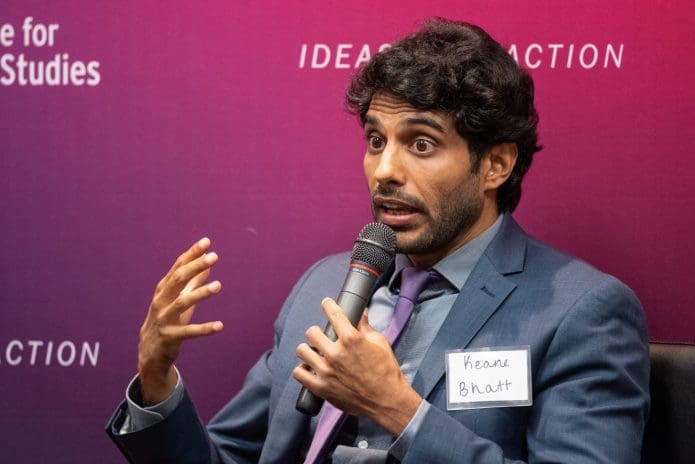
Keane Bhatt (31:18): Yeah. Thank you. First, thank you for having me, and really appreciate all the thoughtful comments from my colleagues here. I was reflecting on this and also in your opening remarks about Henry Wallace, who had this kind of a populist vision for mobilizing ordinary people in the affairs of their government and for a better and more peaceful world.
And I think that in the same way as progressives in Congress are trying to reclaim the legacy of Franklin Delano Roosevelt when it comes to these landmark achievements on labor rights, on union organizing, on unemployment insurance, on Social Security — creating the bedrocks of decent social democracy and how you build that out — similarly, I think that there’s also a an important legacy that FDR left us when it came to foreign policy, particularly when it came to the Good Neighbor Policy, which was a major break from the gunboat diplomacy of previous times, and that fostered a robust egalitarian and cooperative relationship throughout Latin America.
I think that progressives on the Hill are committed to both of those dimensions: advancing a new kind of a Democratic agenda that builds off of that legacy of FDR in terms of social uplift at home, as well as a kind of a cooperative spirit of egalitarianism abroad.
So I want to start there, and I also wanted to build off of an analogy coming from Phyllis’s remarks about how grassroots participation has helped to revitalize international law and create de facto mechanisms for enforcement. I think that there’s a very clear parallel to the rule of law at home, and how that pertains to foreign policy.
The constitution is very explicit that questions of war and peace were the sole domain of the legislature, and the framers constructed that precisely because of the inducements and the attractions that war-making would hold for the executive. And by enshrining in the Constitution the role of Congress as the sole arbiter for such a momentous decision of going into war, that was intended to be a safeguard. And not just a procedural mechanism, but a normative one of trying to decrease as much as possible the incidence of war, so it was a moral position as well.
I wanted to give a couple of examples, because a lot of these foreign policy decisions feel very removed, very distant, and also the domain of these lumbering bureaucracies that are less than transparent, that are less than accountable, and that have a kind of bipartisan character. They just stagger along without any real consequences for the actors who make some of the most disastrous decisions in foreign policy or not. (A good example is an administration official like Brett McGurk, who began under Bush and has continued through subsequent administrations, and is very widely understood to be deeply connected to a lot of the key Middle Eastern policy decisions for the United States government, whether Bush or Obama or Trump or Biden, etc.)
And so I would like to invite all of our participants here who care about these kinds of questions and want to see how to engage to think carefully about Congress, and the role of Congress as being the branch of government closest to the people and most responsive to them. And this may seem to land a little bit flat in light of some of the horrors that we’ve seen in recent months with the passage of, for example, the one big, ugly bill that is going to devastate the poor and the vulnerable to extract greater enrichment for the wealthy and ultra-wealthy, but I’m going to give a couple of good examples to folks to show how we can leverage some of the tools that are available to us and the responsiveness of Congress, particularly the House of Representatives, to effect meaningful changes that have major impacts on the rest of the world.
So the first example is the case of the War Powers Act of 1973. That was passed in the wake of President Nixon’s lawless bombings across Indochina, and it was intended to rein in these kinds of secret wars. The Progressive Caucus led an effort starting soon after Trump came into office to begin to rein in U.S. involvement in the disastrous Saudi-led bombing campaign of Yemen. And this was a rather sleepy issue, it was under-reported, and typically when it was reported, it was framed as the United States trying to provide mitigating roles to try to reduce civilian casualties, to try to advise the Saudi government to bomb less and to bomb more accurately and more precisely, almost as a kind of an independent character, not involved in the actual commission of war.
What we were able to do at the Progressive Caucus was launch a bipartisan measure called the War Powers Resolution that invoked that law from 1973 to trigger votes, accountability votes, over and over again. And we were able to partner with Republicans across the aisle, and we were able to pioneer a very important innovation to the idea of hostilities.
Prior to that effort, hostilities were conventionally thought of as just having American boots on the ground, and we got a lot of naysayers who said, “why are you focusing on this far flung conflict where there are no U.S. soldiers at risk? They’re just flying 30,000 feet above the conflict providing mid-air refueling services for those Saudi jets.”
And what we were able to prove is that if you are able to organize ordinary people to see that there’s a vehicle to engage with their members of Congress, to build co-sponsors, you could actually have a major impact, both on the media landscape and eventually, its passage. And so after a number of votes under Paul Ryan, and then when we were able to take back the majority, we were able to ping pong that Yemen War Powers Resolution between the House and the Senate, in each instance, accruing more and more support, including amongst Democrats who were reluctant or hostile to that effort.
So for example, the former Senator Bob Menendez voted against that measure as the chair of the Foreign Relations Committee in the Senate. Because of the kind of constant grassroots pressure, he relented. He ended up going along with this, along with every other Senate Democrat. And so this was a really good example, because this was initiated in the deep minority, where we had a Republican trifecta under Trump, and then we were able to steadily build so that we were able to pass this War Powers Resolution under Mitch McConnell’s Senate with a simple majority.
And even before it passed, the Trump administration was so fearful of that precedent that they actually unilaterally terminated mid-air refueling services for the Saudi warplanes. And they said, “hey, look, there’s no need to pass this bill anymore. We stopped the thing that you are trying to codify.” And so this is a really important kind of tool.
And to fast forward to the current day: this went from something that was dormant for 40 years basically into something that’s part of the muscle memory of active lawmakers today. A good example of this is the Iran War Powers Resolution, which was voted on just a couple of weeks ago, in which 46 out of the 47 senators who caucus with the Democrats voted for that measure, whereas 52 of the 53 Republicans in the Senate opposed it. But it’s a good example of the way that Democrats were able to restore the function of this tool, to force these kinds of debates, to generate greater media exposure for it, and to build out an ecosystem with the peace movement that has a direct impact on the kinds of considerations that even a Republican administration has to take into account.
I’m going to give you a couple of other minor items to just paint a picture of what else is possible. There are, as both Kathy and Phyllis mentioned, international financial institutions as part of the U.S.-led global order. In the IMF — which has had a lot of problems with the developing world and some of the onerous conditions that it has placed on it — there is another very sleepy tool called Special Drawing Rights. And this is a reserve asset that can be sent out to the entirety of the IMF member states, and it’s basically a costless reserve asset that helps protect vulnerable countries that are oftentimes spending so much of their budgets on debt reservicing, on all kinds of onerous things, and it provides them with a cushion.
And progressives were able to lead an effort to start pushing the Treasury Department, which tends to be the de facto veto entity when it comes to the IMF — which is supposed to be an international institution, but is largely dominated by the [U.S.] Treasury — and House Progressives were able to lead an effort that ultimately obtained all House Democratic support to issue a new big issuance of Special Drawing Rights. That helped influence the Biden administration, which ended up passing this massive financial relief, and it probably helped save hundreds of thousands of lives abroad during a very complicated and very disruptive pandemic that was ballooning the kinds of needs around health care, nutrition, public health measures, and so on.
So this is another kind of an example of how House letters, House amendments, ultimately impacted and influenced a Treasury Department that is typically not willing to go along with these kinds of innovative tools — where it cedes control over a lot of these questions around restrictions on aid and so on, and provide costless, no-strings attached financial support to the entire Global South.
So I’m going to stop there, but I just wanted to give a couple of these examples of the way that Congress interfaces with the Executive Branch and pushes it in the right direction, and I invite all of you to continue to organize around these questions and engage with your members of Congress.
Khury Petersen-Smith (44:18): Thank you so much, Keane. Thank you to this amazing panel. We have a little time for Q and A, we have some of our fantastic Wallace fellows collecting questions. So I’m going to ask this question that I’ll direct toward Phyllis. Though if others want to weigh in, feel free as well. Do you have any optimism that a Democratic majority or Democratic president would break with Israel? Take it away, Phyllis.
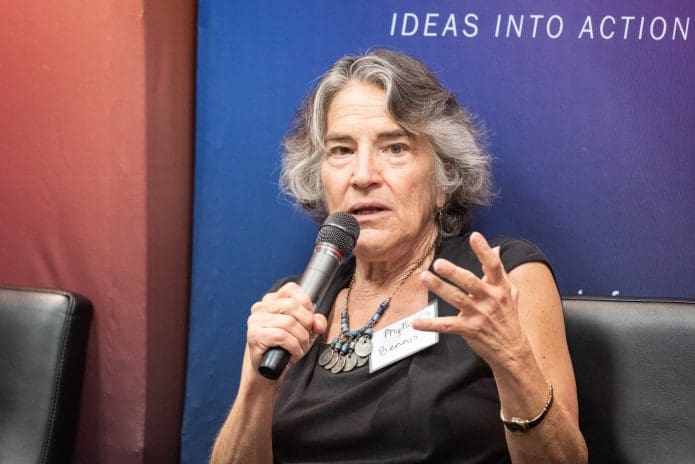
Phyllis Bennis (44:58): That’s an easy one. The answer is not what they would do, it’s what we would do.
I don’t think there’s a president that is currently in the running, shall we say — nobody’s officially running, but we kind of know who some of the people are who are considering it. I’m not sure any of them have any intention of “breaking with Israel.” What has changed dramatically in the last several years has been the people of this country.
You know, polls are a dicey thing — they’re a photograph of a moment. They’re like what do you call it? The photographs that are instant, a Polaroid. A poll is like a Polaroid picture, in that it takes a picture of that moment and it could change the next day and often does. But when you see a bunch of polls over and over again, all trending in the same direction, then you need to take them seriously.
So the fact that, for example, 77 percent of Democrats now say there should be no military aid to Israel, period full stop, that’s staggering. We never imagined something like this five years ago in the Palestinian rights movement. 61 percent of all voters say that. It’s never happened before.
Now so far, that’s not been enough to make nervous vote-getters nervous enough to change their positions. But right now, the gap between the base of the Democratic Party and the electeds within the Democratic Party is greater than the difference between Democrats and Republicans on the substance. So that’s something that if there are elections, they’re going to have to take that seriously at some point.
Now, the threat of what happens to elections is a very real one, but I do think that we have to recognize what has changed and hold people accountable. So this is all about us again. What do we do with those facts? I promise you, the majority of people, and I would bet that most, well, I won’t say that…I would say that a lot of people even within the Progressive Caucus, don’t know that stat, don’t know that poll. And it’s up to us to make sure they hear it.
There are folks, some in this room, that spend a lot of time running around the halls of Congress trying to change people’s minds there and doing a good job of it, and using those polls. We need more of that. We need people going to their offices in their districts, when they go home for weekends, etc. Go to the barbecue, and then raise the question: “why are you still voting this way when the vast majority of your constituents, who need to elect you next time if you want to get elected again, disagree with you?”
So it comes back to us. Left to their own devices, the answer would be absolutely not. But it’s not as easy as that, because we have something to say about it.
Khury Petersen-Smith (48:08): Beautiful. We have time for one more question, and it’s a great one for each of you to respond to briefly. How do we invest and in which ways should we do so in order to ensure that we have an electorate knowledgeable and passionate about foreign affairs and global justice issues?
Cathy Feingold (48:39): I think that’s a great one, and one that I spend a lot of time thinking about, given the fact that I represent a very diverse population that voted on both sides of the aisle, right?
I mean our movement, and I like that, because it holds me accountable, when we talk about accountability, that I don’t just get to come up with my grandiose ideas. You actually have to speak to where people are and the values they’re holding that make them vote the way they are. So I would just start there. This is really hard work.
So that’s why, as I’ve mentioned already, we are doing two bus tours, and they’re going to different sides of the country to just talk to people about what is happening. And it’s bubbling up. Each community is deciding what’s most important to talk about, and it often is not foreign affairs issues or foreign policy, which I think is a challenge.
But one thing we do try to do is bring these issues in from where they are. For some people, it’s the job, and they’re working for a multinational company, and they’re very aware of what is happening with supply chains and with the world around them, or it’s the clean energy transition that is impacting the way that they’ve done agricultural work, right? So we’re trying to build a conversation around foreign policy that is less top-down and more bottom-up from where people come from. Or you come from another country and are nervous about this, right?
I’ve been trying to crack this up for a very long time. It is not easy. When you just say the words “foreign policy”…and if you all remember the fights about the Trans-Pacific Partnership, the result of that was we had our National Security Advisor come out with Foreign Policy for the Middle Class, right? That was sort of a response. They went to Carnegie, they said “something went wrong with the TPP, maybe those people were right. It wasn’t going to be good.”
They came out with Foreign Policy for the Middle Class and they tried to implement it in the last administration. It really didn’t go very far, right? Because, again, it was top down. It was like, “here middle class, here’s the foreign policy we’re going to give you.” And obviously, as we’ve heard, it wasn’t a foreign policy that people wanted.
And so I guess the part I would say is, when you think about foreign policy not as a top-down — which is basically how everyone in DC sees foreign policy, very top-down — and instead see it as something starting from people’s real lived experiences, that is a different starting point. People live very global experiences. They have families spread out from the world. They have stories about how they came to this country. They have jobs that are part of supply chains.
So we need to start there, and we need to do deep education with people about how they’re part of the movement to shape foreign policy issues.
Phyllis Bennis (51:12): Really quick, two things, and both have to do with movements. One is that all of our movements — the labor movement, the LGBTQ movement, the women’s movement, the anti-racist movement — all of these movements, their people are impacted by foreign policy. They need to make those demands their own demands, so that we’re not just talking about the anti-militarism movement that’s out there, the Palestinian rights movement that’s out there. There’s a role, an important role, for those specific movements and organizations, but we need every other movement to make this part of their work.
And the way to do it — and this is the second part — is to draw on organizations like our own National Priorities Project at IPS, whose job it is know how to read the federal budget, and particularly the military budget, and give all of us the information about our own community, our city, our state, our country and how they are affected. We can then tell people where that money is going and what it could be used for if it wasn’t going to bomb children in Gaza. That’s the reality of it.
It’s so easily accessible: nationalpriorities.org. Go to the website, go to the workshop that Lindsay is going to be talking about in a few minutes, because she’s the director of that program and will be leading that workshop, but it’s the way that U.S. people are the most immediately and directly impacted by our militarism around the world.
Militarism at home is a reflection of the militarism abroad. And one of the ways that plays out is through the almost trillion dollar budget now and the more than a trillion dollar military budget for next year — that money is coming out of SNAP and Medicaid and all the things that actually keep us safer.
Keane Bhatt (53:02): I just want to echo everything that my two co-panelists have mentioned and emphasize a couple additional examples of making those connections. Stagnant wages are directly related to failed pro-corporate policy that pits vulnerable people abroad against their counterparts here at home.
The kind of challenges that we’re dealing with in immigration — a lot of the populations that are coming here are coming because of policies related to broad-based economic sanctions designed to destroy entire economies. They’re related to weapons transfers and the hyper-militarization of a lot of governments. So when you’re talking with your family members, and these kitchen table issues, and also the kinds of issues that are being seized upon by cynical right wing actors, these all have those kinds of linkages. So making those connections and providing an affirmative agenda for what a just future looks like for the rest of the world also has a direct impact here.
My last point: when you cut off USAID and some of the important work that’s going on there, where do you think the next pandemic is going to come from? The fact that we weren’t able to modify our intellectual property rights regime so developing countries could quickly mobilize the development and implementation of vaccines allowed for subsequent waves of new variants of the COVID crisis. This is not ancient history, it’s all directly related to the points that you have all made. Thanks.
KP-S (54:49): Thank you so much, Keane. Thank you all, and on with the program.


