

VIDEO: Defending and Reimagining Democracy


Below is a lightly edited transcript of the closing conversation between IPS executive director Tope Folarin and panelists Lisa Gilbert and Osita Nwanevu at our second annual Wallace Symposium, which brings movements together to fight fascism and envision a more equitable future.
Tope Folarin: I think we should get started so we can get to the reception on time. It’s so wonderful being here. I am so glad that we’ve had this day together. I have certainly learned a great deal. It’s been wonderful to see these conversations playing out and to think deeply about the legacy of Henry Wallace.
As you will see, we are missing one panelist, the great congressman Jamie Raskin. There’s a chance he might join us, but he’s otherwise occupied. He’s on the Hill doing serious things, but if he does show up, we’ll make space for him. We’ll incorporate him into the conversation and will proceed accordingly.
I also want to make it clear that IPS is a 501(c)(3) organization, so at least my questions will be within those parameters. We’re non-partisan. We care deeply about ideas and policy, but we’re not advocating for any particular candidate or another. So just wanted to make that clear at the outset.
I’m really excited about this panel, which we’re calling defending and reimagining democracy, and I want to introduce our fantastic panelists.
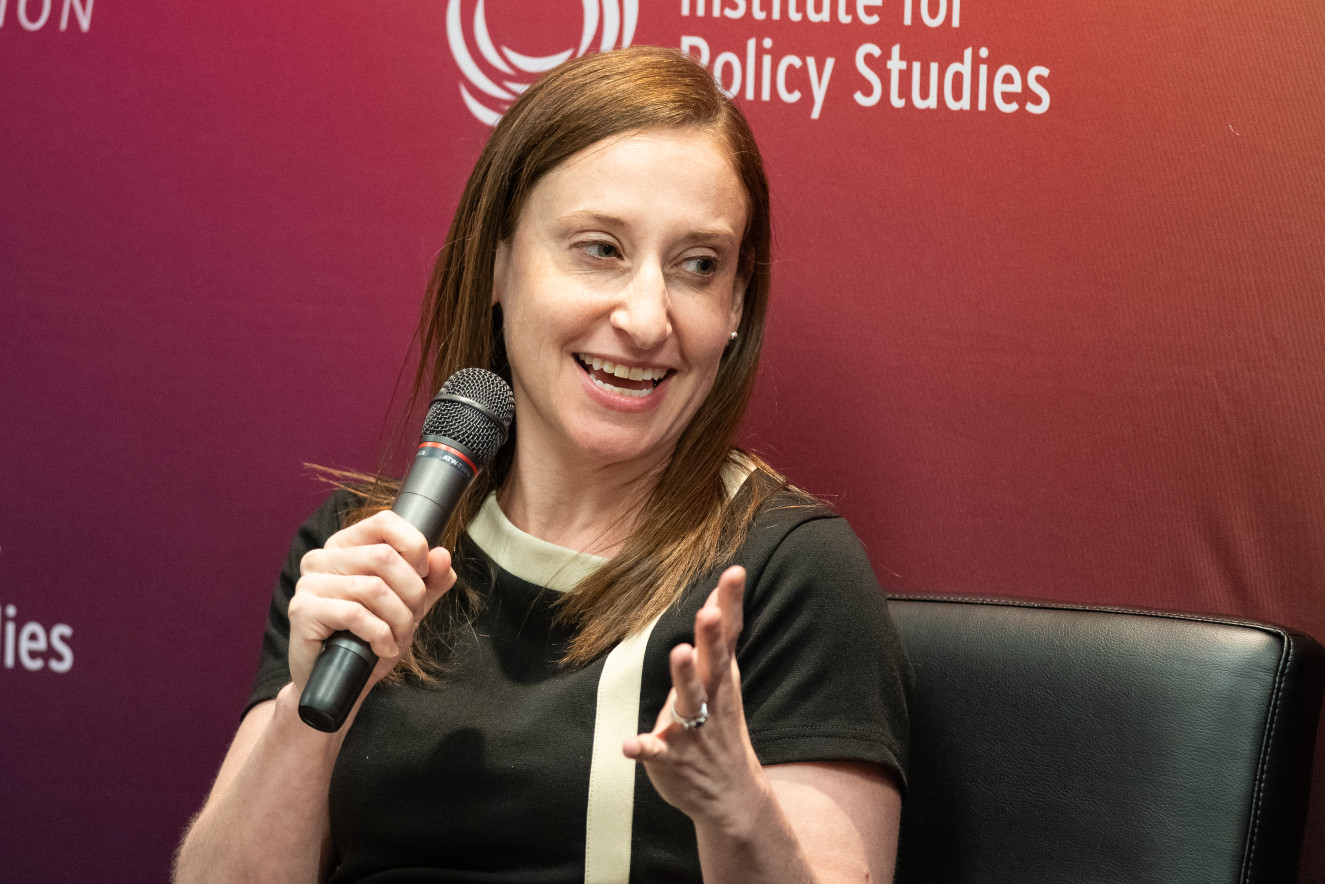
To my left is Lisa Gilbert. She is co-president of Public Citizen and co-founder of the Not Above The Law Coalition. She leads efforts on government ethics, corporate accountability, and defending democracy from authoritarian challenges. Thank you for joining us.
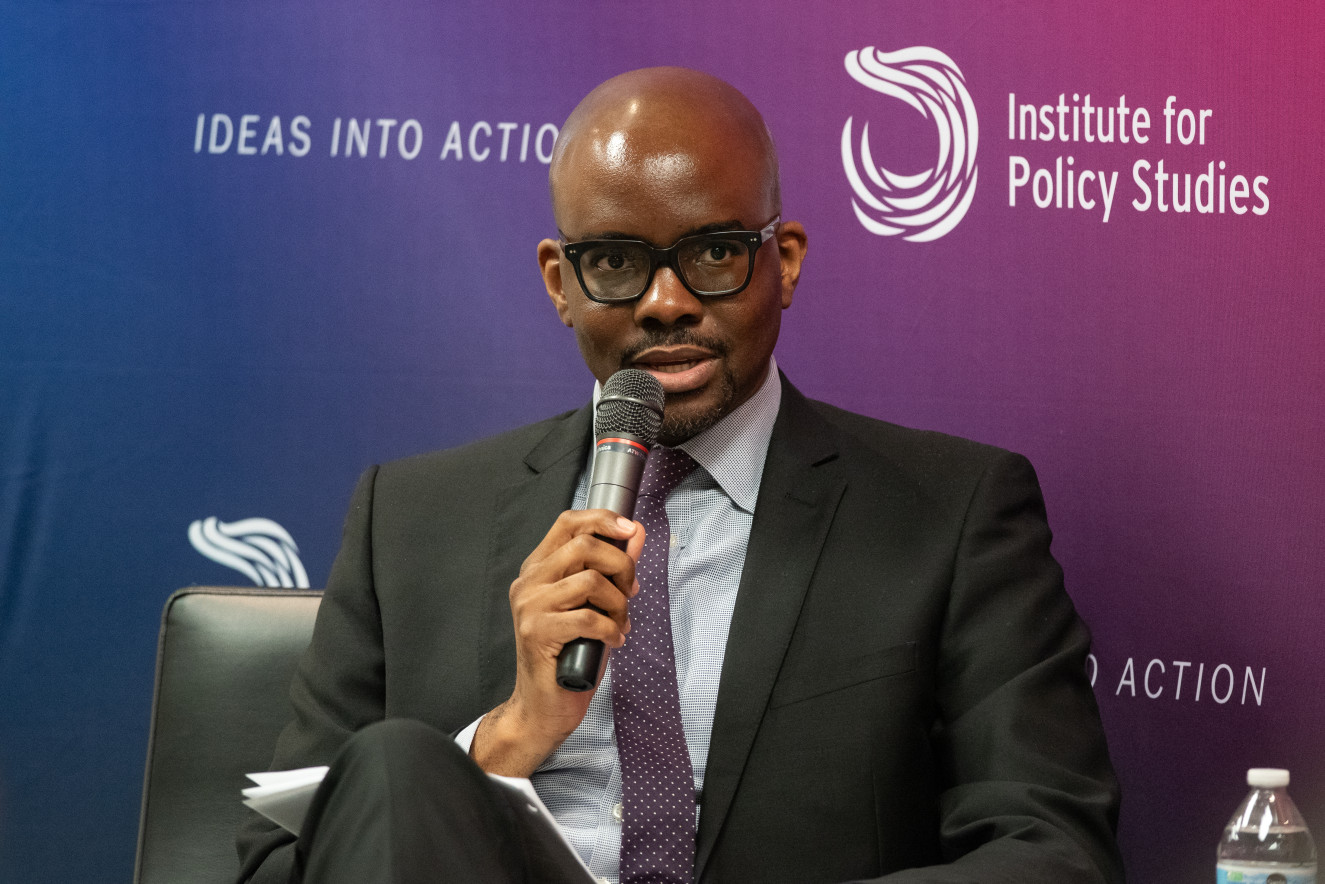
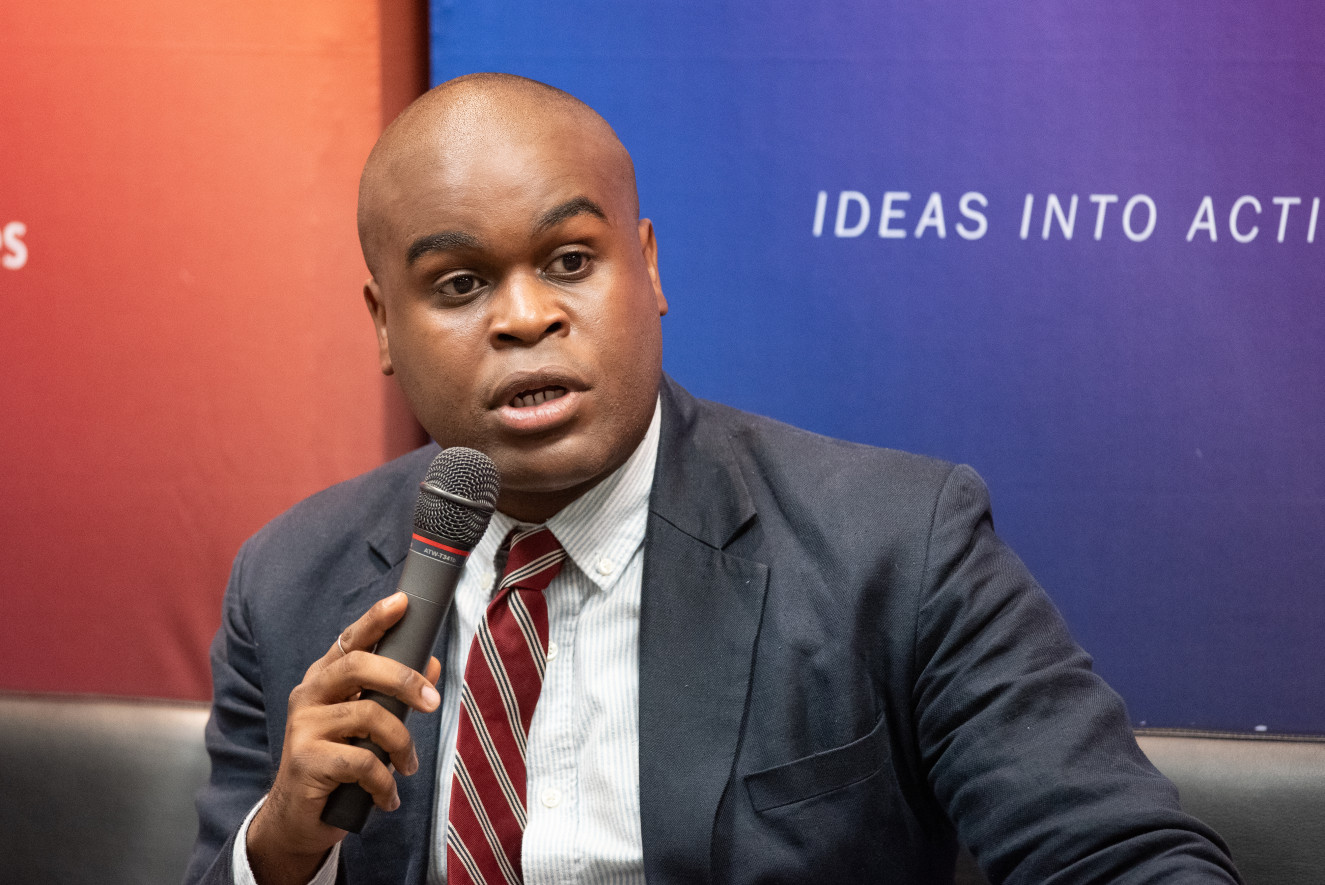
To her left is Osita Nwanevu. He’s a contributing editor at The New Republic, and columnist for The Guardian. His forthcoming debut book is called The Right of the People: Democracy and the Case for a New American Founding. It offers a bold vision for rebuilding democratic institutions. Thank you so much for joining us, Osita.
I wanted to start with a question for both of you, and it’s taken from an essay that we’ve spent a lot of time thinking about and reading at the Institute for Policy Studies. It’s Henry Wallace’s famous 1944 New York Times essay that’s called “The Dangers of American Fascism.” I want to quote a passage from that piece and then ask you to respond to it.
Wallace wrote, “The American fascist would prefer not to use violence. His method is to poison the channels of public information with a fascist. The problem is never how best to present the truth to the public, but how best to use the news to deceive the public into giving the fascist and his group more money or more power.”
So my question to both of you is, in this age of disinformation, media consolidation, and assaults on democratic truth, what strategies can we use to reimagine a public sphere built on transparency, equity, and collective trust? And I wanted to start with you, Lisa.
Lisa Gilbert (03:05): Well, thank you so much for having me, and Public Citizen is also thrilled to be one of the co-hosts of today’s event, so I just want to appreciate everyone else who’s been here all day.
This is an important question in this moment. I think information has become even more channeled into silos. People only view trusted validators as the sources where they can glean what they depend on. That means different things to different people. To young people, that may mean they get their information from Tiktok. You know, to those who still tune in to cable news, it’s MSNBC, it’s Fox, it’s these very different perspectives.
And I think it’s almost impossible to break through those silos, and there isn’t really a current silver bullet to do so. But I completely agree with the premise that these silos are exploited by authoritarianism, by fascism, by those that want to put forth a particular perspective. They know they can get it into one of the silos and then have it permeate until it feels like it’s the truth.
So a couple of things we can do, which are all unfortunately fairly long-term, but one way to think about tackling this problem is making sure that tech platforms are actually held accountable for what they put forth. You know, mis- and disinformation is currently just allowed. On the platforms that I mentioned, there’s no accountability from Meta or the other entities that allow it to percolate. We can’t trust companies to self-police on this, and so the requirement is legislation to put guardrails into place and regulations to follow. So I’m just putting it out there as one solution.
I think the other one I want to proffer is putting truth up, propping truth up, and giving it more air. I think there are still other trusted validators: there are local businesses, there are educators, there are mayors, there are people that in local communities are trusted. So figuring out ways to ensure that those voices are also loud — one way to counter mistruth is to pull the truth up and make sure more people hear it. So that’s the other thing I’ll put forward as a solution that we should grapple with today.
Osita Nwanevu (05:27): Yeah, on my end, as far as specific and concrete strategies are concerned, I’ve always been a fan of public media, going back to when I was learning my ABCs with Sesame Street.
I think that there is something really, really important and valuable — and you see this in Europe, especially — about having a journalistic infrastructure that is at least partially non-commercial, non-partisan, not designed to sell you something, not designed to push your buttons, but to get you the information that you need. And we really need to invest in that more seriously in this country. We never have. I mean, we’re at this point where, obviously the public media is under attack in a new way, but we’ve never invested as much as we should have in public radio and PBS and these kinds of things. We should do more, and we should do more specifically, I think, to revive state and local journalism in particular.
I think one of the things that people have come to understand or to believe is that we have ourselves in this kind of nationalized political environment, partially because people used to have the means to understand what was going on in their statehouse, what was going on when it came to funding a particular school.
This was the kind of political information people were taking in back in the day and in the absence of the newspapers that used to provide that information, people now get their political news and information from nationalized sources. They play into or feed into nationalized narratives, and that’s how they understand their entire world. And I’m not saying that there’s something intrinsically wrong necessarily with national narratives, and I’m not saying that you can’t be a demagogue about potholes. You can be a demagogue about anything, and obviously local issues can be very contentious. But I think we’re all understanding now that there’s something fundamentally out of whack with our politics, and that’s partially because people don’t have the means to see materially, concretely, what are people doing in politics that affects me directly, in a concrete way in my community.
Instead of that material, they’re reaching for extraneous things. They’re talking about Jeffrey Epstein, they’re talking about the Green M&M, they’re talking about all this nonsense. And I think that’s not healthy, and I think one of the ways we can fight back against that is rebuilding a real journalistic infrastructure, particularly when it comes to covering state and local politics.
Tope Folarin (07:43): That’s really appropriate, especially considering what’s happening now. I mean, like on the hill, there’s a push back against PBS and public media, so your words are incredibly important. Osita, I wanted to stick with you. I’m among many who’s been reading your work for quite some time, and so I join a bunch of people who are really excited about your new book that’s coming out.
Again, I’ll mention the title. It’s called The Right of the People: Democracy and the Case for A New Founding, which is being described as a bold case for reimagining the American project and making American democracy real. We have spent a lot of time today talking about democracy and what it means and who it applies to, and how to reconstruct and reimagine democracy.
I had another question for you, but I hope you don’t mind if I ask you a slightly different question, what do we mean by “A New American Founding?” Why is that part of the title of your book?
Osita Nwanevu (08:33): It’s a call to really fulfill the promise of American democracy. One of the provocations of the book is that I don’t think we have a very democratic system, and we should see democracy in America is not something that they did 230 something years ago that we have to dust off and protect — it is an ongoing project of creation that we need to invest ourselves, and we should see ourselves as founders.
There wasn’t just one generation two centuries ago that founded democracy for all time. We, on the basis of, I think, more egalitarian principles than they had, knowing more about governance than they do, knowing more political science than they did, have as much of a right, if not more, to see ourselves as part of the project of fundamentally reworking, renewing, actually, from my perspective, creating American democracy for the first time. And that’s a bold thing to say, but I think that that’s where you land when you think from first principles about what democracy actually means.
It’s a word we’ve come to take for granted. We use it all the time casually, but democracy is extremely complicated. It’s a thicket of vexing ideas, and we’re in a place now, obviously too, where many Americans don’t take it for granted, as much as we might in this room, that democracy is a good system, that it has values and virtues that are worth preserving. I think that Donald Trump succeeded in politics partially on that basis.
There are people who didn’t really think that he was either a threat to democracy, or to the extent that he was, they thought that there are more important things that they should vote on. And that’s dangerous. We need to be making an affirmative, robust case for democracy. What the Democratic Party tried out in November clearly did not resonate with the kind of people that it needed to resonate with, and so we’re in a position now of having to articulate a robust defense of democracy, and I think we’re going to be in a bad position to do that if we’re not defining it really coherently and tightly.
So in all that I read and all that I worked through in writing this book, I really could not find a more succinct and coherent definition of democracy than the one that Abraham Lincoln functionally gave in the Gettysburg Address: “government of the people, by the people, and for the people.” Another way of putting that is democracy is a system in which the governed themselves govern. They’re not entrusting governance to some higher superior authority.
Tope Folarin (11:01): [Lights go out in the room temporarily.] Anti-democratic forces are at work!
Osita Nwanevu (11:04): There here always, you have to remain vigilant at all times. They’re not entrusting governance to some other higher authority that’s better than them. They themselves are taking upon the responsibility of governing themselves, right? And that all sounds well and good, but I think to really get a granular sense of what democracy means, you have to think about the principles at work within a democratic system. I think there are three that you really have to emphasize.
One is equality. Everybody who is party to a democratic decision has to be in equal standing. If that’s not the case, you leave the door open to some superior class of people being the ones that actually get to make the decisions that matter. A democratic system is responsive to the government. When the governed speak, they speak with authority, and the system is obligated to respond in some way to what they’ve asserted.
And the last thing is majority rule, or majoritarianism. There are a lot of different ways a group might make a decision collectively, but majority rule is the only one consistent with the principle of equality. When three people want something and two people want some other thing, there is no way that the two people win out unless there’s some kind of inequality at work, right? These seem like very basic, common-sensical principles. I think that people kind of accept them when you say them that way, and yet we live in a political system that flouts all of these things in basic ways.
We are sitting right now in a city, Washington, D.C., of 700,000 people who do not have a full and equal voice in the federal government. They’re among the 4 million Americans for whom that is true. The one delegate that D.C. has in the house, Eleanor Holmes Norton, does not have a vote on the final passage of legislation in the House and in Congress. That is democratically untenable. D.C. is, in fact, governed more intimately than other parts of the country because it is a constitutionally created city. It has become the play thing of Republican members of Congress and other parts of the country, right? But there are 4 million Americans for whom this is true, mostly in Puerto Rico. And I don’t think there’s an honest definition of democracy that allows us to say that those people are living in democracy today. They’re not.
Even those of us who do have some kind of a say do not have an equal say, obviously so. California, a population of about 40 million people — if it were its own country, it would be one of the 40 largest in the world, one of the largest economies in the world — it has the very same number of seats in the Senate as Wyoming, a state with, I think, under 600,000 people. [Wyoming] is smaller, in fact, than Washington, D.C. So on a mathematical basis, when you divide representation by population of each state, that resident of Wyoming has about 67 times the representation in the Senate as a resident of California, right?
That’s not a purely academic fact — that matters. That disparity speaks to the reasons why we can’t pass the gun control policies most people in this country want. We can’t pass immigration reform, which most people in this country want. We can’t do the environmental work most people in this country want. And I think it also speaks to why the President of the United States can send troops into Los Angeles without having to worry very much about what the people of Los Angeles think, or that there’s going to be some kind of political backlash against him, because there might not be. California is, again, not represented adequately in the Senate, not an important state when it comes to winning the Electoral College.
This matters. And I think we’re in a position where we can no longer pretend that it doesn’t matter. It does. It shapes policymaking, the Senate shapes the judiciary, it shapes the Executive Branch. And these disparities are only getting worse and worse with time. I think we’re at a point where if we want to really solve the problems we face in this country, we have to deal with these basic inequities or we’re going to find ourselves pulled more deeply and more rapidly towards authoritarianism.
Tope Folarin (15:05): Beautifully said. Thank you so much for that. Lisa, one of the reasons I’m so glad that you’re here is because you’ve been thinking about the question of tech and policy and politics, and a few times here we’ve mentioned the rise of AI and its ubiquity. It’s everywhere; everyone’s using it.
In my other life, I teach at Georgetown, and my students are using it. Everyone’s using it all the time. And I don’t think we’ve fully grappled with a few things. One, just how profoundly it will unsettle society. It’ll change our relationships with each other and with power. And secondly, the sheer amount of money that’s flooding into these companies, the sheer amount of insane money, which means power that’s flowing to these companies that are putting out chat bots and whatever successor technologies take their place.
I wanted to ask you, what are the key threats posed by tech money in politics right now, and how should progressives respond to that?
Lisa Gilbert (16:14): Well, it’s a very provocative question, so thank you. I think that tech money, corporate money in general, but tech money in particular, has become one of the most pervasive forces in democracy over the last two years. They have become some of the most dominant players in our elections, and it’s the traditional “Big Four” tech companies like Meta and Apple, but it is also these new entities. It’s AI, it’s crypto.
Crypto in particular was one of the biggest players in 2024. Forty-four percent of all of the corporate money that came in came from crypto backers. It’s a massive amount. An even wilder stat is that crypto money is 15 percent of all of the corporate money that has been spent since Citizens United fifteen years ago. It’s an insane volume. It’s hard to even quantify, and even crazier when you think about the fact that crypto has only been around for a couple of election cycles. Ninety-two percent of the money they’ve ever spent was in 2024.
So it’s hard to get our arms around this, but the volume is massive, and what that brings is immediate dividends to policymakers. They poured most of this money through a PAC they called Fairshake. It was non-partisan, it went to Democrats and to Republicans, with the idea that they should prop up those that are supportive of crypto and take down those that are skeptics. And we’re already seeing the consequences, even before this new Congress came in, before Trump got here. One of the SEC commissioners, the Minority Commissioner, went through unanimously in the last Congress, but she was painted as a crypto opponent, and she couldn’t even get a hearing in the Banking Committee because people were so nervous about crossing crypto.
We’re seeing it now, we’re seeing it actually today. There are votes on pieces of legislation, A Stablecoin bill, that will make it easier for crypto to permeate. We’ve seen the idea of a reserve, a Bitcoin reserve for the nation. And even worse, the absurd, profit-off-the-presidency action of Trump having his own meme coin. I’m sure you all saw, he advertised, we think illegally, his meme coin by offering people a private dinner at his golf course, offering people tours of the White House with him there, so they would buy more of his meme coin while he is in the Oval Office.
So the levels of corruption surrounding crypto and AI — I’m focusing here on crypto because of the sheer amounts of money — but AI money is flowing too, it’s really intense, and I think it’s definitely changing in real time how politicians are voting and what is happening in Washington.
So, what should progressives do? What should everybody do? I mean, the remedies are actually not new. You know, corporate money has been a problem since Citizens United and before, but exacerbated by that decision 15 years ago. What we need to do, first and foremost, is overturn the Citizens United decision. Short of that, on our way to that, we also need more disclosure of how the money is flowing, so we can better understand how these decisions are being made.
We need shareholders to have more checks on the corporate money that’s flowing. There’s a reputational risk associated with publicly traded corporations playing in politics, so we need to provide checks through shareholder democracy. And then we need public financing, which is something I know we’ll talk about more later in the panel, but we need to give regular people a louder voice in the meantime, so we can combat and level the playing field from what these corporations are doing.
Tope Folarin (19:57): Thank you, and thank you for that focus on crypto as well, that’s also incredibly important.
Osita, part of the reason why we’re holding this conversation is because we want to focus on vision and what it means to have vision, especially at this moment, at this juncture in American history. The difficulty of coming up with a vision that empowers people and encompasses our ambitions, but that also enables us to work consistently towards a goal and to achieve it.
I was going back to read some of your work, and I came across this quote in an essay that you wrote for The New Republic in 2020. I’ll read it now and then ask you to respond to it. So this was a few years ago, but I think it still applies in so many ways.
You wrote: “A substantial portion of the American electorate and many of our political elites value technocratic and administrative competence or the appearance of either over political vision. Another enemy of progress is a political culture that dissuades us from pursuing grand schemes no matter how much we might want them.”
What does it look like to build a political culture that encourages political vision and makes it achievable?
Osita Nwanevu (21:10): Well, I mean, I think that part of that is supporting and fostering people, candidates, leaders who offer that vision. When a candidate like Zohran Mamdani, for instance, comes around, you don’t harangue that person with a bunch of nonsense. Even if you disagree with them on certain things, you try to work with them and establish a dialogue with them.
And funnily enough, that piece was in part about Andrew Cuomo, who, in this period, was being framed as an American hero by the press. And I couldn’t really figure out for the life of me why he was doing things that were very similar to what other governors were doing, but he was also doing these press conferences where he told people to cover their mouths when they were coughing, and this made him like a great statesman or something.
And I wrote part of this piece about my puzzling at why that was, and I think what I came down to is that Andrew Cuomo is somebody who projected competence, projected a particular kind of leadership and ability. He doesn’t have grand political visions and schemes and so on, but he knows how to get things done, and that’s what really counts. I think that’s the basis upon which a lot of the people in the press lionized him at the time, and people in Democratic Party did, even though, and this is before we knew about the nursing home scandal, even though people were making critiques of his administration.
And frankly, I think that’s the basis upon which, in this last election, people rallied behind him. It was about this kind of image of competency and control, and that kind of vision of what leadership is about, even though he left office in as much disgrace as a politician can. And that was real, it was striking to see people in Democratic Party in New York City rally behind him in spite of that.
So I think part of it is having a different sense of the kinds of politicians and candidates and leaders we even want and desire and are willing to put our faith and support in. And I think that Mamdani is one of those people, and there’s a lot we can learn. I think about the fact that he’s been treated the way that he has. We’re in this conversation now about policy bottlenecks and difficulties that we have in building and achieving great things, the abundance agenda, and the extent to which we are shooting ourselves in the foot with certain policy mechanisms that we ought to change. I think there are reasonable and important debates to be had in that realm, that we don’t have to get into at this particular point in time.
But I think one of the other obstacles is, look, if you think that we should be changing certain things about policymaking in order to achieve big things, you have to be telling people that we want to achieve big things. You have to have a vision that animates the desire to improve, to reform, to remake those bottlenecks in the first place, and I think we have a lot of people making technocratic complaints about technocratic issues without the kind of larger vision.
What is the actual thing that you think we’re going to do when we fix this stuff? What is the actual large-scale vision you have for reforming American healthcare, reforming housing in this country, reforming the environment, what is the large-scale, grand plan that you have? Because that, I think for a lot of people, is the stuff of politics. Especially at a point now where our problems are so large and getting larger, you have to have a background vision and part of having that is fostering, supporting, and backing candidates who speak in those terms about politics.
Tope Folarin (24:34): Thank you. I also want to note that in about 10 minutes I’ll be asking for questions. So if you have any questions in mind, we’ll use the same system we’ve been using. You’ll get a note card and a pen if you need it, you can write the question, and then I’ll take the question up here.
Staying in this realm, Lisa, about the influence of money in politics and how some candidates are pushing against that. Public Citizen is championing expanding public financing of elections. How might small-dollar donor systems and public financing reshape not just campaign funding, but who runs for office and ultimately, who democracy serves?
Lisa Gilbert (25:16): So we are longtime champions of public financing, as you know. I’ve already mentioned it as one of the remedies we think is incredibly important.
Right now, our political system favors those who have a Rolodex and can reach out to major donors, and it makes it incredibly unempowering for everyone else. The idea that what you need to run for office are connections and big dollars, and if you don’t have that, you cannot step up to the plate, is incredibly discouraging and really hinders the diversity of those who can run. So public financing, first and foremost, allows more people to take the stage, to step up to the plate, whatever metaphor you want, and run.
In addition, it grapples with one of the systemic problems in our system, which is that people do not trust that politicians are there for anything but their big-dollar donors. The whole example I ran through around crypto is illustrative of the realities of our political system right now. If you run for office, you are absolutely going to take into account those who give you the money that made it possible and their K Street lobbyists. So taking that out of the equation by leveling the playing field, by allowing regular people to also have a voice and to contribute in an equal way, just changes the dynamic incredibly. And hopefully, if we ever have it implemented at the federal level, it will help to begin to rebuild trust in government, which is sorely lacking right now.
There are a number of different types of systems. There is a system wherein you give a contribution and then it is matched at a five to one rate, or a six or nine to one rate, so elevating your contribution. There are systems in some states where vouchers are provided, where you can use that to contribute to politics, and systems where there are tax breaks or incentives for contributing a small-dollar amount. Whatever system is put into place, the point is to make sure that regular people, that all of our voices, are equal to that of the corporate and special interest donors who right now have the power.
Tope Folarin (27:30): Thank you for that. And really well stated. I think anyone who knows me knows that I’m obsessed with the intersection between culture and politics and policy, and the fact that we need to be attuned to what’s happening and speak to culture in all kinds of ways, and that that needs to be a relationship that goes in both directions.
And Osita, you’ve written about this as well. I particularly loved reading an essay that you wrote for The New Republic, I think it was last year if I’m not mistaken, about Tom Wolfe. It’s a piece about Tom Wolfe and how pop culture became central to serious criticism. And you write “being articulate about the inarticulable for Wolfe demanded the adoption of a now standard critical posture: taking popular culture seriously and viewing its products and developments as worthy of close study, if not respect.”
How can progressive movements harness pop culture, not just high art or critical literature, but the everyday cultural narratives and spectacles that shape public life, to articulate a richer democratic imagination and help reweave a shared public culture?
Osita Nwanevu (28:42): So I have a lot of thoughts about this. I mean, I have a lot of thoughts about everything, but it’s something I’ve been thinking about a lot, especially as I’ve finished this book and looked at the next things I’m working on.
One of the things I’ve always been interested about in politics is the fact that conservatives have a cultural agenda, and progressives don’t really to the same extent. Conservatives really, really care about cultural power and cultural influence. If you talk to people on the right during the first Trump administration, you’d hear them say things all the time like, “progressives have all the power in this country. The left rules this country.”
And you say to them: “what are you talking about? You have the presidency, you have the Senate. You have or had the House. You just locked in a majority on the Supreme Court for God knows how long. You control state governments totally across this country. What are you talking about?” And they’ll say something like, “well, I saw a transgender person on Good Morning America, and that’s what really counts.”
Conservatives care about culture, because I think that they have a particular vision of what they want from American society and the role culture plays there. And they’re thinking about this and talking about this all the time. We on our hand, I mean, there are certain policy issues where musicians and actors and so on come to Congress to talk about rights and this kind of thing, and obviously support things like arts education. Beyond politics we push for more representation in Hollywood, we push for changing certain narratives. All of those things are important. We don’t have high aspirations and expectations for culture, I think, in the same way the conservatives do on the basis of their values.
But culture matters for politics, and obviously so, for a few different reasons. One, it’s the source of our political ideas. Two, it is a meaningfully important sector of the economy — it’s about 5 million workers, about a trillion dollars of GDP, before you talk about the second order effects. But the third thing, and I think the most important thing, is that culture is a basic need. It’s not the same kind of need as food or healthcare or housing, but we do need stories and art and music and have from the beginning of time.
And I think because it’s a basic need, we also have a kind of obligation to make sure that we are providing quality and providing innovation, we’re not just rehashing the same things over and over and over again. We’re always giving people new ideas, new ways to see themselves and the lives in the world around them. And those are expectations we should have of culture, partially because when we do that, we actually grow the economy. When we innovate culturally, we produce new things that create jobs, you know, in a very basic way. But also, you know, this existential question I think is important.
I think this all has a lot to do with democracy. And people in the 19th century took it for granted that there was a connection here. So if you read Democracy in America, Alexis de Tocqueville, as was common for his time, makes the argument that aristocratic societies, European societies, those are the kinds of societies where you’re going to see the highest and best in culture, that there was something about democratic society and equality that would lower standards, and we produce things that would be okay in America, but nothing as great as the Europeans did.
And the funny thing about it was that around this time, we started proving them wrong with Herman Melville and Emily Dickinson and Mark Twain and Walt Whitman. And it was Whitman, specifically, in his book Democratic Vistas — which every American should read — he makes the direct democratic counter argument, which is that when you actually take the intrinsic worth and value and dignity of every single human being as a first principle, and you create a system, and you create a society in which they are empowered and given agency, you’re actually going to have creative flourishing, and people coming up with new ideas and new things that the world has never seen before.
And for a very, very long time in this country, we proved Whitman right. The explosion of creativity in America from the 1850s through, I want to say, 2000 is unlike anything in the history of civilization. On every front. Whether you’re talking about visual arts, music, jazz, rock and roll, hip hop, theater, the film industry, we were creating in ways that we can’t even fathom now.
The amount of creative energy we had in this country — look at the highest grossing movies of 1975 or 1972, 50 years ago. You’d see a lot of dumb garbage, sure, that’s always the case, but we also saw things like The Godfather and Dog Day Afternoon, these kinds of things. Now we’ve got like, Ant Man 17, or the Captain Crunch cinematic universe or something. You know, we’re doing Superman again, I’ve heard that it’s fine. I might see it, I might not. But if I don’t see it, I know I can catch it the next time we do it in 2030.
But the thing that it’s important to understand about Superman is that there was a time when Superman was a new thing in the world, a new idea derived from certain sources, yes, but the product of the imaginations of people from Jewish immigrant families in this country — and it’s the case for a lot of the superheroes, you know. We provided that as a new kind of story to tell, and we gave that to the world. And if the people a hundred years ago, in the 1930s rather, who came up with the first superheroes said to themselves, “actually, we’re just gonna do what we did 30 years ago, 40 years ago, 50 years ago, and keep doing that,” we never would have had them, right?
This really matters to me as somebody who, you know, journalism was my third choice. I wanted to be a filmmaker, and I decided to take the more lucrative and stable path of print journalism. But I also think it really matters in a concrete policy sense. We were talking just a few minutes ago about AI, and I won’t say all the things I have to say about AI here, because we’d here all evening. But the artificial intelligence and LLM models that we have now are models that are based upon the regurgitation of what has come before, and the materials that are used to do this are materials that have been stolen.
I wish that Congressman Raskin were here, because I don’t understand why nobody in Congress seems to care about this at all. If you are a hip hop artist in this country and if you want to sample somebody else’s song, you have to legally clear that song, otherwise you might end up in legal trouble. If you are Open AI or Anthropic or Meta, one of these companies, because you have so much money, because you have all of these resources, you can take in, and this is not an exaggeration, literally every book ever written in the English language, all the TV show scripts, all the movie scripts, all the photographs and all the illustrations on the internet. You can steal that, put it into a meat grinder, and then charge people for access to the crank, where they can turn out whatever slop they want out of it.
This, to me, is a real pivot point in the culture of this country, and it matters for concrete, material reasons even if you don’t have the high existential kinds of concerns. Workers are being replaced. Photographers, writers, musicians are being replaced by this. And I think instead, we should have a kind of cultural agenda as progressives that says that that is wrong, that if we’re going to have this technology, we should have it in a way that respects workers and respects their creativity and respect what they’ve done.
And we can’t let this be the logical end result of the way Silicon Valley has worked. You know, where we had an illegal taxi company that just because they were out there first, and were bold enough and brazen enough, we have Uber. We had an illegal hotel company because they’re bold and brazen enough, we have Airbnb. Now we have something that is going to upend the entire framework of laws we’ve had in this country for years and years and years, and nobody cares, and it’s having a real impact on real workers already in the creative industry.
So all of that is my long winded way of saying, culture matters for all kinds of reasons. And I think we’re in a moment now where progressives have to stand up and say the culture matters and protect people who produce it and urge us to continue being the innovative and extraordinary society that we’ve been in the past.
Tope Folarin (37:15): Thank you for that, and you’re right. We could talk about that more, and I would love to continue that conversation, so perhaps we’ll find another venue to do so. I’ve gotten a number of questions from the audience. I haven’t had a chance to sort them, so how about we just do like a potpourri? I’ll read a few, and you can respond to them as the spirit moves you.
So this question goes, how do we expand the definition of democracy beyond elections, which is necessary because there is so much disillusionment with electoral politics? Let’s see, I’m not sure what this one says. We’ll skip. What are your thoughts on to what degree ranked choice voting provides a hopeful electoral reform to defuse the polarization of our politics that keeps us divided and conquered?
I’ll read one more. What can be done to overturn Citizens United? So very easy topics at hand here.
Lisa Gilbert (38:34): Expanding the definition of democracy is a really good question. In this moment we are seeing a litany of lawlessness from this administration, a slide towards authoritarianism that is very different from what we experienced in the first term.
We’re seeing a sitting judge arrested, we’re seeing a sitting congressperson arrested just for doing her oversight responsibilities. We’re seeing attacks on different pillars of democracy, on nonprofits, on media, on universities. It’s this kind of systematic undercutting of things that we have trusted for an incredibly long time. It’s ignoring due process. It’s defying court orders. It’s this really long laundry list that I could keep saying, and I think part of our challenge is to figure out the cohesive narrative that pulls it all together, and fight back. And we’ve been trying to do that at Public Citizen.
Tope mentioned earlier our Not About The Law coalition. A big part of our work right now is trying to create a cohesive narrative that weaves this all together so we can at least describe the attack, and then figure out how to fight back.
And I think our conclusion, as we’ve pulled it into a narrative, is that what we need to do is mobilize, and use this narrative to mobilize. I’m sure many of you were at the No Kings events, which happened last month. You know, 1,500 [events] around the country with this let’s fight authoritarianism narrative at the forefront. We don’t want a king. I hope many of you are coming tonight to our next iteration of this. We’re making good trouble in John Lewis’ memory — 1,640 events all around the country calling for democracy and defining what’s happening right now, this authoritarian slide that we’re in.
So I think you know, the first thing is to define the problem and it’s robust and bigger than anything we’ve ever seen in this country. The second is to organize and take to the streets and call it out, and then to keep that momentum up as we continue to build engagement with many across our country to reach the point where we can fight in such a way that there is no recourse for the administration.
Osita Nwanevu (40:50): Are we taking all of them at once? Do I just run it through?
Tope Folarin: Yeah, whatever one you want to take.
Osita Nwanevu: Okay, I’ll do it lightning for a couple of them. And yeah, maybe do a longer one for one of them. Ranked choice voting is good. So when I was talking earlier about how we take certain things about democracy for granted, we take the word for granted without thinking it through, it should matter to us that most of the elections in this country, if you win 40 something percent of the vote, but most people don’t want you to be elected, you can still win as long as you have more votes than the next guy.
That’s not majority rule, right? So that should be democratically troubling to us. We don’t really think about it. Ranked choice voting is a way to adjust that particular problem, but there’s a particular configuration of ranked choice voting, as I think the questioner was implying, that political scientists have said would actually lead to the formation, potentially, of new parties. Combined with proportional representation, which also has its own benefits, we could sort of work our way out of the two party duopoly gradually, and I think it’s worth exploring for that reason.
Even on a smaller scale, we’ve seen it put into practice, there’s a different kind of campaigning at work in elections where you’ve seen rank choice voting because people rank different candidates and rank multiple candidates at a time. You have people working together and interacting with each other in different kinds of ways, friendlier to each other. Look at what happened in the Democratic primary between Brad Lander and Zohran Mamdani, right? So those kinds of interactions are incentivized by ranked choice voting, I think that kind of thing is good.
Overturning Citizens United — you maybe have a better idea of how to do this than I do. Right now I think functionally, what we have to do is kind of wait for a lot of people to die. That’s how our judicial system works. I don’t know what you were going to say. But at the Supreme Court, we’re one of the few countries in the world that has lifetime appointments for our judges. It’s an insane system. Other countries don’t do this.
I’ve been one of the people who says we should actively consider, when Democrats next have the chance, putting more people on the Supreme Court. And maybe, if we can, working towards a long-term bipartisan solution there, one where we’re not just relying on getting health updates about someone who fell two weeks ago to see if we’re gonna have abortion rights in this country. It’s an insane system. It’s gone on for too long.
The question was expanding the concept of democracy. So one of the big things I talk about in this book is the concept of economic democracy, which is a phrase that used to be used more commonly in our politics. Roosevelt said it. Martin Luther King referred to it. JFK referred to it. We don’t really talk about it very much anymore. People mean by it different things.
But what it means for me is this: if we desire democracy because it gives us a measure of control over the conditions that shape our lives, we should desire that not just in politics, when we go to the ballot box. We should also desire it within the economy, including at work. We spend about a third of our lives at work. The decisions that are made at the top of the corporations or firms we work for often affect us more immediately, intimately, and directly, than the decisions being made in Washington, D.C. or in state houses or in city hall. And yet, we take it for granted that workers are not entitled to a basic level of voice at the firms they work for. We take it for granted that an Amazon warehouse worker should have the right and they should voice their opinion on foreign policy with Russia or Iran, but they don’t have a say in how Amazon is run. They don’t have a say in how their basic work is structured. And that is democratically troubling.
It’s a question that democratic theories have kind of worked around for years, and people have different ideas about it, but for me, giving workers more agency and control at work, is something that would actually help us deal with the problem of inequality in new ways. There are all kinds of policy mechanisms in Europe, whether it’s co-determination or workers councils that we could explore, that would give workers a level of agency they don’t have here. We obviously need to rebuild traditional labor unions as well. All of these things intersect together in important ways in building labor power. But that’s not a conversation we’ve had very seriously in this country, and I think that we should.
We’re now in a place where pretty soon, we’re gonna have the first trillionaire in the world. We just saw Elon Musk for the low, low price of $250-260 million purchase a seat in government that he used to implement the policies that he wanted. We can’t pretend that the economy and politics are two different realms anymore. I think it’s important for us to push for campaign finance reform, lobbying reform, overturning Citizens United, on the political side of things.
But one of the reasons why it’s been so hard to do that is that we have a level of economic inequality that allows the wealthy to influence the political system and prevent us from getting those things done. You have to get at the wealth itself on some level or you’re not gonna have a democracy. And I think that it’s time for us to take that challenge seriously.
Lisa Gilbert (45:56): The only thing I will add on the Citizens United question: so at Public Citizen, we’ve run a very long (10 years or so) campaign passing state level resolutions in support of an amendment. The thing you can do in the near term, as I completely agree, the Supreme Court — the Roberts Court, as I prefer to call it — is unethical. There’s no code of ethics. They should have term limits. We should have more justices. There are numerous things we should do to improve the court.
But in the interim, you can create the momentum around the nation that helps us eventually hit that high bar, which is a constitutional amendment. At this point, we’ve got a very large number of states and counties and municipalities that have supported, on their own, a constitutional amendment to overturn Citizens United, and the momentum does continue to build.
Tope Folarin (46:45): Let’s end on one question. We’re almost at our finished time here. We’ve talked a little bit today about the importance of everyday people stepping up and running for office and taking charge of their communities, and stepping forward and doing the good work that we need to see.
So here’s the question that I’m really intrigued by: “I’m a Gen Z-er planning on running in 2026. I’m an underdog in my local county council race. What is your advice?” That’s to both of you.
Osita Nwanevu (47:24): Advice on running? Well, if I knew things about that, I don’t think I’d be a journalist. I mean, it’s really hard.
One of the other things I’ve thought about, too, and written about some, is the age of candidacy laws we have in this country. They don’t make any sense. I think that if you are an adult, you should have your full slate of political rights given to you — you shouldn’t have this kind of helter skelter, if you’re 25 you can do this, if you’re 21 — it doesn’t make any sense, and it’s politically unegalitarian. So if we’re talking about constitutional amendments and the prospect of their passing, I think it’s extremely difficult. But that’s another one, in addition to amending Citizens United, that I would push for. Changing age of candidacy laws at the federal level in this country, and actually establishing that if you’re 18, you should be able to run for any office in the land.
But as far as practical advice for running is concerned, I would just say, listen to the people in your community. Listen to what they say their problems are. And try to, as we talked about at the very beginning, try to detach to the extent that you can from these national narratives. Understand what are the issues that are affecting your life directly that nobody else is talking about, nobody else maybe even knows about, but that somebody in local government could do something to fix and help. I think, sadly, that doing that might just set you apart from a lot of candidates for office these days.
But it’s really important. Focus on the actual problems that people tell you, upon reflection, that they care the most about, and don’t make assumptions about what those necessarily are. Beyond that, I don’t know, good luck.
Lisa Gilbert (49:06): It’s a really good question, and I hope for your chances. I think the moment of having the tools that you may be able to use more effectively than other older candidates, using social media more effectively, using influencer tools, thinking about how to reach back across those silos that I was talking about at the top. You know your contemporaries and your constituents, hopefully, and can figure out what messages resonate and push them through these channels in a more effective way, perhaps.
So you know, recommendation one is just use the tools you have for the things that you’ve learned, and the other one is just also use the old school tools. Knock on the doors, go talk to the people. Because I do think that that’s a huge part of democracy, that participatory engagement, and making sure that you actually talk to people on the ground so you understand what the concerns are.
Tope Folarin (50:02): Thank you and thanks so much to both of you. I’m so sad that we have to end the conversation here, but it’s truly been a pleasure and an honor to have you both. Thank you for being here.
So we are at the end. It’s been a tremendous honor to have this conversation with all of you, to think through this moment and think about vision and what we have to do to make the pivot. Before we end, part of the reason we’re here is because of our Wallace Fellows. They’ve been helping throughout the day, and they’ve done incredible work. I’d like to ask them to stand: Wallace Fellows, please stand if you’re here. A tremendous crop and group of people. Thank you so much for being here.
I said a little bit of this at the outset, but my staff has asked me to read it again, so I shall. I serve at their pleasure. As a reminder, the Institute for Policy Studies is a nonpartisan 501(c)(3) nonprofit organization. We do not weigh in on elections or candidates, nor do we endorse or oppose political candidates or political parties. Any individuals who share their thoughts or ideas on particular candidates or election outcomes are speaking purely in their own individual capacity and not on behalf of IPS as an organization.
I also want to acknowledge our partners, The Nation magazine, which has been a wonderful, wonderful partner for us. Public Citizen, shout out to Public Citizen. Thank you so very much to the Wallace Global Fund. We are indebted to you. We thank you for your long standing support of IPS. We’re so grateful.
As all of you know, it takes so many people to make something like this happen, and I’m just so blessed to have an incredible set of colleagues who are tireless, who work so hard to make something like this happen. I want to give a couple shout outs right now. Special thanks to Tim, Ashley, Sonia, Daijah, John, Netfa, Kathleen, and Sarah G. for making this event possible.


