

VIDEO: Beginning the “Hard, Beautiful Work of Envisioning”


Below is a lightly edited transcript of the opening remarks at our second annual Wallace Symposium, which brings movements together to fight fascism and envision a more equitable future.
Tope Folarin: Welcome everyone, it’s so lovely to see all of you this morning. My name is Tope Folarin, and I’m the Director of the Institute for Policy Studies. Thank you for being here, whether you’re with us in this room in Washington, DC, joining us by live stream or tuning in through Pacifica stations across the country.
I want to begin by thanking our co-sponsors: The Nation, which has defined independent progressive journalism for 170 years; Public Citizen, which is leading bold challenges to the illegal actions of the Trump Administration; and the Wallace Global Fund, whose support has powered movements for environmental justice and democracy and made possible the Henry A. Wallace Fellows Program. We’re honored to have many of the fellows with us here today.
We are gathered here at a pivotal moment, a moment that requires us to not just resist, but to reimagine. We all know how to fight back. We’ve had no choice but to become experts in defense, defending rights, defending democracy, defending the most basic protections for working people, immigrants, black and brown communities, women, queer and trans folks, and the planet itself.
But defense alone is exhausting, and defense alone cannot deliver the world we need. At some point, we must step beyond reaction and begin the hard, beautiful work of envisioning.
For the last few months, I’ve been thinking a great deal about Harriet Tubman, about how she responded when she found herself at a crossroads between the brutal reality she knew and the uncertain possibility of something better. In 1849 she made a decision that would change the course of her life and American history: she resolved to escape slavery.
She was 27 years old and had endured a life of abuse and oppression. She planned a route North with her brothers, but a few days into their journey, they panicked. They feared the consequences of getting caught, so they turned back. Tubman, disappointed, but determined, accompanied them home, but she didn’t stay. Within days, she left again, this time alone in the middle of the night into the woods of the eastern shore of Maryland.
The historian Tia Miles writes that Tubman didn’t just run toward freedom. She first authored a new world in her mind, a landscape filled with possibilities that did not yet exist. She imagined herself already free, and made that vision real by crossing into Pennsylvania and securing her own liberation.
But she didn’t stop there. She held that vision close and returned south again and again, risking her life to bring others with her, mapping the way forward, not just with facts, but with imagination. Tubman’s story is extraordinary, of course, but it’s not mythical, and it’s not so distant. Her example is practical. She reminds us that when the status quo is unbearable, the first step is to imagine something else, the first step is vision.

That’s where we are now. For years, we’ve been resisting the violent policies of rising authoritarianism, and we must continue that work. But we’re also called to do something else, to offer a bold alternative. As Henry A. Wallace put it, “a liberal knows that the only certainty in life is change, but believes that the change can be directed toward a constructive end.” And he said something else that feels really urgent right now. He said: “if we put our trust in the common sense of common men and women, if we go forward on the great adventure of making political, economic and social democracy a practical reality, we shall not fail.”
So the question becomes: what is the vision we’re moving toward? What is the world we’re trying to build together? That’s the purpose of this gathering.
Our organizations have come together today with a challenge to progressives. We believe we must raise the level of our resistance, and we must also raise the level of our imagination. We cannot be content with reacting to bad policy. We need to articulate bold, inspiring answers to the biggest challenges of our time.
Tens of millions of people stayed home from the polls last November because they didn’t see leaders offering a vision that met the scale of the moment. But progressives have answers, and those answers get stronger when they emerge from what Sulma Arias of People’s Action calls curious listening. The collaborative dynamic exchange between movements, policy specialists and elected officials — that’s what today is about.
We’ll bring together these communities to challenge each other, to build power, to end inequality, accelerate the green transition, reimagine America’s role in the world, and expand democracy. This morning and afternoon, you’ll hear from some of the most innovative leaders of our time, moderated by my colleagues from IPS. Then we’ll break into smaller groups to get hands-on, strategizing about rural organizing, youth climate leadership and growing the peace movement.
This isn’t just a conference — it’s a vision workshop for the country we want to build next.
If you can forgive me, I’m going to tell one more story before we close. When I think about the practice of developing a vision, I inevitably think of my first pastor, Pastor Stephen Ilesanmi, who recently passed away.
When I was a teenager, growing up in Texas, I attended a small Nigerian storefront church. My disciplinarian father was afraid he was losing us to the world, so he insisted that we attend services each night. One evening, just before the end of the service, Pastor Ilesanmi asked all the kids to come to the front of the church.
I hated being summoned in church, as did my friends. Imagine a few gangly Nigerian and Nigerian American kids, awkwardly shuffling away from their folding chairs toward the makeshift stage. When we reached the front, he asked us to do something so simple — he told us to close our eyes and imagine the most incredible, improbable life we could think of. To picture it in detail. To believe, just for a few moments, that the impossible was already real.
At first, I thought he was being ridiculous. But as time passed, I began to look forward to those moments at the end of each service because it was the only time in my life when I was invited to dream without limits. In every other part of my life, possibility seemed constrained. All around me I saw nothing but deferred dreams.
Looking back, I realize now that Pastor Ilesanmi was teaching us a discipline. He was training us to practice vision — to rehearse, over and over again, the act of imagining a world beyond the limits that had been set for us. That’s what social movements do. They don’t just oppose injustice. They propose new realities. They teach people to imagine and practice a better future until it becomes possible.
Today marks the fifth anniversary of the passing of Congressman John Lewis, one of the great visionaries of American democracy. He reminded us that movements begin with imagination, with ordinary people daring to see beyond the present into a more just and beautiful future. He was famous for urging us to get into good trouble, necessary trouble, to stand up, speak out, and resist injustice.
But his life also teaches us that resistance is not enough. We need a vision of the world we’re fighting for, not just the one we’re fighting against. We are here to practice vision, not just individually but collectively, to step beyond resistance and begin drafting the blueprint for what comes next. So let’s listen bravely, imagine courageously, and build a future that matches the scale of our hopes and ambitions.
Thank you so much. And now I’d like to invite two members of the Wallace Global Fund board of directors, Henry Scott Wallace and Scott Fitzmorris to the podium.

Scott Fitzmorris (08:57): Hello everybody. Thanks for being here. It’s an amazing event to participate in. I’m lucky to be Co-Chair and participate with the Wallace Global Fund, where we really have tried to accommodate and think about Henry A. Wallace’s vision throughout our grants. And so much of what we do is focused on what Henry A. Wallace termed “the rise of American fascism,” which we’ll hear more about today.
But what I’d like to talk about is his earlier years, where he developed his ideas and tried to get to the root of the problems that he saw in the world, and that got worse as he got older. It was his time with George Washington Carver studying plants, and thinking about agriculture in rural Iowa, which positioned him to go on and work in other amazing things around that.
His spirituality, and his work with agriculture and nature, gave him a respect of all people, and led him to see the equality of all people. And that’s the opposite of what the monopolists, and the people who wanted to self-aggrandize and promote hierarchy, wanted to build, and that he considered the rise of American fascism.
At Wallace Global, we’ve tried to support organizations that not only fight the bad, but also build the good, non-hierarchical solutions that are not one size fits all. One example is the SHINE campaign, where in areas that need more energy access around the world, we don’t want to recreate the same hierarchical top-down problems where one person controls the energy access of everybody. Instead, we’re promoting solar power systems that are autonomous and women-led.
We’re building a different system with a positive vision. Henry A. Wallace stood for this positive vision, one that begins with the understanding that a healthy Earth creates healthy people and healthy soil helps to foster a healthy society. And that is what leads us in our grantmaking and as we fight.
He was my great-grandfather, and I’m lucky to participate today as Co-Chair of Wallace Global, as well as introduce my Uncle Scott, who is my fellow Co-Chair and the grandson of Henry Wallace.
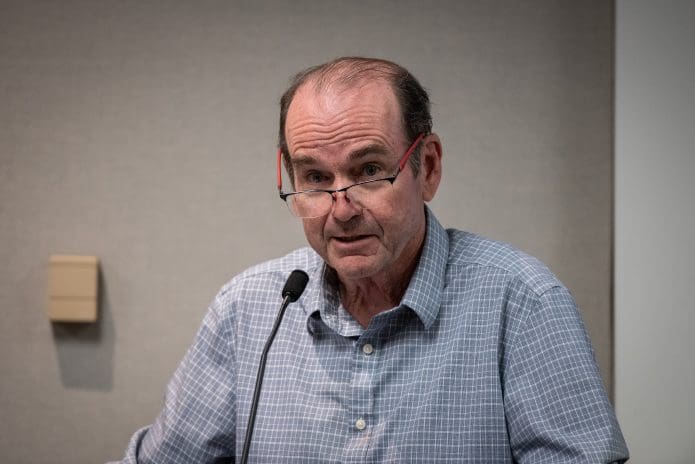
Scott Wallace (12:44): Good morning everybody. It’s a real thrill for me to be here with our young Henry Wallace fellows. There were 1,000 applicants, and these 12 were picked. You can imagine how brilliant and competitive they are. So I’m very proud of this group, and we hope to continue to have more talent like it in the future and keep the legacy of Henry Wallace going strong.
The New Deal is almost a century old — the idea that America’s government could actively help pull ordinary Americans out of the worst economic disaster ever, to conquer fear and inspire hope, not sit on the sidelines and pray for free enterprise to solve everything.
The New Deal is under assault as never before. “All government is useless. Taxes are theft, medical care, wasteful and expensive food for indigent children — that’s for charity, not government.” The world’s richest man dictates that we must withhold food from the world’s most starving poor. Millions are dying right now, today. Social Security and Medicare are next, and Congress is poised to agree.
A century later, Hooverism is back — and the only answer is for ordinary Americans to fight back.
My grandfather would be shocked, but not surprised. He knew this was coming. He warned about it three-quarters of a century ago. He warned about American fascism — the unholy combination of government and corporate power to preserve the power and privilege of the wealthiest. They would do it through lies, propaganda, and division along racial, religious, and cultural lines and through police state ultra-nationalism and suppressing civil liberties and dissent. “Stand up for the common man,” he said. “We are no more a master race than the Nazis” he said in his most famous speech as Vice President.
American fascism is here. The only question is: what are we, and these brilliant young scholars and activists, going to do about it?
My grandfather highlighted a passage in his personal Book of Common Prayer: “God has made of one blood all nations to dwell on the face of the earth.” The equal inherent dignity of every single human being — a far cry from today’s vitriolic division, demonizing all others. He openly campaigned against Jim Crow in the Deep South in the face of death threats and political suicide.
Today, he would demand leaders who seek to unite rather than divide. He was a scientist, above all — denying truths, facts, news, medicine, climate, intelligence would be unthinkable. He would fight for science, the environment, and public health, and he would fight for U.S. leadership to ease suffering around the world. “America First” was the rallying cry of Nazi sympathizers like Henry Ford and Charles Lindbergh.
In his time, he fought for FDR’s four freedoms: freedom of speech, freedom of worship, freedom from want, and freedom from fear. And he fought for his own dreams for the common man everywhere around the world. Abandoning our leadership to allow the deaths of millions in other countries would sicken him.
And he was a tennis player, self-taught with terrible form, but passionately committed. I think we can all relate to that.
These are supremely challenging times, but every single one of us can make a difference. Remember, in both the House and the Senate, the big, ugly bill — the giveaway to the ultra-rich at the expense of the other 99 percent — passed by just one vote. One pissed-off vote in either house could have stopped it dead.
Every single one of us matters: mounting resistance, fighting authoritarianism, fighting fascism, standing up for working people and the poor. And to our young scholars, a suggestion: run for something. Win or lose, nothing else so compels you to sharpen your values, articulate them compellingly, thicken your skin, and prepare you for leadership.
We have the power. We need the movements. My grandfather is urging all of us on. We hope this convening can strengthen our resolve. Thank you.


