

The War on Trans People is a Culture War — and a Class War


President Trump has launched a wave of attacks against transgender people, issuing executive orders designed to undermine their protections in the workplace, education and health care systems, the military, and other spaces.
While some characterize this assault as a “culture war,” attacks on trans people are also part of a class war. As the data below make clear, trans people have higher unemployment and poverty rates and earn less than other Americans, on average. So when a police officer or business owner engages in transphobia, they typically do so from a position of class advantage.
Anti-trans rights actions serve as class war weapons in another way as well. The White House and the Republican-controlled Congress are attempting to weaken opposition to their proposed new tax cuts for the ultra-wealthy by sowing divisions among the rest of us based on gender and sexuality, as well as race, gender, immigration status, religion, and other factors.
Only by coming together and resisting these attempts to divide us, can we protect our democracy and create an economy that works for everyone.
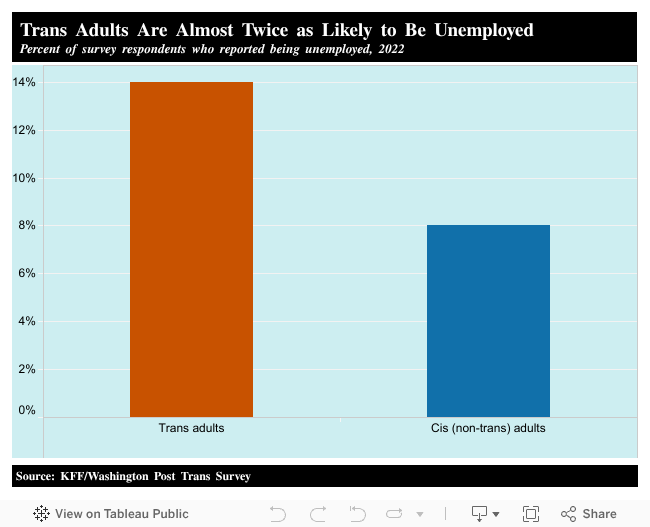
According to a KFF/Washington Post Trans Survey, a larger share of trans adults report being unemployed (14 percent vs. 8 percent) compared to cisgender (non-trans) adults. These findings reflect the significant barriers trans individuals already face in employment access and opportunity. In the National Center for Transgender Equality’s 2022 U.S Trans Survey, more than one in ten (11 percent) of respondents who had ever held a job said they had been fired, forced to resign, or laid off because of their gender identity or expression.
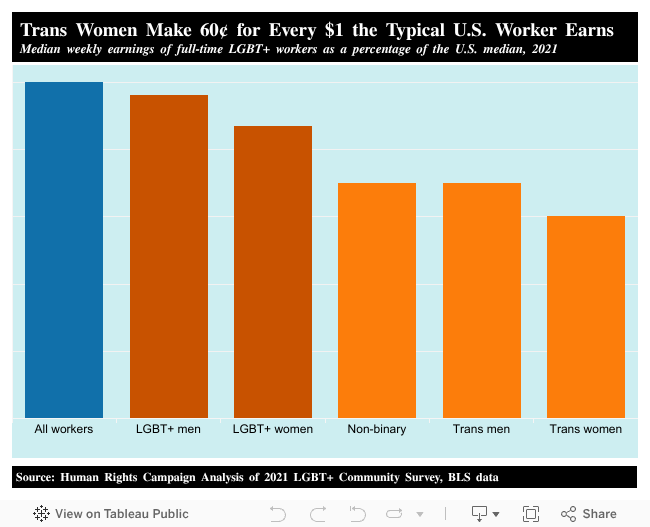
People in the LGBTQ+ community tend to earn significantly less than the typical U.S. worker. Transgender women experience the largest gap, earning only 60 cents for every dollar earned by the typical U.S. worker, according to Human Rights Campaign analysis. Trans men earn just 70 percent of U.S. median pay. This analysis focuses only on full-time workers, meaning the wage gap for transgender individuals may be even larger, since they are more likely to be unemployed or underemployed.

Transgender individuals also experience exceptionally high poverty rates. The Williams Institute at the UCLA Law School analyzed results from CDC surveys conducted between 2014 and 2017. They found that the overall poverty rate among trans people stood at 29.4 percent — nearly twice the 15.7 percent poverty rate among cisgender straight people. Racial and gender disparities further exacerbate the disparities. The Williams Institute found that 38.5 percent of Black transgender and 48.4 percent of Latinx transgender adults were experiencing poverty. White cis-straight men had by far the lowest poverty rate, at just 7.6 percent.
The harmful effects of unemployment, low wages, and poverty extend into other aspects of wellbeing, from housing and food insecurity to lack of health coverage. For transgender Americans, the current surge of attacks will only worsen these problems. For economic and political elites, these attacks advance a divide-and-conquer strategy to strengthen the power of those at the top.
Originally in Inequality.org.


