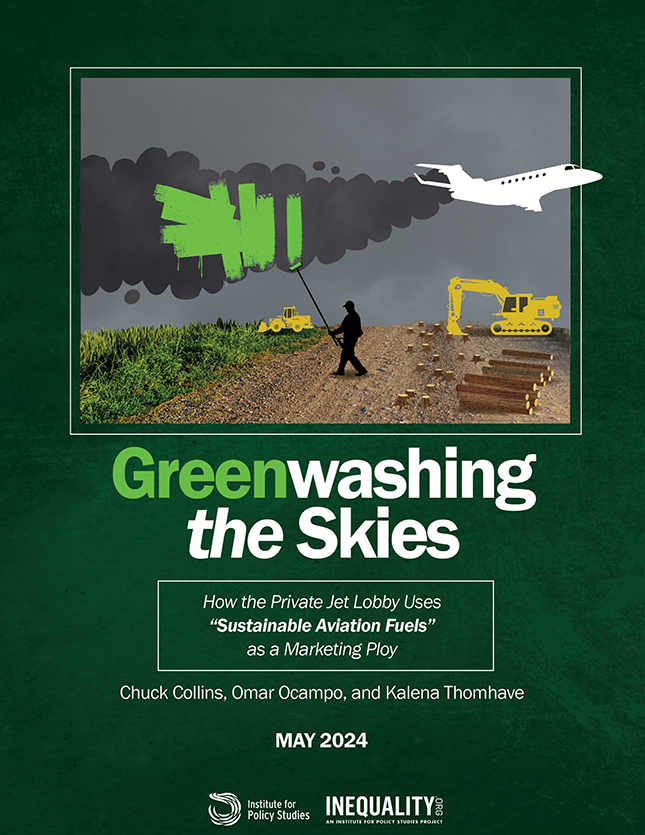
Greenwashing the Skies: How the Private Jet Lobby Uses “Sustainable Aviation Fuels” as a Marketing Ploy


Introduction
As the climate crisis intensifies, the private jet industry is facing a reckoning over its massive carbon footprint. After all, private jets emit 10 to 20 times more pollutants per passenger than commercial planes. According to one estimate, U.S. private jets emitted more than 16 million metric tons of carbon in 2022.
So now, as consumers and policymakers look to reduce fossil fuel emissions, private jet companies and their lobbyists are touting new commitments to sustainability.
Specifically, they’re promising to develop and use a less-polluting alternative to fossil jet fuel, commonly referred to as “sustainable aviation fuel” or SAF. This fuel is typically made from crops or waste and can be substituted for current forms of jet fuel, or more likely mixed with it, ostensibly reducing emissions.
Unfortunately, we find that these fuels are largely — so far — a false solution.
There is currently no realistic or scalable alternative to kerosene-based fuels that would meet current aviation needs, let alone the industry’s projections of future growth. At present, SAF technologies would fail to meet U.S. climate goals by the target year of 2050.
Though it may be technologically possible to create alternate fuels for private jets, policymakers should consider the tradeoffs in terms of government subsidies, land use changes, and competing decarbonization needs in other sectors such as heating, ground transportation, buildings, and electricity generation.
Private jet expansion, even with alternative fuels, is the least defensible use of societal resources on a warming planet. A summary of our findings follows, but readers can learn more in the full-length report.
Key Findings
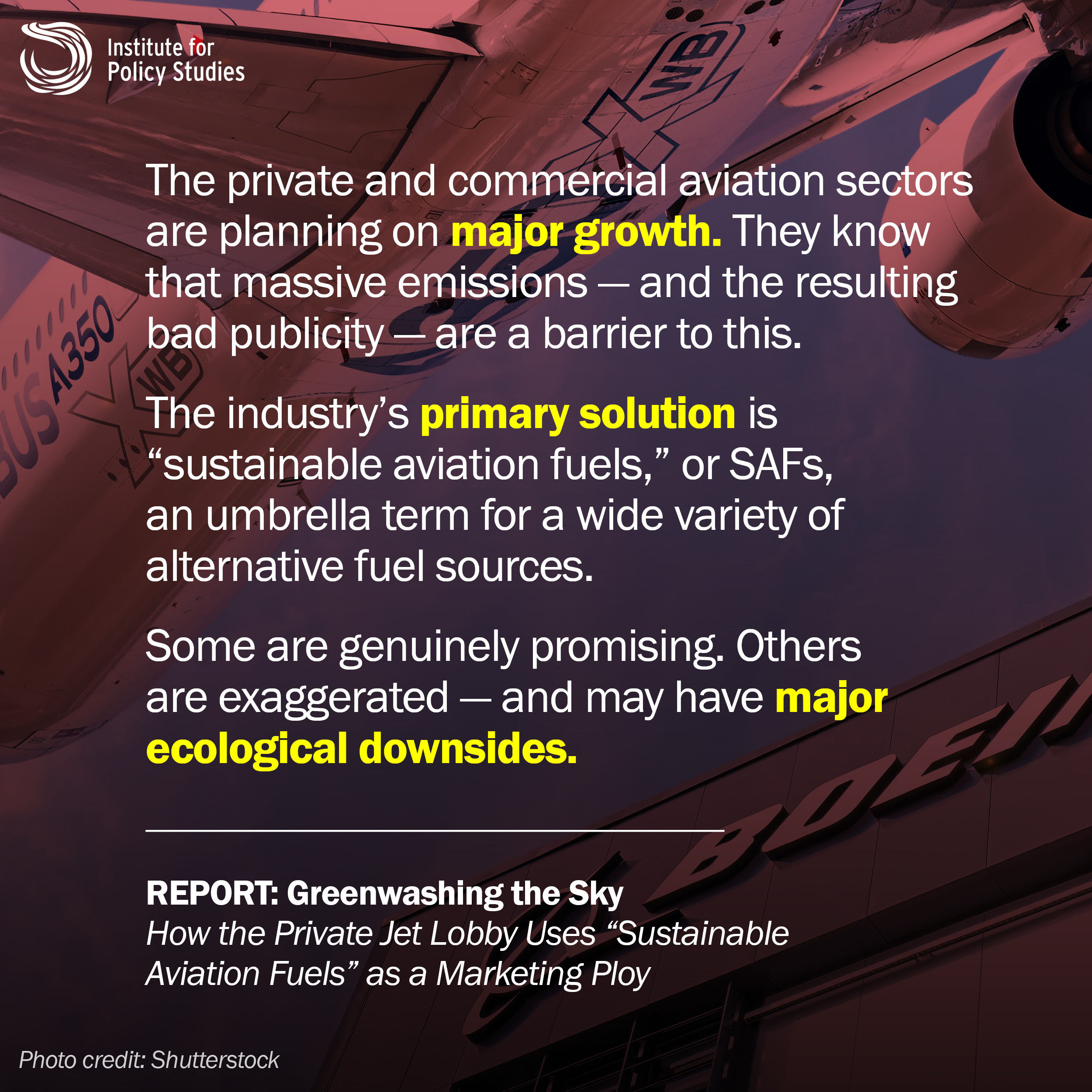
- Sustainable aviation fuels are critical to the aviation sector’s vision for growth. The industry recognizes that massive emissions — and negative publicity — is a barrier to expansion. SAFs are its primary solution, although they remains a speculative solutions at best.
- The private jet aviation market remains resilient. Private aviation enjoyed a strong 2023. Even though private jet operations and transaction dollar volume were down compared to 2022, both were still above pre-pandemic levels. There were close to 5.1 million private jet flights taken in 2023 with a transaction dollar volume of $32.2 billion.
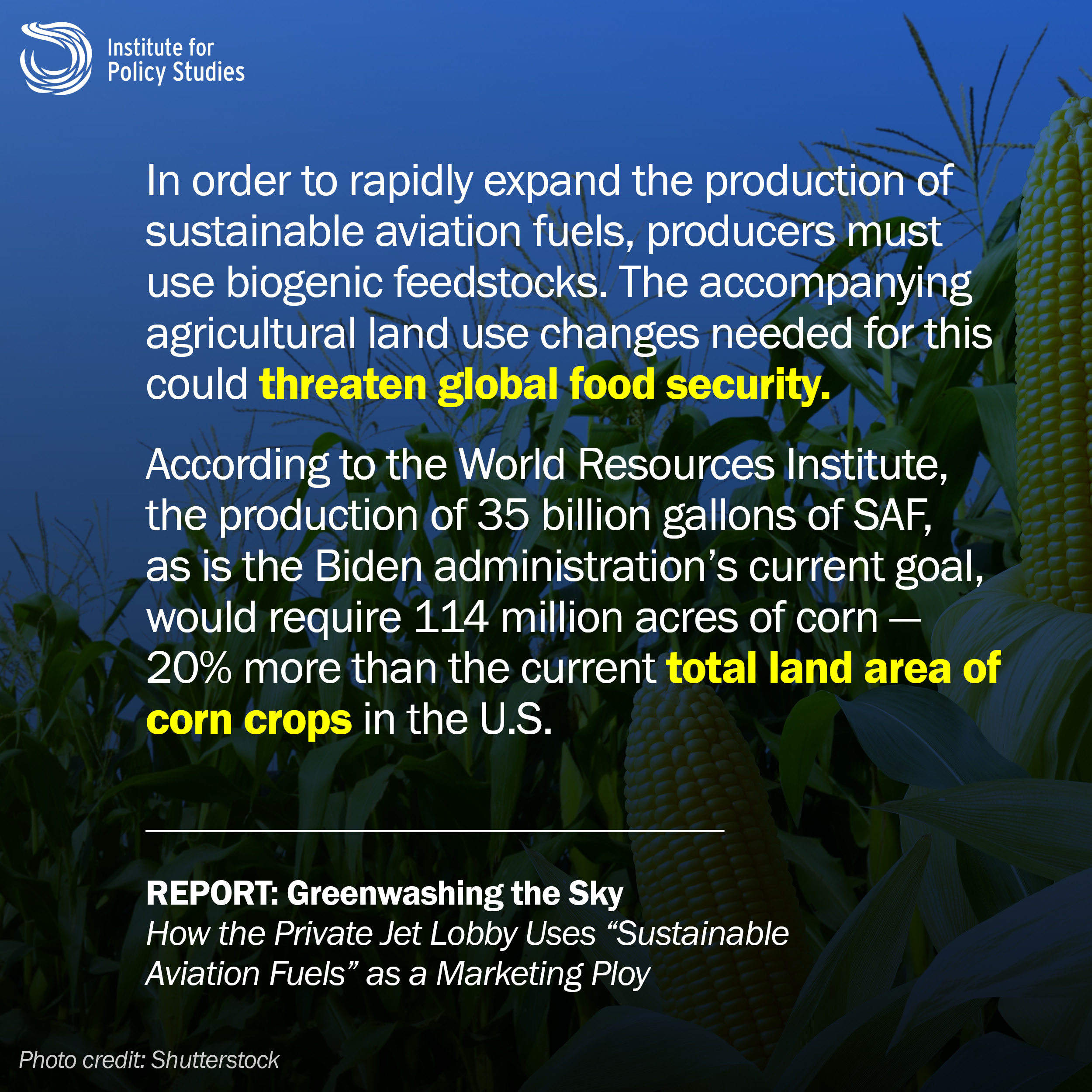
- Scaling up SAF production may thwart emissions reduction goals. Currently, in order to rapidly expand the production of sustainable aviation fuels, producers must use biogenic feedstocks — which could threaten global food security as well as nature-based carbon sequestration solutions such as the preservation of forests and wetlands. Plus, burning SAFs still emits CO2 — sometimes more than that of kerosene-based jet fuel. As such, SAF production may actively undermine Paris Agreement emissions reduction targets.
- Realistic increases in SAF production are decades off. In 2022, the U.S. produced just 15.8 million gallons of SAF. Meeting the Biden administration’s 2030 SAF production target of 3 billion gallons per year would require an 18,887 percent production increase over the next six years. To meet the 2050 target of 35 billion gallons, production would have to increase a whopping 227,400 percent over 2022 production levels.
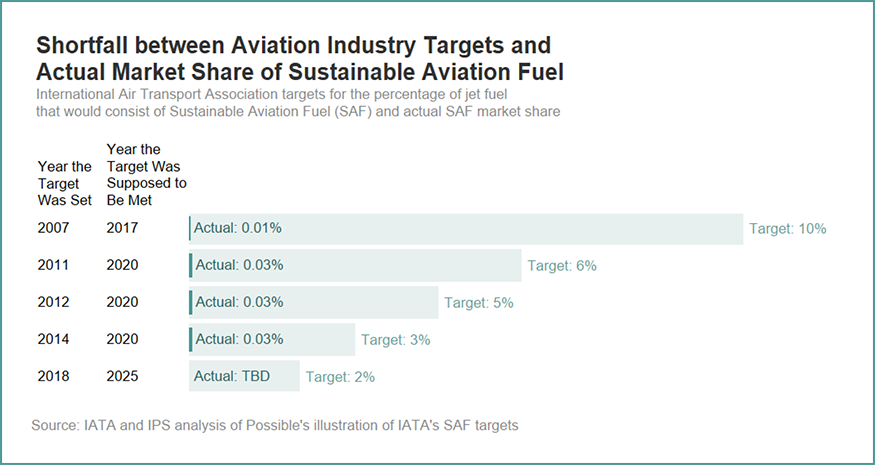
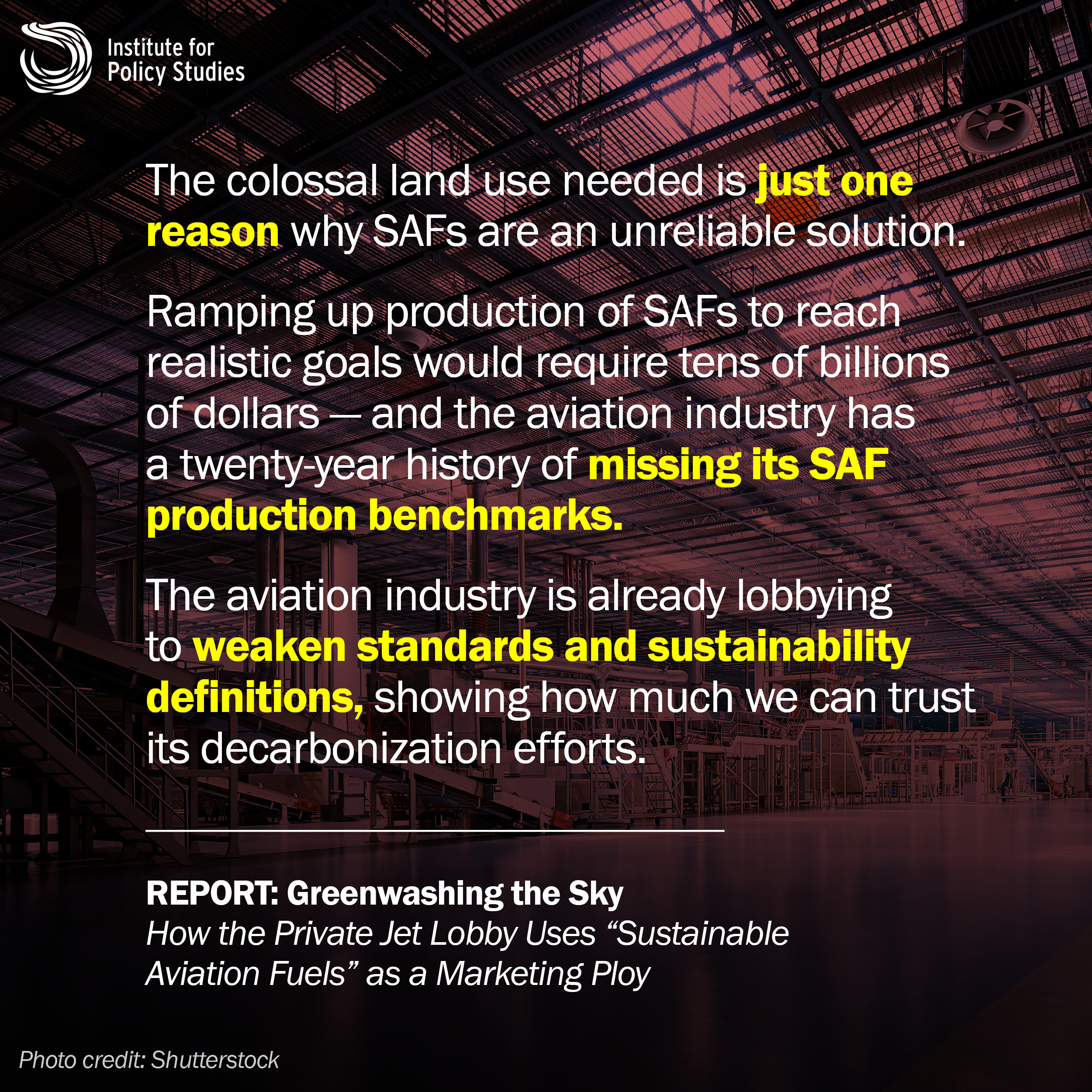
- The aviation industry has a 20-year history of missing its SAF production benchmarks. The International Air Transport Association (IATA) announced an aggressive climate goal in 2007, asserting that SAFs would account for 10 percent of all jet fuel consumed by the aviation sector within a decade. Even after the association lowered that benchmark repeatedly, SAFs currently account for just 0.2 percent of the total jet fuel supply.
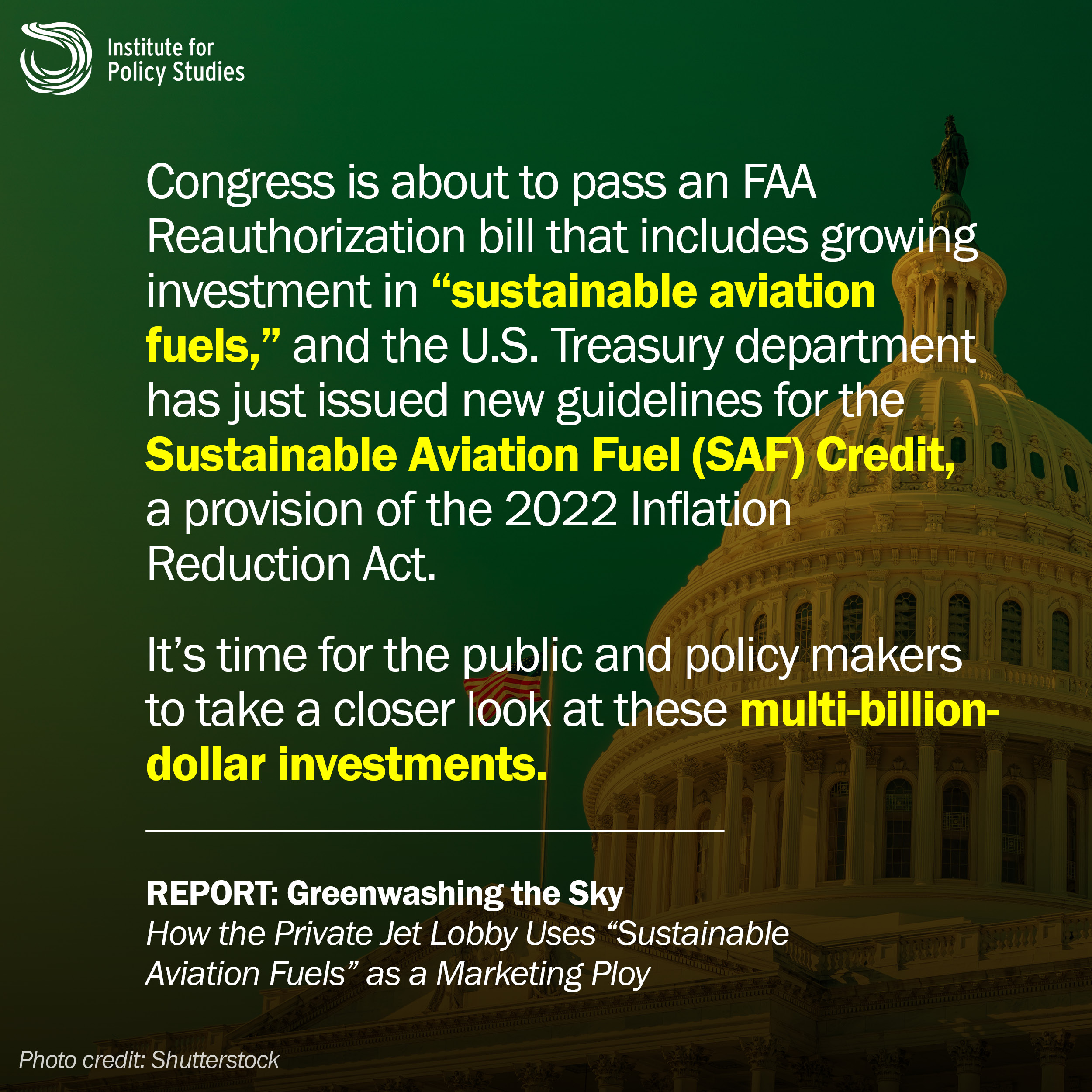
- The cost of SAF infrastructure and production will require massive subsidies. The aviation industry is asking for substantial governmental subsidies in order to increase the scale of SAF production. The Biden administration has estimated that the infrastructure necessary to meet the annual production goal of 3 billion gallons by 2030 could cost roughly $30 billion. The U.S. government would likely need to pour tens of billions of dollars into additional SAF subsidies to incentivize corporations to build relevant infrastructure and mandate the use of SAFs, further subsidizing private jet travel.
- The aviation industry is already lobbying to weaken standards and sustainability definitions. Even while touting its commitment to sustainability, the U.S. aviation industry is aggressively lobbying to water down SAF definitions, which would shift climate goalposts. The aviation industry has teamed up with lobbyists for Big Corn to press for the expansion of corn-based ethanol expansion, which has dubious benefits in reducing life cycle emissions.
- A key question remains: Are SAFs a serious alternative solution or a PR strategy? The aviation industry is failing to meet climate benchmarks while it promotes aggressive communications and advertising campaigns meant to demonstrate its commitment to environmentalism.
- The best way to be green is to stay grounded. We know that reducing carbon and other greenhouse gas emissions is the most effective and most direct strategy against climate change. Regarding aviation, and especially private aviation, this can simply mean flying less and curtailing the demand for air travel.
- More independent research into SAFs is necessary. More research is needed from independent research bodies that are not funded or influenced by the fossil fuel or aviation industries. We must learn more about SAF fuel sources, estimated timetables, and costs — including opportunity costs like competing decarbonization needs.
Recommendations
The aviation industry does deserve some credit: it recognizes the importance of reducing greenhouse gas emissions and is investing in the production of alternative fuels to decarbonize the sector. Unfortunately, there are legitimate concerns about the true sustainability of SAFs.
One thing is for certain: we must reduce the amount of carbon emissions dumped into the Earth’s atmosphere. And the best way to accomplish this is by lowering aviation demand, starting with private jet aviation demand. We must also allocate more resources to the investment of green public transportation, such as the construction of high-speed rail and bus electrification.
After all, no matter how much the aviation industry tries to greenwash the skies, we cannot fly our way out of the climate crisis.
Here are our recommendations:
- Commission more independent research on the viability of sustainable aviation fuels. If independent research finds that SAF production can potentially harm our climate goals, the resources demanded by the aviation industry should instead be allocated towards scaling up green infrastructure and transportation.
- Reject the inclusion of ethanol-based fuel as a SAF. Because of the impact of direct land use changes, ethanol’s life cycle emissions should preclude it from being designated a truly sustainable fuel.
- Impose more severe penalties for greenwashing and false advertisements. False and deceptive advertisements on the sustainability of an airline or flight should be heavily penalized.
- Increase private jet fuel taxes. The Fueling Alternative Transportation with a Carbon Aviation Tax Act of 2023 (FATCAT Act) would increase the excise tax on jet fuel by 786 percent, from 22 cents per gallon to $1.95. This would add an estimated $200 per ton of carbon emitted by a private jet flight. And Senator Ed Markey’s (D-MA) plan to increase the excise tax on private jet fuel is estimated to generate more than $1.8 billion annually, which could be invested in transit alternatives.
- Institute a “short hop” surcharge for private aviation. We consider any private jet operation under 210 miles a short hop flight. We recommend establishing a progressive tax regime that levies a significant surcharge on this activity — the shorter the flight, the higher the surcharge rate, especially if there are public transportation options available.
- Ban short hop flights. An outright ban on short hop flights would preempt carbon emissions from private aircraft flying short distances. France recently implemented a ban on short hop flights when there is a train to the destination that takes less than two and a half hours.
- Levy a transfer tax on private jet sales and resales. We recommend a transfer tax of 10 percent on all preowned aircraft and a 5 percent tax on new private aircraft transactions, since newer models tend to be more fuel efficient. Our recommended transfer tax proposal, which would not apply to 99.9 percent of the population, would yield approximately $2.4 billion in revenue for 2023.
- Invest in sustainable public transportation. A “Sustainable Transportation Fund” — funded by taxes on private jet sales, fuel, and flights — could allocate resources towards light rail, city-to-city rail, cycle tracks and bike lanes, and other non-emission burning transportation infrastructure. A short-term goal should be the electrification of our bus fleet.
- Increase transparency of private jet ownership and flying activity. The ultrawealthy exploit legal entities like limited liability companies to effectively hide their identity and conceal the ownership of their assets, including private jets. Increasing private jet ownership transparency provides the public the ability to accurately measure the climate-destroying flight activity of the ultrawealthy. If there are security concerns related to real-time reporting of jet locations, compromises could be explored that allow the data reporting to lag for a day or a week.
- Eliminate tax benefits for private jets. Thanks to the unpopular 2017 Trump tax law, the ultrawealthy receive enormous benefits when they purchase a private aircraft and can write off the jet as a business expense. Those cuts will expire in 2025 and any private jet tax breaks should not be renewed.
- Stop new private jet expansion and infrastructure projects. More private jet infrastructure incentivizes private jet usage to the detriment of the environment. At the time of writing, a citizens’ grassroots campaign in Massachusetts is working to block the expansion of Hanscom Field (KBED), the region’s largest general aviation airport in the region.
Social Sharing Graphics


Subscribe to our newsletter
Further reading

Executive Excess 2026

A Perfect Storm: How Federal Policy Changes Are Increasing Economic Insecurity for America's Families