

Excerpts from ‘Understanding Palestine and Israel’


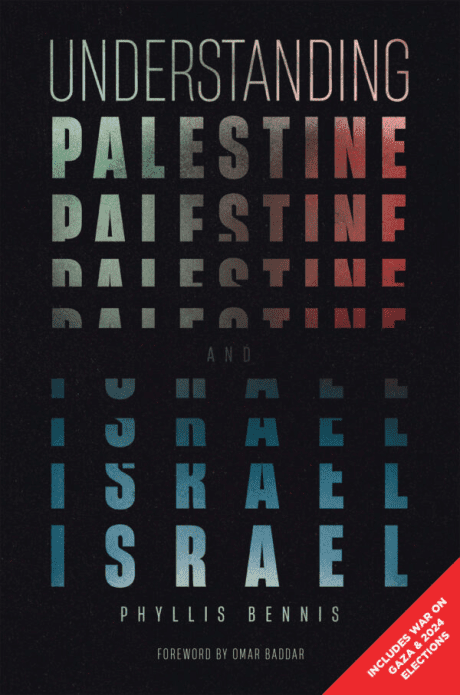
With the permission of Interlink Books, we’re pleased to offer this excerpt of Understanding Palestine and Israel, an essential new book by IPS Middle East expert Phyllis Bennis.
The book cuts through the noise and delivers clear, accessible answers to the most pressing questions about the Israeli-Palestinian conflict — questions that many have never had the opportunity to ask. In an easy to read, FAQ-style format, it covers the origins of the Israeli state, the movement for Palestinian liberation, U.S. foreign policy, and much, much more — including the events of October 7, 2023, the war that followed, and the role of the conflict in 2024 presidential election in the United States.
Below, we’ve selected samples from the 120 or so FAQs that make up this essential work. Feel free to browse them directly in the sidebar on the right or to scroll down and read on.
Want to save on this book and support IPS? Purchase “Understanding Palestine and Israel” at this link and use coupon code IPS to save 10 percent. An additional 20 percent will be donated to IPS at no cost to you. (This offer will expire on September 1, 2025. )
Introduction
When Israel went to war against the people of Gaza on October 8, 2023, following the Hamas-led attack on southern Israel the day before, something unprecedented happened in the United States. For the first time in the long history of Israeli wars against Palestinians, people across the country were suddenly seeing, hearing, talking about—and soon being outraged by—the brutality of the assault, the pain that Palestinian children and elders and everyone else in Gaza were experiencing. The call for a ceasefire started almost immediately, and within days we could see the beginnings of what would soon become a huge, broad movement demanding “Ceasefire Now!”
The need was urgent—and the huge mobilizations of protest, of petitions, of pressuring Congress and the White House, of working for city council and state assembly resolutions, for campus encampments and campaigns for divesting from corporations profiting from Israeli occupation—all reflected the passion, the commitment, and the need for more.
Never before had so many people across the U.S. responded so powerfully to an attack on Palestinians, with the demand for a ceasefire and the determination to do something to make it happen. And right from the beginning, for many that meant insisting on an end not only to Israeli violations but to the U.S. military and economic support that made those violations possible.
People were certainly shocked by the violence of the attack on Israel on October 7, and the demand to release the hostages remained important. Yet the images of massive Israeli bombing—using U.S.-made and to a large degree U.S.-funded warplanes, bombs, drones, helicopters, and other weaponry, attacking the entire population and wreaking absolute devastation across Gaza right in front of us, on our phones, computer screens, televisions, newspapers, podcasts 24/7—were too powerful to ignore. The movement was growing very quickly—faster than ever before. And many of the hundreds of thousands—eventually millions—of people outraged and responding to the war hadn’t been exposed to much of the history, the politics, the culture, or the U.S. and international roles in this longstanding but suddenly urgent crisis. People began to look for information.
At the same time, though, campaigns rooted in longstanding myths, deliberate historical falsehoods, biased media, careless or intentional distortion, and carefully crafted disinformation all took hold, making accurate information difficult or impossible to find. Legacy organizations in the U.S. that had for decades worked to build official and broad popular support for Israel escalated their efforts. They ramped up their efforts to paint those demanding a ceasefire as “antisemitic,” and claimed that all those calling for Israel to be held accountable for its war crimes and violations of human rights were supporting Hamas. From the beginning of the war, they pressured members of Congress and especially the White House to reject calls for a ceasefire despite the war’s atrocities. Soon they were lobbying Congress to punish South Africa for bringing Israel’s violations of the Genocide Convention to the International Court of Justice. And they did all of that hoping that most people in the U.S.—including the millions calling for a ceasefire and demanding an end to the U.S. military support that was enabling Israel’s war—would not know enough to challenge their claims.
But they were wrong. Because the movement for ceasefire had sprung up so fast and so strong, those campaigns of falsehoods did not go unchallenged. Students creating ceasefire encampments on their campuses included teach-ins in their programs to share their knowledge. Israel’s exclusion of foreign reporters from Gaza meant that even mainstream media turned to Palestinian journalists already on the ground, who continued their work documenting the war even as their colleagues were killed in unthinkable numbers. Independent media outlets upped their game. Unions, faith-based, and other types of organizations, worked to provide fact sheets for members wanting to learn and to protest. Focusing on racial and climate justice, anti-militarism, immigrant and economic rights, and women’s and LGBTQ rights, social movements built partnerships with Palestinians and others to lead webinars and discussions. It was all aimed at providing the background information, the talking points, and some of the history for new supporters of ceasefire who had never thought much about the issue before, for activists who had questions they had never investigated before, and for longtime supporters of Palestinian rights and a just peace in the Middle East who simply had never had the time to learn all they wanted to. This book is part of that effort, to foster discussion and share information where it has too often been unavailable.
That public outrage and the demand for a ceasefire didn’t fade away. They continued to grow as the war entered its second year, escalating as Israel’s war—which the International Court of Justice ruled was plausibly a genocide—escalated. And while the demand for ceasefire remained the central message, the ceasefire movement altered the very definition of its watchword. The cries of “Ceasefire Now!” continued, but in the war’s second year, they signified more than just the demand for a permanent stop to the bombing. “Ceasefire” now also included humanitarian aid for a devastated people now facing death from famine as well as bombing. It meant the resumption of funding to the key UN agency working in Gaza to provide support for Palestinians, and crucially, “ceasefire” soon was understood to also mean an end to weapons transfers to Israel. “Ceasefire Now” was transformed into a three-part demand.
And this demand was being raised by millions of people. Four months into the war, 67 percent of all Americans, of all political affiliations, supported the call for a permanent ceasefire. By June 2024, a CBS poll showed 61 percent of all Americans, and 77 percent of Democrats and young people of all stripes, believed the U.S. should not send weapons to Israel. …
One of the things that people in the U.S. were beginning to grasp, especially those who had become part of the ceasefire movement, was that understanding history always depends on when you start the clock. As many people have begun to realize, the terrible events in Gaza did not begin with the events of October 7. Rather, they were rooted in the long legacy of colonialism, ethnic cleansing, occupation, and apartheid that have characterized Israel’s relationship with the Palestinians from the beginning. As a young pro-Israel activist, I absorbed much of the same false and incomplete information that we see today. When I first began learning about Palestine—its land and its history, its people and its poets—I had to challenge all those ideas and all the information I thought I knew. The clock was already ticking. It took me a long time to catch up.
This book is for looking back to what has happened since then. Most of all it’s for people who recognize why we still urgently need a permanent three-dimensional ceasefire now, right now—and for those who also want to understand what led to the current crisis and what is happening now, and who want to at least begin to think about what, beyond a ceasefire, may lie ahead. The clock is still ticking.
— Phyllis Bennis Washington, DC, November 2024
How does the U.S. support Israel?

U.S. support for Israel emerges in several ways: economic, military, and diplomatic. While most Americans assume that U.S. foreign aid goes to help the poorest people in the poorest countries, in fact it is Israel (wealthier than a number of European Union member countries) that since 1976 has received 25 percent or more of the entire U.S. foreign aid budget and remains the highest recipient of U.S. foreign aid in the world. (The sudden enormous escalation of military aid to Ukraine in 2023–24 surpassed aid to Israel, most likely temporarily.)
From the time of its founding until 1962, all of the U.S. aid to Israel was economic aid. By 1971, military aid far outstripped the amounts of economic aid. And in 2008, at Israel’s own request, the U.S. ended its economic assistance and began sending only military aid—in the billions of dollars every year. In 2016 President Obama signed a ten-year agreement to provide Israel with $3.8 billion of U.S. tax money every year—a huge increase from the earlier grant of $3 billion each year.
In 2022 Israel’s military budget was about $23 billion—so Washington’s $3.8 billion paid for almost 17 percent of Israel’s entire military budget—something unheard of for any other country.
When Israel launched its war against Gaza following the attack on southern Israel in October 2023, military aid to Israel skyrocketed. Within just a few months, Congress had voted to send Israel $26 billion more of weapons, tank ammunition, bombs, drones and more—even including giant 500and 2,000-pound bombs that can destroy an entire city block, killing virtually every person there. In May 2024, the Biden administration’s National Security Memorandum 20, requiring an investigation of human rights issues in countries receiving U.S. weapons, found that it was “reasonable to assess” that the Israeli military had used U.S. weapons to violate the laws of war.
That same month, under enormous pressure, President Biden finally acknowledged that “civilians have been killed in Gaza as a consequence of those bombs,” and said he would halt some weapons shipments to Israel if Netanyahu ordered an invasion of Rafah, a small city on Gaza’s coast already overcrowded with refugees seeking shelter from the bombs. Days later, as Palestinians continued to be killed by Israeli air attacks in Rafah, Biden “paused” one shipment of the giant bombs, but a short time later he released the massive 500-pound bombs, holding back only the 2,000-pound behemoths. According to the Washington Post, even at the height of Israel’s deadly war in Gaza, “the Biden administration views weapons transfers as off-limits when considering how to influence the actions of Prime Minister Benjamin Netanyahu.”
Beyond the almost unlimited cash to purchase U.S. weapons, Israel has access to some of the most advanced weapons systems in the Pentagon’s arsenal. Despite Israel’s widely known nuclear arsenal, the U.S. defends its refusal to sign the Nuclear Non-Proliferation Treaty, and has endorsed the principle of “strategic ambiguity” in which Israel refuses to officially acknowledge its documented nuclear capacity. Its arsenal of high-density nuclear bombs in the Dimona nuclear facility remains uninspected by the International Atomic Energy Agency.
During the Cold War, the U.S. relied on Israel’s military power as an extension of its own, with Israeli arms sales, military training, and backing of pro-U.S. governments and pro-U.S. anti-government guerrillas in countries from Mozambique and Angola to El Salvador, Chile, and Nicaragua. That “cat’s paw” relationship consolidated the U.S.–Israeli military ties that continue today. Most of the weapons Israel has used in the occupied territories since 1967, including Apache helicopter gunships, F-16 fighter jets, wire-guided missiles, armored Caterpillar bulldozers used to demolish Palestinian houses, and others are all made in the U.S., and purchased from U.S. manufacturers with U.S. military aid funds. Some of the weapons, such as the Merkava tanks, are joint products of Israel’s domestic arms industry and U.S. manufacturing technology.
Diplomatically, the U.S. stands alone as it protects Israel in the United Nations, the International Criminal Court and other international arenas, and keeps it from being held accountable for its violations of international law. After 1967, the U.S. patterns of opposing UN resolutions critical of Israel become more pronounced. The U.S. cast its first veto in 1970—and from then until April 2024 it cast a total of 86 vetoes. Of those, 49 vetoes—57 percent of all U.S. vetoes—were cast to protect Israel.
Is a two-state solution really fair, and is it still possible?
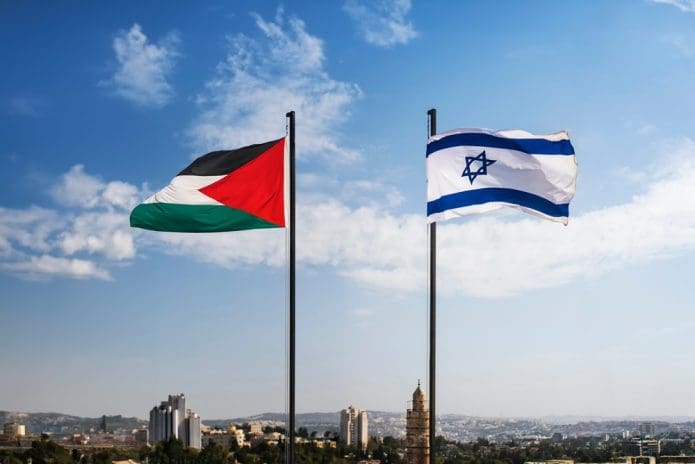
The notion of a “two-state solution” has been official U.S. and international policy for Palestine-Israel for decades. Efforts towards creating a Palestinian state began years after the 1967 war brought the last 22 percent of Palestinian land under Israeli occupation, and Jewish settlers began to colonize much of the occupied territory. U.S.-led negotiations officially to realize a Palestinian state began in 1991. The Palestine Liberation Organization’s official acceptance of the notion of two states in 1988, recognizing the State of Israel and accepting that the Palestinian state would be limited to only the West Bank, Gaza, and East Jerusalem, had been an enormous concession, but was rarely recognized as such in the U.S. or in Europe.
A two-state arrangement—dividing the total land of historic Palestine, now entirely under Israel’s control—was never ultimately based on justice. United Nations resolutions call for two states, with the establishment of a Palestinian state on only 22 percent of the land of historic Palestine. And that 22 percent would include all of the West Bank, Gaza, and East Jerusalem. Limiting Palestine to such a tiny state, when even the 1947 UN partition resolution designated an already unjust 45 percent of Mandate Palestine as the Palestinian state (unjust because Palestinians were 70 percent of the population), would be profoundly unfair. Today, of course, only a small percentage of that 22 percent, in disconnected broken-up pieces, is even being considered for a Palestinian state.
Historical injustices sometimes do become permanent. They do not become just or fair because time passes, they remain unjust and unfair realities. The genocide that led to the dispossession and near-extermination of indigenous peoples during the early history of the United States is no less of an historic injustice now. But how that continuing injustice should be addressed did in fact change. In the year 1700, when the colonial population was 260,000, it might have been appropriate to advocate sending the European colonists back to Europe and returning all the land to the indigenous people; three hundred years later that is not possible and no one is calling for it. Combinations of national recognition, reparations, affirmative action, protection of remaining tribal-held lands are the new demands of Native Americans.
The Palestinian case bears some similarities and many differences. In 2024, the Nakba was seventy-five years ago—not 300 or 400 years past. A declining number of Palestinians around the world, now mostly in their eighties and nineties, still remember fleeing their homes. It is not something familiar only through history books or dusty engravings.
However, history has moved much faster in the last three-quarters of a century than in the many years before it. In its seventy-five years of existence, Israel has been consolidated as a highly technologically advanced, wealthy, militarily powerful and nuclear-armed Western-oriented society under the absolute protection of the United States. It is also an apartheid state, in which different social groups, separated by religion and ethnicity and where they reside within all lands controlled by the Israeli state, live under different legal systems. That means different—and unequal—sets of rights, privileges, and discriminations are imposed on or available to Israeli Jews; Palestinian citizens of Israel; Palestinian non-citizen residents of Jerusalem; indigenous Palestinians in the occupied West Bank, Gaza, and East Jerusalem; Jewish colonial settlers in Jerusalem and the West Bank, and Palestinian refugees still not allowed to return to their homes.
The years of U.S.-controlled diplomacy, supposedly aimed at achieving a two-state solution beginning with the Madrid talks of 1991 and continuing through the Oslo process and beyond, have failed. And major changes on the ground in the occupied territories during those years have made the creation of anything remotely resembling a just or even viable two-state solution impossible.
Over 750,000 illegal Jewish settlers are spread throughout the West Bank and East Jerusalem, most of them in large settlement blocs built on huge tracts of the best land. Israel has imposed hundreds of militarized checkpoints, built the Apartheid Wall, and claimed large amounts of West Bank land for military zones, nature reserves, and settlement expansion. Sixty percent of the West Bank (part of the 22 percent of historic Palestine that remained Palestinian until 1967) remains officially under complete Israeli control, making it virtually inaccessible for any Palestinian use. Alongside the hundreds of Jews-only settlements, some of them city-sized, built in the West Bank, thousands of olive trees have been uprooted, water sources are almost all in Israeli hands, thousands of Palestinian homes demolished, and tens of thousands of families forcibly separated. Palestinian towns and villages across the West Bank are cut off from each other and from the cities they historically linked to for health care, commerce, education, cultural life, and more. Gaza is besieged and cut off from both Israel and the West Bank.
From 1977 when they first came to power in the Knesset, the Likud Party stated clearly in its platform that “between the Sea and the Jordan there will be only Israeli sovereignty.” In July 2014, Prime Minister Netanyahu said, “there cannot be a situation, under any agreement, in which we relinquish security control of the territory west of the River Jordan.” When he was reelected the following year, he reaffirmed there would be no Palestinian state during his tenure. He based his right-wing extremist coalition on that commitment. Response from the Obama administration, already frustrated with Netanyahu’s deliberate rejection of U.S. diplomatic initiatives and deliberate disrespect of President Obama, was to put aside efforts to negotiate a solution to the long-standing conflict.
In May 2024, at the height of Israel’s lethal war against Gaza, then-U.S. secretary of state Antony Blinken said that Israel would never have “genuine security” without a pathway to a Palestinian state. Netanyahu’s answer was unequivocal rejection—claiming Israel “must have security control over the entire territory west of the Jordan River” even though “that collides with the idea of sovereignty.”
One could imagine a two-state solution created in 1967 or 1968, made up of the entire territory that Israel had just conquered and occupied—all of the West Bank, all of Gaza, and all of East Jerusalem. But what has actually been discussed in the diplomatic debate since the late 1980s has been a far cry from that; what has been under discussion has been what tiny, unconnected scraps of land Israel might turn over to Palestinians for some modicum of local authority.
Despite decades of clear Israeli rejection of an independent Palestinian state, the call for a “two-state solution” remains a constant in U.S. policy circles, in diplomatic engagements, at the United Nations, and beyond. It serves as a convenient excuse for not challenging Israeli intransigence. In the U.S., providing virtually unlimited weapons to Israel to enable its wars against Palestinians and consolidate the impossibility of a Palestinian state is often justified by “We’re calling for a two-state solution.”
Israel continues expanding settlements and seizing land, making the creation of any kind of state impossible because of lack of territory. The “state” of Palestine under discussion for more than three decades was in fact far from independent or sovereign. It was understood that “Palestine” would be forcibly disarmed and not allowed to have a military for self-defense, so the prospect of sovereignty would remain illusory. Israel would maintain control of Palestine’s borders, entry and exit of goods and people, airspace, coastal waters, and electromagnetic spectrum. The Jordan Valley would see long-term or perhaps permanent Israeli military occupation, possibly with U.S. or NATO troops supplementing the Israeli soldiers. Jerusalem would remain Israel’s capital and would remain under complete Israeli control, forcing the creation of Palestine’s capital to be located outside of the city, perhaps in Abu Dis or another village bordering Jerusalem. And Gaza would remain cut off, with no infrastructure created to link Gaza and the West Bank, despite long-ago promises for a land bridge or tunnel or another arrangement that would allow for a unified Palestinian state including both parts.
Without real sovereignty, without contiguity, and without control of borders and resources, Palestine would not be a state; it would be a series of truncated bantustans.
In response, the strategy for Palestinian freedom has been transformed. Instead of focusing on the arrangement-based demand for a “two-state solution,” many Palestinian campaigners and human rights activists around the world are waging a rights-based struggle for freedom: for an end to occupation and apartheid, for human rights, and equality for all—regardless of whether the ultimate political arrangement encompasses one, two, or several states.
What is the global movement known as “BDS”?
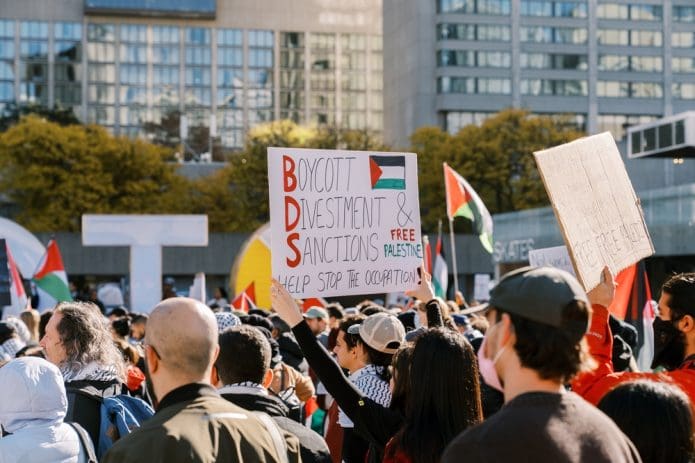
In 2005, a coalition of more than 170 Palestinian civil society organizations issued a global call to supporters around the world to “impose broad boycotts and implement divestment initiatives against Israel similar to those applied to South Africa in the apartheid era. We appeal to you to pressure your respective states to impose embargoes and sanctions against Israel. We also invite conscientious Israelis to support this Call, for the sake of justice and genuine peace.”
The non-violent economic and cultural pressure of the boycott, divestment, and sanctions campaign (BDS) would be maintained, “until Israel meets its obligation to recognize the Palestinian people’s inalienable right to self-determination and fully complies with the precepts of international law by:
Ending its occupation and colonization of all Arab lands and dismantling the Wall;
Recognizing the fundamental rights of the Arab-Palestinian citizens of Israel to full equality; and
Respecting, protecting and promoting the rights of Palestinian refugees to return to their homes and properties as stipulated in UN resolution 194.”
BDS soon became central among Palestinians and to the movements around the world supporting Palestinian rights. It was powerful because it identified a unified global strategy for ending Israel’s violations of international law and human rights, while recognizing that conditions and movements differ between countries. Consumer boycotts might be the centerpiece in some European countries where Israeli produce and other goods were widely available, while divestment campaigns in the U.S. targeting corporations, banks and universities might be most successful, and in countries purchasing significant military goods from Israel (such as India or Argentina), pressure for government sanctions might make the most sense.
The UN-based International Coordinating Network on Palestine, a consortium of 400+ civil society organizations working for Palestinian rights around the world, endorsed the coalition’s call the day after it was released. In the U.S., the BDS call was quickly endorsed by organizations such as the U.S. Campaign for Palestinian Rights (formerly the U.S. Campaign to End the Israeli Occupation), a coalition of several hundred groups working to change U.S. policy. The campaign had already been working on boycott and divestment efforts against corporations that profited from Israel’s occupation, such as Caterpillar, but becoming part of the global BDS movement significantly strengthened the campaign’s U.S. work and its global ties.
From 2005 on, BDS campaigns arose on campuses and in communities, with perhaps the most important taking shape in mainstream churches, such as the Presbyterians and Methodists, where years-long efforts for social responsibility in investments, and ultimately calls for divestment, took on new urgency. Local efforts to mobilize city council resolutions supporting BDS took shape, and longstanding campaigns against U.S. military aid to Israel fit easily into a BDS framework.
Over the next decade, BDS expanded in breadth and depth of participation, and in impact. BDS successes in Europe included Veolia—a French corporate giant that lost $24 billion in canceled or rejected contracts between 2006 and 2014 in response to global campaigns against its involvement in Israeli settlement projects. By 2015, Veolia announced it was selling off almost all of its Israeli operations, admitting that BDS campaigns had cost the company “important contracts.” Elsewhere in Europe, opposition to Israeli banks’ support for occupation led large pension-fund management companies in the Netherlands and Luxembourg to cut ties with five Israeli banks, Denmark’s largest bank to blacklist Bank Hapoalim, and Norway’s state investment fund to boycott Israeli construction companies involved in building settlements. Numerous other campaigns in France, Spain, and elsewhere brought further economic pressure to bear on Israel to end its violations.
In the United States, BDS played a huge role in education and advocacy campaigns, and by 2010 or so was starting to show some real, though still largely symbolic, economic impact. The role of faith-based organizations in building BDS campaigns remained strong, and mainstream churches reflected that. The United Methodist Church passed a strong boycott resolution in 2012 and took up a move to divest from the G4S Israeli security company operating in West Bank and East Jerusalem settlements as well as in the private prison industry in the United States. The Presbyterian Church passed boycott and divestment resolutions, including decisions to divest funds from Caterpillar, MotoSolutions (Motorola), and Hewlett-Packard because of those companies’ role in supporting Israeli repression in the occupied territories.
Beyond the churches, BDS campaigns became common on campuses across the United States, including demands for both divestment of university funds from corporations profiting from occupation or Israeli apartheid and boycotts of specific Israeli products. They also included calls to join the global academic and cultural boycotts, which did not target individual Israeli academics or artists, but rather aimed at ending the institutional ties between U.S. and Israeli academic or cultural institutions funded and supported by the Israeli government.
In October 2014, Stephen Hawking, probably the most famous scientist in the world, announced he was withdrawing from participation in a high-profile Israeli conference, saying that he had decided “to respect the boycott, based upon his knowledge of Palestine, and on the unanimous advice of his own academic contacts there.” Academic organizations, including the American Studies, Asian-American Studies, and Native American Studies Associations all passed resolutions supporting the academic boycott.
And in the world of popular culture, numerous U.S. and global artists publicly rejected performing in Israel or the occupied territories, linking their decision to the legacy of the “Don’t play Sun City” campaigns of the South African anti-apartheid years. Sometimes, decisions not to support BDS brought consequences. U.S. film star Scarlett Johansson made commercials for SodaStream drink machines, manufactured in an illegal West Bank settlement, and as a result was forced to step down from her position as an ambassador of Oxfam when the British charity made clear its opposition to SodaStream’s role in the occupied territories.
The Israeli government, backed by the pro-Israel lobby in the U.S., tried to portray the BDS campaign as antisemitic or racist. In fact BDS was, from its origins, precisely the opposite: a nonviolent strategy against the systemic discriminatory policies of Israel, and explicitly opposed to racism and all forms of discrimination, including antisemitism. The 2005 BDS call made clear that the goal was not a permanent boycott or effort to isolate Israel, but rather the use of BDS as a means of bringing nonviolent economic pressure to bear on Israel to end its three specific areas of violations of international law and human rights: the occupation of the 1967 territories, the legal discrimination against Palestinian citizens of Israel, and the refusal to reach a just solution for Palestinian refugees denied their right to return home. In that context, compared to Israel’s own policies, the BDS campaign was an explicitly anti-racist, equality-for-all challenge.
As BDS campaigns became more frequent, and won more victories, the strategy also became the centerpiece of growing efforts to shut down work supporting Palestinian rights by using false claims of antisemitism to discredit and undermine campaigns and campaigners. Led by parts of the pro-Israel lobbies, components of the U.S. government including the Department of Education and the State Department worked towards discrediting BDS, including by weaponizing false claims of antisemitism among its adherents. More than thirty U.S. states, and numerous cities and other jurisdictions, followed suit, passing or trying to pass laws criminalizing BDS or denying access to state or municipal contracts to anyone who refused to sign a McCarthy-era-style pledge that they were not then and never would boycott Israel. The longstanding U.S. laws and Supreme Court decisions holding that boycotts are a First Amendment-protected form of political speech, seemed not to apply when the target of the boycott was Israel.
What is Zionism? Do all Jews support Zionism?

Zionism is a political movement that calls for the creation of a specifically Jewish state. When the movement began in the late 1880s, antisemitism was a powerful and growing force in Russia and Europe. Most Jews at that time believed that the best way to stop antisemitism was either through some kind of assimilation, or through alliances with other political movements. But a small number of Jews believed that antisemitism was a permanent feature of national and world politics, and that the only way for Jews to be safe would be for them to leave their home countries and establish a Jewish state elsewhere. Early Zionist leaders believed that a Jewish state could be established anywhere (Uganda, Argentina, and Turkey were all considered at different times); it was a thoroughly secular movement. But the founder of the modern Zionist movement, Theodore Herzl, recognized that linking Zionism to Palestine would gain wider support for the movement among Jews, including more religious elements in the Jewish community who had not been early supporters. Herzl, who is known as the founder of political Zionism, also believed that a Jewish state could only be created with the support of a colonial sponsor, and he traveled the imperial capitals of the world seeking a patron.
Many Jews opposed Zionism. Most of the ultra-orthodox Jews in Palestine believed that only God could deliver a state to the Jewish people, and that a human-based effort was against God’s will. Many Jews facing anti-Semitic attacks, especially in Russia and eastern Europe, rejected Zionism’s call for them to leave their homelands, seeing that position as reflecting the demand of the anti-Semites themselves, to “get out of our country.” The Zionist movement won strong support from the British when the League of Nations gave London control of Palestine after the defeat of the Ottoman Empire in 1922. Earlier, in 1917, the Balfour Declaration stated that “His Majesty’s Government views with favour the establishment in Palestine of a national home for the Jewish people, … it being clearly understood that nothing shall be done which may prejudice the civil and religious rights of existing non-Jewish communities in Palestine.” In the stroke of a pen, the vast majority of the population of Palestine was reduced to the “non-Jewish communities.” Zionism gradually gained more adherents, though slowly. It was only in the 1930s and ’40s, as German, Polish, and other European Jews frantically sought to escape Hitler and their first-choice countries of refuge, the U.S. and Britain, denied them entry, that Zionism and the call to create a Jewish state in Palestine became a more popular view among Jews.
After World War II, with desperate Holocaust survivors filling displaced persons camps across Europe, Zionism became the majority position. The Zionist slogan claimed that Palestine was “a land without a people for a people without a land.” Certainly the second part was true— the European Jews who had escaped or survived the Holocaust had lost everything—their homes, their families, their countries, their land. Turned away from the U.S. because of a combination of antisemitism and anti-communism, and encouraged to go to Palestine instead, it was not surprising that thousands flocked to join Jewish communities there.
But the first part of the slogan hid the reality—for Palestine was not a land without a people. Its indigenous people had been there all along. The fundamental nature of the Zionist movement was perhaps most clearly defined in the diary of Theodore Herzl, known as the father of modern Zionism. While he was more famously the author of “The Jewish State,” outlining his defense of the idea of a separate Jewish-dominated state as the only way to challenge antisemitism, his diaries included some of the most important of his beliefs.
One such component of Herzl’s Zionism was included in the text of a letter he wrote to Cecil Rhodes, the infamous British colonialist for whom Zimbabwe was once named Rhodesia, asking for Rhodes’s help in getting the British crown to support the creation of a Jewish state in Palestine. In the letter Herzl noted that he knew that Rhodes’s interest was in Africa, not the Arab world, that his concern was for Englishmen, not Jews, and then asked rhetorically why he would ask Rhodes for such help. “How, then, do I happen to turn to you since this is an out-of-the-way matter for you? How indeed?” he asked. Herzl then answered his own question, telling Rhodes he should support Herzl’s vision of Zionism “because it is something colonial.” …
What was the significance of the Trump administration’s decision to recognize Jerusalem as the capital of Israel and move the U.S. embassy to Jerusalem?
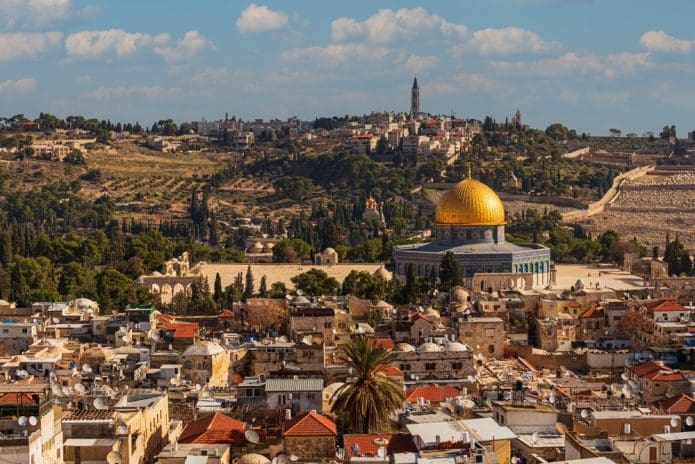
Throughout his 2016 presidential campaign, Donald Trump promised to move the U.S. embassy in Israel from Tel Aviv to Jerusalem. The promise—or threat—to move the embassy had a long history in U.S. politics. Back in 1995, Israel supporters in Congress orchestrated a law mandating the embassy move, but giving the president a way out to avoid actually doing it—the president could waive the requirement if national security might be at stake. The waiver allowed congressional Israel-backers to blame the president for not implementing the law, and the White House could lament that security threats prevented the move. Every president since took advantage of that waiver—including Donald Trump for the first six months into his presidency.
But Trump’s campaign commitment to move the embassy was more important to more influential supporters than was true of earlier presidents. Much of Trump’s motivation was linked to his desire to please his key Israel-backing donors, particularly the Las Vegas casino mogul Sheldon Adelson and his wife, Miriam, as well as the influential Christian Zionist component within his powerful right-wing evangelical base. And Trump’s overall failure to win many legislative victories in Congress meant he had more incentive to make good on his White House-based Jerusalem promise.
As the second six-month deadline approached, in December 2017, Trump announced his intention to recognize Jerusalem as the capital of Israel and to move the U.S. embassy from Tel Aviv to Jerusalem. In doing so he broke with decades of U.S. and global precedent and violated international law. Jerusalem had been divided since 1948, with the newly declared State of Israel holding the western side, while the eastern side remained part of the Palestinian West Bank, under Jordanian control. Israel claimed Jerusalem as its capital, but virtually all foreign embassies were located in Tel Aviv.
Trump called the move a “recognition of reality,” but it was longstanding U.S. policy of providing Tel Aviv with billions of dollars of military aid, acceptance of Jews-only settlements within occupied Arab East Jerusalem, protection of Israel in the United Nations, that had enabled Trump’s—and Israel’s—claimed reality. When the UN partitioned Palestine in 1947, it recognized not only what were supposed to become Jewish and Palestinian Arab states, but also a special status for Jerusalem. The city was to belong to neither “state,” but rather be a corpus separatum, a separate body to remain under international control. In 1967 Israel illegally occupied the eastern half of the city, and in 1980 it announced the annexation of Arab East Jerusalem and the forcibly unified city as its capital.
No country in the world recognized the annexation, and since that time, legally binding UN Security Council resolutions continue to reaffirm that East Jerusalem remains occupied Palestinian territory. UN Security Council Resolution 478, passed in 1980 with the U.S. abstaining, determined that the Israeli decision to annex East Jerusalem “constitutes a violation of international law” and called on all “States that have established diplomatic missions at Jerusalem to withdraw such missions from the Holy City.” They did.
So when Trump announced in 2017 he would move the U.S. embassy to Jerusalem, not a single other country maintained an embassy there. The decision to recognize Jerusalem was in direct violation of the Security Council resolution. Four days after Trump’s announcement, on December 21, 2017, the UN General Assembly responded. Despite U.S. Ambassador Nikki Haley’s dire threats to governments that might consider voting against the United States, a huge majority of countries voted to condemn Trump’s recognition of Jerusalem as the capital of Israel—128 countries voted to condemn, only nine opposed, and thirty-five abstained.
Those celebrating at the embassy opening, along with Israeli officials, were Trump’s daughter and son-in-law, Ivanka Trump and Jared Kushner. Also included were the evangelical Christian Zionist pastors John Hagee and Robert Jeffress, known for their fulsome support for Israel, Islamophobia, and racist hatred towards Palestinians, as well as the belief that the second coming of Christ required all Jews to be gathered in Israel, where they would then either convert or die. Just sixty miles away, it was Nakba Day in the Gaza Strip, the commemoration of the 1948 dispossession and a day ahead of what was planned to be the culmination of the Great March of Return. At exactly the same time, Israeli sharpshooters were firing live ammunition over the fences into Gaza, where Palestinians, commemorating the Nakba on their own land, were shot by the thousands. At least sixty Palestinians were killed and almost 3,000 injured on that day, most by Israeli sniper fire as the new U.S. embassy in Jerusalem opened its doors.
Months later, Trump addressed the Republican Jewish Coalition, and bragged about moving the embassy. Addressing his two biggest funders, longtime supporters of Israeli settlements he said, “We got you something that you wanted, I can tell you, Sheldon and Miriam.”
What kind of war did Israel launch following the October 7 attack and how did the U.S. respond?
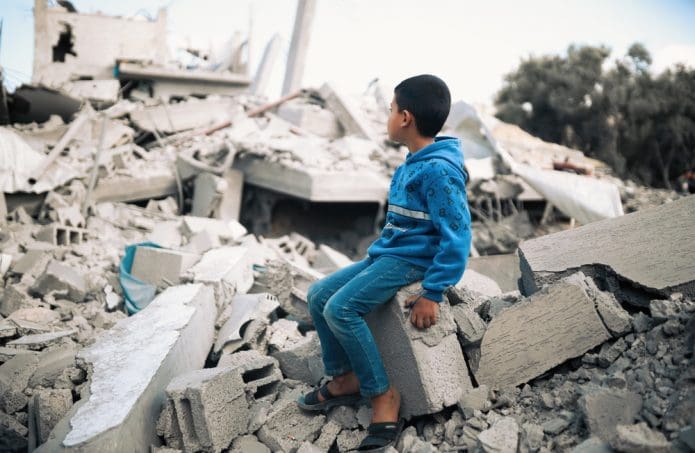
The conditions that existed in Gaza before October 7 did not justify the illegal acts that were part of the Hamas-led attack. They do, however, help explain why they happen. And to be sure that such attacks on civilians, and the wars that follow those attacks, do not happen in the future, it is crucial to understand those root causes, and to change the conditions that give rise to them.
In the case of the October 7 events, quite the opposite occurred. The massive U.S. and global media response to the attack focused overwhelmingly on the civilian victims—largely ignoring the military installations and personnel who were the first targets. And the attack overall was widely portrayed in the U.S. and much of Europe as something not only shocking, which it certainly was, but as astonishing and surprising— which it most certainly was not. It was placed outside of history, as if it had occurred out of thin air, denying that the attack, however brutal much of it was, occurred in response to years of imprisonment, siege, blockade, and massive air and ground military assaults against Gaza every two or three years, that killed hundreds or thousands of people but were justified in Israeli political life as “mowing the grass” to tamp down any hint of resistance.
In Israel, the popularity of the war against the entire population of Gaza in response to the crimes of October 7 mirrored, in some ways, the overwhelming U.S. public support for George W. Bush’s call for global war against the entire population of Afghanistan after the crimes of 9/11. International media coverage of the October 7 attack, particularly in the U.S., was nonstop, and immediately turned into cheerleading for the Israeli assault. That onslaught soon became what the International Court of Justice identified as plausibly genocidal. Reporting of the actual brutality that occurred in many of the October 7 attacks on civilians was soon bolstered with false claims of ruthless acts of violence that never happened. While alternative and eventually mainstream press investigations eventually laid bare the false claims, debunking them as complete fabrications, many political and media figures continued to repeat them for months, building greater support for the Israeli military offensive.
Throughout the first weeks of Israel’s war on Gaza, some U.S. officials supported the call for a ceasefire, but always limited and temporary, always framed around bringing home the hostages, and always beginning with statements of support for “Israel’s right to self-defense.” Other necessary aspects of even a temporary ceasefire—actually stopping the bombing and other means of killing, allowing in the massive levels of humanitarian aid so desperately needed in Gaza—were always secondary. The initial temporary truce, carefully not called a ceasefire, in November 2023, lasted for a week, and led to the release of 105 Israeli and international hostages and 240 Palestinian prisoners, along with bringing in briefly significant amounts of food, medicine, and other humanitarian supplies goods.
But after that, calls for a ceasefire—even use of the word—largely disappeared from the White House. It was not until the Uncommitted movement began to be seen as a potential threat to the president’s re-election, that Biden began to change his language. That was the mobilization of Palestinian-, Arab-, and Muslim-Americans, along with young people, African-Americans, and other progressive sectors, who voted “uncommitted” in the Democratic primaries in the spring of 2024 to protest the Biden administration’s support for Israel’s war. And even then, it was Vice President Kamala Harris, months before she replaced Biden as the 2024 presidential candidate in July, who first reflected the rhetorical change. It was a high-visibility moment for Harris, at the annual commemoration of Bloody Friday, the iconic moment when civil rights marchers were assaulted by Alabama state police in 1964 as they tried to cross the Edmund Pettus Bridge in Selma, when she first called directly for an immediate ceasefire. It was a limited shift—she didn’t call for a permanent ceasefire, instead referencing Biden’s call for a six-week “pause”—but her use of the ceasefire term at all seemed to reflect a small step away from Biden’s refusal to break from his whatever-Israel-wants-Israel-gets position.
Ceasefire negotiations sputtered on and off for months. A pattern emerged that saw optimistic reports of diplomatic talks in Qatar or Cairo, then a press report of a breakthrough, that Israel had agreed to new terms or that Hamas had accepted an Israeli-initiated version, followed by a “clarification” from the Israeli prime minister’s office indicating that Netanyahu had not agreed to any such thing. The White House’s linguistic shift to talk about a ceasefire, to request support for a ceasefire, did not lead to an actual ceasefire, or to any willingness from Israel to even consider a ceasefire because the change in language—ceasefire vs. pause, immediate vs. permanent, request vs. urge—had nothing to do with the consistency of action: the weapons kept on flowing. The death toll continued to rise by November 2024 more than 43,300 Gazans had been killed, and the UN confirmed that during a six-month period of that first year, seventy percent of the victims were children and women. By October 3, 2024, almost a full year into the Israeli assault, the Biden administration was acknowledging what many observers of the failed ceasefire “efforts” had already seen: Matthew Miller, spokesman of the State Department, announced in a briefing that “we’ve never wanted to see a diplomatic resolution with Hamas.”
Biden’s fervent bear-hug greeting of Netanyahu on his arrival in Israel in October 2023 was symbolically powerful—but it was hardly the most important part of Washington’s backing. Over that first year of the war the U.S. gave Israel $12.5 billion in direct military financing, accounting for a full 40 percent of Tel Aviv’s military spending. The White House signed off on sending U.S.-made warplanes, 500and 2,000-pound bombs, tank ammunition, and much more. (One small batch of 2,000-pound bombs was delayed in May 2024, but that was after Israel had amassed an arsenal of more than 1,400 of those bunker-busters. Several were used in September that year in Israel’s assassination of Hezbollah leader Hassan Nasrallah in Beirut, an attack that killed at least six Lebanese civilians and left more than ninety seriously injured.) And the $12.5 billion didn’t even include the military actions that the Pentagon undertook on behalf of Israel—which brought the total cost for aiding Israel’s war in Gaza for its first year to $22 billion of U.S. taxpayer money.
Those numbers explained a great deal about Benjamin Netanyahu’s willingness to ignore President Biden’s requests for a ceasefire in Gaza and his pleas for preventing escalation to a region-wide war: as long as the billions of dollars’ worth of weapons continued, as long as the U.S. continued to supply 65 percent of Israel’s weapons and military equipment, it mattered not at all what language the White House used, what requests were made, what appeals were issued.
In 2024, ProPublica published leaked memos from both U.S.AID and the State Department’s own refugee agency documenting how Israel was blocking U.S. humanitarian aid for Gaza, using “arbitrary denial, restriction and impediments.” Under the Foreign Assistance Act of 1961, any country responsible for preventing U.S. assistance from reaching people in need must be denied access to U.S. military aid. But in Israel’s case, just a month after the April 2024 memos were written, Secretary of State Blinken delivered his department’s official report to Congress, saying exactly the opposite: “We do not currently assess that the Israeli government is prohibiting or otherwise restricting the transport or delivery of U.S. humanitarian assistance.” His department’s own agencies’ reports were discarded, and with the false claim in place that Israel was not interfering with the aid shipments, virtually unlimited military aid to Israel—bombs, warplanes, tank ammunition, and other weapons of war—continued to flow. A ceasefire remained out of reach and the Israel exception continued.
Little changed after Israeli troops killed Hamas leader Yahya Sinwar in mid-October 2024. Despite claims from Biden, Harris, and others that this should open new possibilities for a ceasefire, there was still no evidence of actual U.S. pressure in the form of ending arms transfers and military aid. A leaked letter of October 13 from U.S. secretaries of state and defense to Israel’s ministers of defense and strategic affairs spoke with “deep concern about the deteriorating humanitarian conditions” in Gaza, calling the situation facing two million people in Gaza “increasingly dire.” The letter reminded Israel of its obligations to facilitate access to humanitarian aid and noted that U.S. law required the U.S. government to assess that process as well. It went on to name several specific actions Israel needed to take within the next thirty days—which would end only after the U.S. elections of November 5. The letter mentioned that the U.S. assessment was required under the terms of the Foreign Assistance Act. But it did not provide any specific consequences if Israel failed to comply, and U.S. officials in the days that followed stated specifically that “the letter was not meant as a threat. …The letter was simply meant to reiterate the sense of urgency we feel and the seriousness with which we feel it.” When the ostensible deadline passed on November 12, 2024, eight widely respected international aid organizations reported that “Israel not only failed to meet the U.S. criteria,” but also had taken actions “that dramatically worsened the situation on the ground, particularly in Northern Gaza. …That situation is in an even more dire state today than a month ago.” The State Department, however, announced that the Biden administration “had not assessed” Israel to be in violation of U.S. law. And the weapons continued to flow.
What was the role of Gaza in the U.S. presidential election of 2024?
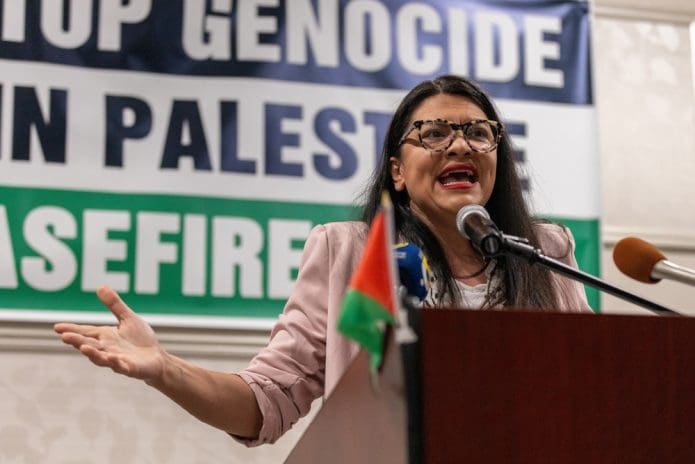
The November 2024 election that sent Donald Trump back to the White House for his second term provided a powerful example of the longtime principle that support for Israel—including massive military support—is an issue of bipartisan consensus. And it provided another example: of how profoundly distant the political leadership of at least one of the two U.S. political parties is from its base.
In this case, the consensus came down to leadership. Polls indicated that much of Trump’s Republican base agreed with his anti-Palestinian and unalterably pro-Israel positions—despite what they might have felt about his documented misogyny, Islamophobia, racism, antisemitism, xenophobia and criminality. On the other hand, much of the Democratic base had moved away from the party’s longstanding pro-Israel positions, leaving the leadership behind. That process had been underway for most of a decade, but during the first year of Israel’s brutal war in Gaza, the shift among Democrats away from automatic support for Israel had grown to unprecedented levels.
Vice President Kamala Harris, the Democratic candidate for president after incumbent Joe Biden stepped down from the campaign, took on Biden’s political priorities and policies and held on to them as her own. Despite a popular campaign theme that she was from a younger generation and it was time to “turn the page” to new leadership, she made clear that she would not diverge from Biden’s approach, particularly on continuing military support to Israel’s war. At various points Harris seemed to want to signal a slight difference from Biden, showing more empathy towards Palestinians and calling for a (limited, temporary) ceasefire before Biden did. But she began every reference to Gaza with an unequivocal “our support for Israel is iron-clad” and rejected any possible shift in actual policy.
The Uncommitted movement emerged in the spring of 2024 and worked tirelessly to pressure, persuade, and demand that the BidenHarris administration make good on its claimed interest in ending the war—specifically by cutting U.S. arms transfers to Tel Aviv, widely understood as necessary for a ceasefire to take hold. During the primaries, more than 700,000 people in numerous states voted “uncommitted” instead of for the otherwise unopposed candidate Joe Biden. The Guardian reported the overall protest vote against Biden was 13 percent. But by the summer, the primaries were over, Biden rescinded his candidacy after a disastrous televised debate against Donald Trump, and as the Democratic National Convention convened in Chicago, the Democratic Party leadership under then-candidate Harris rejected every request from the Uncommitted movement for recognition of their influence in the party. Their initial request reflected the position of large Democratic majorities: a commitment to ending arms transfers to Israel. When that was rejected, things that should have been easy were requested, such as a face-to-face meeting with the candidate. Those were refused as well. Finally the Uncommitted leaders, themselves Democratic activists working within party structures to try to change it from within, appealed simply for a vetted, two-minute convention speech by a Democratic elected official, a state assemblywoman from Georgia, who was a Palestinian-American. That too was rejected (see pages 259–261). Post-DNC entreaties similarly fell on deaf ears, and fury and desolation rose from Palestinianand other Arab-Americans and Muslims, as well as students and other young people, African-Americans, progressive Jews and a host of others.
There’s no evidence to suggest that likely Harris voters who instead voted “Gaza” or third parties or left the top line of the ballot blank were numerous enough to account for her loss. Anger at the economy and numerous other factors played key roles. But certainly those voters were part of the equation. In Dearborn, the largest Arab majority city in the country and historically a Democratic stronghold, Harris lost badly, with 36 percent to Trump’s 42 percent. The national exit poll by the Council on American-Islamic Relations showed that among Muslim voters, a traditionally reliably Democratic constituency, Harris won only 20 percent of the vote. That was a precipitous drop from the 2020 election, when 69 percent of Muslims voted for Biden, and 2016, when a CAIR study showed 72 percent of Muslims supported Hillary Clinton.
Politico made clear that the “protest vote was not limited solely to Arab Americans, who make up a fraction of the U.S. population. Their furor toward the Biden administration over Gaza spilled out onto college campuses across the nation and among progressives of all ages, amounting to the most significant anti-war protest in a generation.” There was no question that the loss of that whole range of other key progressive constituencies weakened her campaign. Students came to the campaign fresh from their ceasefire-based encampments on campuses across the country, facing potentially harsh consequences for their nonviolent protests. So they were far less likely to volunteer for long stints knocking on doors, staffing phone banks, or mobilizing voter registration drives for a candidate/vice-president who had refused to break with her administration’s complicity in Israel’s genocide in Gaza through the provision of weapons.
As Peter Beinart, a noted Jewish intellectual and strong critic of Israel, wrote in the New York Times, “Despite overwhelming evidence that the Democratic Party’s most devoted constituents wanted to end sales of weapons to Israel, the Biden administration kept sending them, even after Prime Minister Benjamin Netanyahu of Israel expanded the war into Lebanon. And not only did Ms. Harris not break with Mr. Biden’s policy, she went out of her way to make voters who care about Palestinian rights feel unwelcome. … For decades, the party’s politicians and operatives have treated the struggle for Palestinian freedom as a taboo. They’ve grown so accustomed to sequestering it from their stated commitment to human rights that, even amid what prominent scholars call a genocide, Ms. Harris thought it wiser to campaign with Ms. [Liz] Cheney than, say, Representative Rashida Tlaib. Despite overwhelming evidence, her campaign could not see that among progressive voters, the Palestine exception no longer applies.” …
…In Trump’s second term, Washington’s virtually unlimited level of military support for Israel will almost certainly remain in place, regardless of civilian deaths or violations of U.S. or international law. From the beginning of his term in 2021, even before the 2023 war began, Biden had left standing key aspects of Trump’s 2018 policy shifts that enabled some of the most extreme goals of the Israeli right wing. Those included recognizing the annexation of Jerusalem as Israel’s capital and moving the U.S. embassy there, accepting Israeli sovereignty over the Syrian Golan Heights, legitimizing settlements and future annexations in the West Bank, closing the U.S. consulate in East Jerusalem that had served Palestinians, and shuttering the Palestinian diplomatic office in Washington.
Biden had also accepted, and to some degree tried to build on Trump’s embrace of Arab dictators, most significantly the crown prince of Saudi Arabia Mohammad bin Salman, and the Abraham Accords that normalized relations between Israel and various Arab governments. During the second Trump term, efforts to expand that process will likely continue, and will likely continue to ignore or directly undermine Palestinian rights and Palestinian lives, as his policies always have.
The United Nations, and especially its agencies that help support Palestinians, are likely to come under greater attack. One indication was evident in Trump’s announcement that he would appoint Elise Stefanik, the far-right congresswoman known for harsh anti-Palestinian rhetoric and positions, as the U.S. ambassador to the UN. The Israeli newspaper Ha’aretz responded to the announcement saying, “the New York Representative, who has a history of propagating antisemitic conspiracy theories, is widely expected to prioritize attacking the United Nations’ criticism of Israel during her tenure as ambassador.” Any effort to reverse the congressional halting of funds to UNRWA (legislated to remain in place through March 2025) will likely fail under the Trump administration.
What else Trump might do differently than his predecessor remains unclear. He has said he wants Israel’s war in Gaza to end soon, but also made clear he would give Netanyahu everything he wants. And, as Foreign Policy described it, “If the Trump administration allows the Israeli government to pursue the end of the conflict in ways it sees fit, it is likely that more Palestinians will be killed along the way. Then, of course, there are Netanyahu’s partners who want to resettle the Gaza Strip, the logical conclusion of which is the further dispossession of a population that was already predominantly refugees and their descendants.”
That means ethnic cleansing—and a continuation of genocide. It is not surprising that polls of Israeli public opinion across the political spectrum indicated strong support for Trump over Harris. Netanyahu chose Trump as well. He was one of the first world leaders, by some reports the first, to turn to social media to congratulate Trump the moment the election results were called.
Changing those realities means we have a great deal of work to do.
Buy the book!
Want to save on this book and support IPS? Purchase “Understanding Palestine and Israel” at this link and use coupon code IPS to save 10 percent. An additional 20 percent will be donated to IPS at no cost to you. (This offer will expire on September 1, 2025. )
Subscribe to our newsletter
Further reading

Is AI About to Destroy Humanity?
Foreign Policy Crisis Points Awaiting the Next Generation of Progressive Lawmakers


